

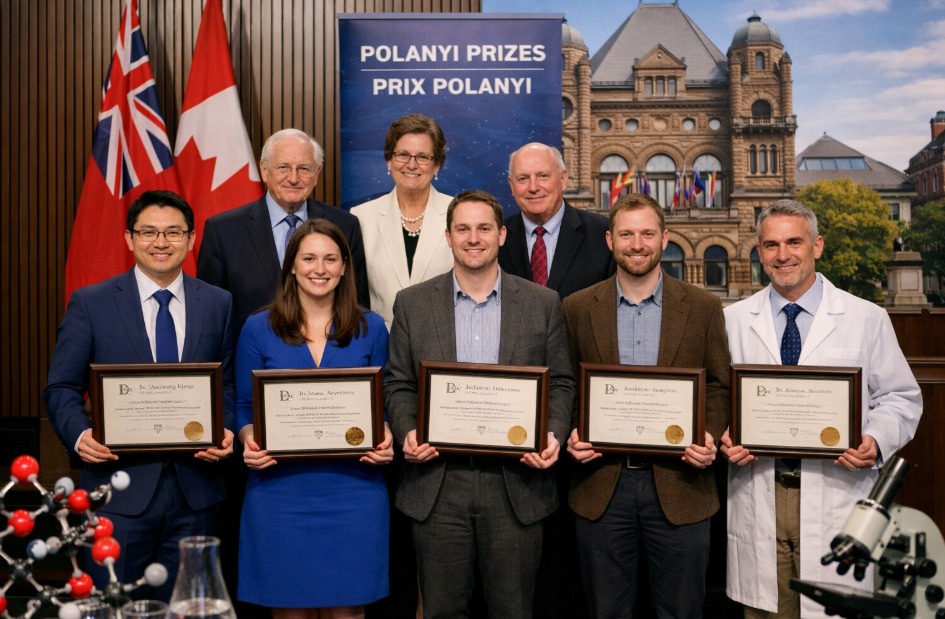
TORONTO — Ontario has recognized five of its leading researchers with the 2025 John Charles Polanyi Prizes, underscoring the province’s push to translate homegrown research into economic growth and social impact across key sectors.
The annual awards, named after 1986 Nobel laureate John Charles Polanyi, celebrate early-career researchers whose discoveries advance Ontario’s economy, improve quality of life and strengthen the province’s global competitiveness. The prizes were presented at a ceremony at Queen’s Park hosted by Nolan Quinn, Minister of Colleges, Universities, Research Excellence and Security, alongside Edith Dumont, Lieutenant Governor of Ontario, and Polanyi himself.
“Ontario researchers are saving lives and building a brighter, more prosperous future for our province,” said Nolan Quinn, Minister of Colleges, Universities, Research Excellence and Security. “Congratulations to the 2025 winners of the John Charles Polanyi Prizes for their outstanding achievements that continue to cement our province as a world-class hub of research excellence.”
This year’s recipients span chemistry, economic science, literature and physiology/medicine, with research tied to advanced manufacturing, housing, health care and clean technology — sectors the province has identified as central to long-term economic growth.
“These awards recognize and encourage the achievements of Ontarians of high promise,” said Dr. John Charles Polanyi. “This year’s recipients cover a huge range of thought, encompassing many shared fears and hopes. They clearly recognize the dangers in our period of rapid change, while acknowledging that change should be cause for optimism.”
In chemistry, Dr. Katherine Marczenko of Carleton University was honoured for developing safer and more environmentally friendly energetic materials. Her research focuses on designing materials that react only when exposed to light, reducing risks associated with traditionally toxic substances used in industrial and manufacturing applications. The work supports Ontario’s ambitions in advanced manufacturing and clean technology while improving worker safety.
“We are incredibly proud to see Kate Marczenko recognized for her impactful work with the prestigious Polanyi Prize. As the pace of innovation accelerates worldwide, awards like this enable researchers to advance discoveries that address critical global issues,” said Wisdom Tettey, President and Vice-Chancellor, Carleton University.
Also recognized in chemistry is Dr. Fanwang Meng of Queen’s University. Meng applies machine learning to accelerate drug discovery, improving how computers analyze limited and imperfect data. His work aims to reduce the time and cost required to identify promising treatments, including therapies for diseases such as malaria, strengthening Ontario’s life sciences sector.
“Congratulations to Dr. Fanwang Meng on receiving the Polanyi Prize for Chemistry. His research is reshaping the field of drug discovery, accelerating the identification of new medicines, and contributing to the development of safer, more effective treatments for Ontarians. Through the open-source release of his models and datasets, he is enabling collaboration across the global research community and exemplifying Queen’s University’s commitment to innovation in service of society,” said Patrick Deane, Principal and Vice-Chancellor, Queen’s University.
In economic science, Dr. Jeffrey Hicks of the University of Toronto was recognized for his research into homelessness. By tracking housing insecurity, health and social outcomes through detailed data analysis, Hicks’ work informs evidence-based policy and prevention strategies aimed at supporting vulnerable populations.
“On behalf of the University of Toronto, I am delighted to congratulate Professor Jeffrey Hicks on his winning the 2025 Polanyi Prize in Economic Science. Professor Hicks is poised to make major contributions in understanding the causes of homelessness and in shaping public policy to address it. He exemplifies the highest standards of research and innovation in service to individuals and society. We are proud of his accomplishments so far, and excited to see his career unfold in the years to come,” said Melanie A. Woodin, President, University of Toronto.
Dr. Andrew Sargent of Huron University College received the literature prize for his scholarship on early Victorian poetry and its relevance to contemporary issues such as environmental change and uncertainty.
“Dr. Andrew Sargent is one of those remarkable academics, who conducts research at the highest level and still manages to hold the attention of undergraduate students in the classroom. As a scholar of literature, his boundary crossing work also speaks to our time and its needs, exploring ecology and environmental issues. His course on “Ecology and Catastrophe” is wildly popular at Huron,” said Dr. Barry Craig, President and Vice-Chancellor, Huron University College.
In physiology/medicine, Dr. David Cook of the University of Ottawa was honoured for his work on ovarian cancer. His research examines how cancer cells adapt during treatment, particularly in therapy-resistant cases, using advanced laboratory and data tools to inform new treatment approaches.
“The University of Ottawa is very proud to congratulate Dr. David Cook on this well-earned recognition of his groundbreaking research that has unlocked lifesaving insights into ovarian cancer treatments. Dr. Cook’s drive to innovate and discover new knowledge is helping people access better treatments and lead healthier lives. As the second consecutive University of Ottawa researcher to receive the prestigious John Charles Polanyi Prize in Physiology and Medicine, Dr. Cook’s leadership demonstrates how our partnerships with internationally recognized hospitals and health-care organizations are pushing the boundaries of health-care innovation in Ontario and around the world,” said Marie-Eve Sylvestre, President, University of Ottawa.
Established in 1987, the Polanyi Prizes highlight emerging research leaders across the province’s postsecondary institutions. The awards come as Ontario rolls out a new funding model that includes $6.4 billion in additional support for colleges, universities and Indigenous Institutes. Since taking office, the government says it has invested more than $2 billion into the research sector, backing over 1,800 projects.
Recent commitments include more than $47 million for 195 research projects through the Ontario Research Fund, $19.5 million to establish a Centre for Fusion Energy and $18 million to boost medical isotope production at the McMaster Nuclear Reactor.
Provincial officials say the investments are designed to position Ontario as one of the most competitive jurisdictions in the G7 for research, innovation and business growth — with the Polanyi Prizes serving as a showcase for the talent driving that ambition.