

TORONTO — The Ontario government is using Human Trafficking Awareness Day to underscore a sweeping $345-million investment and a cross-government strategy aimed at combating what it describes as one of the province’s most damaging and persistent crimes.
In a joint statement released Sunday, Michael Parsa, Ontario’s Minister of Children, Community and Social Services, alongside Solicitor General Michael Kerzner and Transportation Minister Prabmeet Sarkaria, said the province is expanding enforcement, prevention and survivor support initiatives as part of its Anti-Human Trafficking Strategy.
The statement, issued by the Ministry of Children, Community and Social Services, emphasized both the human and economic toll of trafficking, while outlining targeted investments affecting law enforcement, transportation infrastructure and community services.
“Human trafficking is a horrific crime that targets our most vulnerable, violates victims’ most basic human rights and has a devastating impact on families and communities across Ontario.
Ontario is taking action to support survivors and hold offenders accountable, through a historic investment of $345 million in our Anti-Human Trafficking Strategy, the largest investment of its kind in Canada. We are taking a whole-of-government approach to end human trafficking in Ontario, including:
Launching three Children at Risk of Exploitation (CARE) units since 2021 that unite child protection workers, police and Indigenous liaisons to better safeguard children and youth who have experienced trafficking or are at high risk.
Equipping law enforcement and justice partners with stronger tools to identify and target perpetrators, dismantle trafficking networks and bring criminals to justice, including through the Intelligence-led Joint Forces Strategy dedicated to fighting human trafficking through intelligence gathering.
Investing $6 million from 2025 to 2027 through the Victim Support Grant program to fund 19 projects that help police better support victims of crime, including survivors of gender-based violence and human trafficking.
Developing new resources for parents to have early and age-appropriate conversations with their children about human trafficking and how to recognize the warning signs.
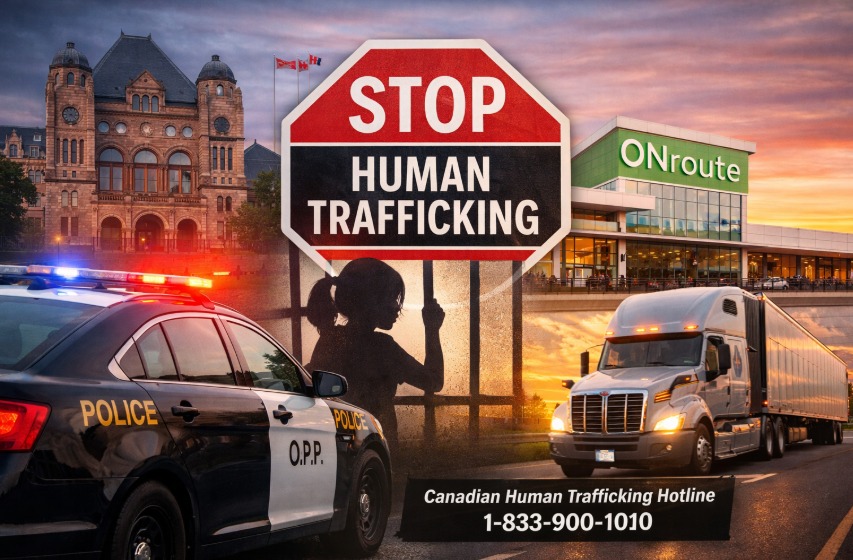
Partnering with the trucking industry to raise awareness and strengthen prevention efforts as well as improving safety at transportation hubs, including ONroute service centres, by improving lighting, security cameras, and displaying the National Human Trafficking Hotline.
Strengthening law enforcement’s access to key information in human trafficking investigations by updating guest registry requirements for the accommodation sector, including hotels and online accommodation platforms.
We are deeply grateful for the compassion, dedication and expertise of service agencies and frontline staff across Ontario. Together, we will continue to support victims and survivors and work together to build a safer Ontario for everyone.””
Economic and operational impact
Ontario’s anti-trafficking strategy represents the largest financial commitment of its kind in Canada and reflects a growing focus on disrupting trafficking networks that operate along major transportation and commercial corridors.
The province’s trucking sector, a critical component of Ontario’s supply chain and broader economy, has become a focal point for awareness and prevention efforts. By working with industry partners and enhancing safety measures at ONroute service centres — rest stops widely used by commercial drivers — the government aims to curb trafficking activity that often intersects with transportation infrastructure.
Businesses in the accommodation sector are also affected by regulatory changes. Updated guest registry requirements for hotels and online accommodation platforms are intended to provide law enforcement with faster access to information during investigations, a move the province says will improve enforcement outcomes.
For hospitality operators and platform providers, the changes signal increased compliance responsibilities and closer coordination with police, reflecting a broader trend of governments engaging private-sector partners in public safety initiatives.
Coordinated enforcement and support
The province’s intelligence-led joint forces operations and CARE units bring together child protection agencies, police and Indigenous partners in an integrated model designed to identify victims earlier and disrupt trafficking networks more effectively.
The government is also directing $6 million over two years into victim support programs, funding projects that help police and community organizations provide services to survivors of gender-based violence and trafficking.
Ontario has increasingly framed human trafficking as both a public safety and social services issue, requiring coordinated responses across ministries and sectors.
Ongoing awareness efforts
Human Trafficking Awareness Day is part of broader public education efforts aimed at helping families, businesses and communities recognize warning signs and report suspected cases.
The province is encouraging anyone in immediate danger or who suspects trafficking to contact emergency services or local police. Support is also available through the Canadian Human Trafficking Hotline.
Ontario officials say continued collaboration between government, industry and community organizations will be critical to sustaining progress and ensuring long-term prevention.
The government maintains that its current strategy — combining funding, enforcement and awareness — is designed to strengthen public safety while supporting survivors and holding offenders accountable.