

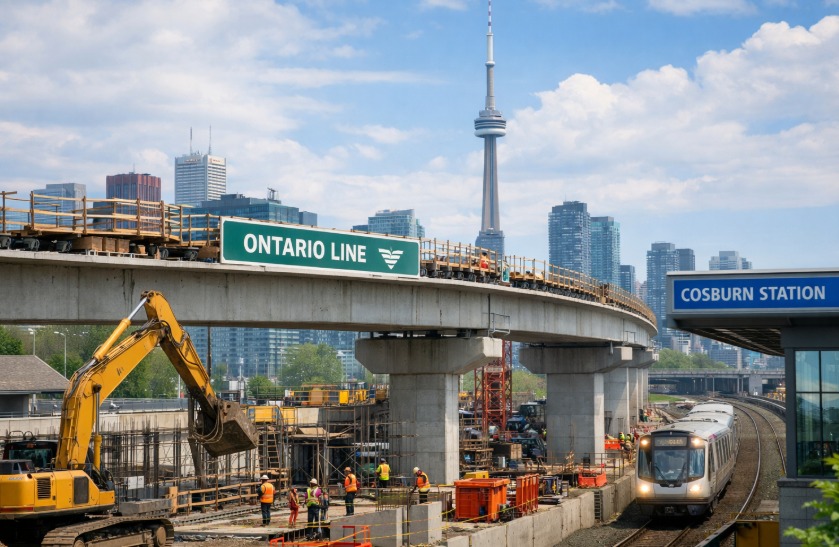
TORONTO — The Ontario government has broken ground on a major elevated segment of the Ontario Line subway and four new stations, marking a significant milestone in one of the largest transit expansions in Canadian history and a centrepiece of the province’s economic and infrastructure strategy.
Construction is now underway on a երեք-kilometre elevated guideway connecting Don Valley, Flemingdon Park and Thorncliffe Park, along with the new Cosburn Station. The project is part of the province’s $70-billion transit investment plan, which the government says will support about 4,700 jobs annually during construction while improving access to transit for hundreds of thousands of residents.
“Our government’s historic $70 billion investment in public transit across the province is helping protect workers in the face of tariffs and economic uncertainty and fight gridlock by getting transit users where they need to go faster,” said Premier Doug Ford. “The Ontario Line will be a game-changer for GTA residents, cutting travel times across Toronto and offering more than 40 convenient connections to other transit services across the region.”
The elevated guideway will run up to 14 metres above street level and is expected to bring about 30,500 additional people within walking distance of a subway station, while improving access to nearly 14,800 jobs in the surrounding area. Overall, the 15.6-kilometre Ontario Line will include 15 stations running from Exhibition Place through downtown Toronto and connecting to the Eglinton Crosstown at Don Mills Road.
Transportation Minister Prabmeet Sarkaria said the transit expansion is critical to both mobility and economic stability.
“Under the leadership of Premier Ford, our government is making historic investments in transit, including the largest subway expansion in Canadian history,” he said. “The Ontario Line is at the centre of our government’s $70 billion plan to build and upgrade transit, helping to fight gridlock and keeping thousands of workers on the job in the face of tariffs and economic uncertainty.”
Toronto Mayor Olivia Chow said the line will improve reliability and affordability for transit riders while reducing congestion.
“The Ontario Line will connect people and communities across our city, helping hundreds of thousands of Torontonians get where they need to go faster and more reliably,” said Chow. “This new line will bring more people within walking distance of transit, reduce congestion on our roads, and make daily commutes shorter for families and workers. As Mayor, I am committed to keeping the TTC affordable by freezing fares for three years while increasing service and improving reliability. We are also introducing fare capping this year so Torontonians can ride more and pay less. The City and Province will continue working together to deliver affordable and convenient transit that keeps Toronto moving.”
The Ontario Line is expected to significantly cut commute times. For example, travel from Thorncliffe Park to downtown Toronto is projected to drop to 25 minutes from about 40 minutes currently. The line will also ease crowding at major transit hubs, including reducing rush-hour congestion at Bloor-Yonge Station by up to 22 per cent.
Federal officials say the project will also contribute to economic growth and sustainability, with Ottawa committing more than $4 billion in funding.
“The Government of Canada is proud to partner with the Government of Ontario to build projects that will deliver efficient, sustainable and affordable public transit in Toronto,” said Julie Dabrusin, Minister of the Environment, Climate Change and Nature and Member of Parliament for Toronto—Danforth, on behalf of the Honourable Gregor Robertson, Minister of Housing and Infrastructure. “Advancing construction of the Ontario Line’s elevated guideway and four new stations means we are another step closer to enhancing connection and productivity in our nation’s largest city. Together, we will build a stronger and more resilient Canadian economy for everyone.”
Infrastructure Minister Todd McCarthy said the line will also help drive housing development and community growth.
“Once complete, the new Ontario Line will revolutionize travel across the Greater Toronto Area, reducing gridlock on our roads and highways and improving travel within the City of Toronto. As part of our government’s more than $220 billion capital plan to protect Ontario, we are building transit-oriented communities along several priority subway stops, including at Thorncliffe Park and Cosburn stations on the new Ontario Line. These vibrant, mixed-use communities will create new and improved public spaces, support jobs and deliver more than 3,000 new homes, making it faster and easier for people to connect to transit, right in their own neighbourhood.”
Transit agency Metrolinx said work is advancing steadily across the route.
“With work underway at all Ontario Line stations south of Bloor-Danforth, and iconic bridges being built over the Don River, we are delighted to begin construction of the four northern stations which will put more than 40,000 residents within walking distance of this incredible project,” said Michael Lindsay, President and CEO, Metrolinx.
Business and construction groups say the project will be essential for economic competitiveness.
“Congestion is impacting economic growth, quality of life and cost of living in our region — and the biggest solution lies in expanded transit. That’s why breaking ground on the Ontario Line’s east-end stations sends an important signal to businesses and commuters alike that Toronto is becoming more competitive and better connected. By cutting commute times and linking more people to jobs, the Ontario Line will be a game-changer. This important milestone is worth celebrating,” said Giles Gherson, President and CEO, Toronto Region Board of Trade.
The Ontario Line is expected to carry nearly 390,000 riders daily once complete, reduce car trips by at least 28,000 per day, and cut greenhouse gas emissions by approximately 14,000 tonnes annually, underscoring its role as both an economic and environmental infrastructure project.