

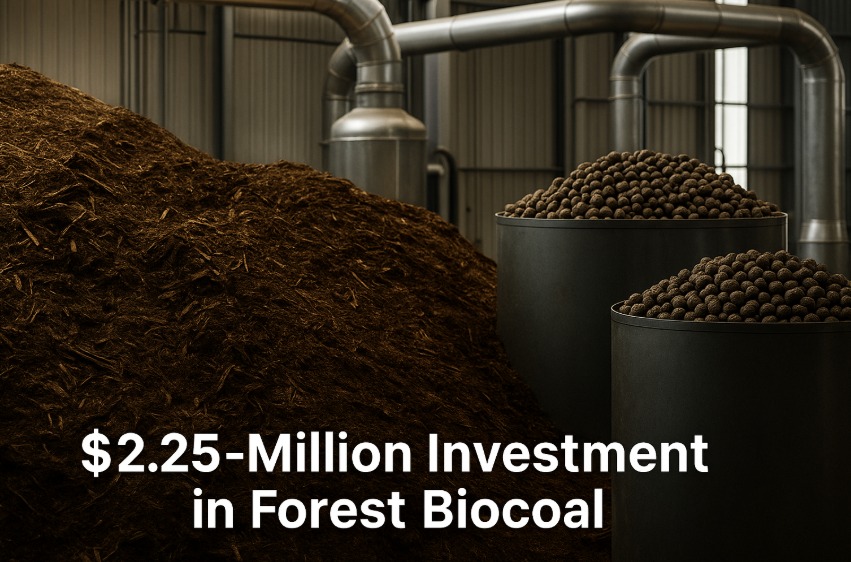
THOROLD, Ont. — The Ontario government is putting $2.25 million toward commercializing forest-based biocoal, marking a significant push to develop new markets for low-carbon fuels and strengthen the province’s forestry sector amid ongoing U.S. trade pressures.
Announced Monday, the funding comes through the Forest Biomass Program and supports CHAR Technologies as it advances production of biocoal, a pelletized fuel made from mill by-products and underused wood. The provincial investment aims to unlock new supply chains, create additional revenue streams for forest-dependent communities, and help heavy industry adopt cleaner energy sources.
In unveiling the funding, the government framed the move as part of a long-term strategy to fortify the sector against U.S. tariffs and ensure the sustainability of Ontario’s forest-based economy.
“Our government is protecting Ontario’s forest sector workers and businesses by empowering innovative businesses to create new markets and revenue opportunities from forest biomass,” said Kevin Holland, Associate Minister of Forestry and Forest Products. “By investing in emerging technologies, we are building strong local supply chains to create stable, long-term opportunities for workers and communities, and driving the growth of made-in-Ontario forest products. We are ready to lead and establish Ontario as a global leader in biocoal.”
The project will help CHAR Technologies improve the durability of biocoal during storage and transport — a key requirement for its use in steelmaking at ArcelorMittal Dofasco. According to the province, the investment will support six existing jobs and create four new ones, while enabling the company to put up to 180,000 tonnes of forest biomass to use annually. Officials say the work represents an important step toward establishing a scalable biofuel supply chain that could serve steel producers and other heavy industries across Canada and abroad.
“We thank the Ontario government for its support to accelerate CHAR Technologies’ work in advancing biocarbon pellets as a made-in-Ontario, drop-in replacement for fossil carbon in steelmaking,” said Andrew White, CEO of CHAR Technologies. “This investment strengthens the market for forest biomass, supports jobs in the North, and positions us to increase supply to local partners and to begin exporting Ontario-made biocarbon to Europe, further strengthening the province’s trade opportunities.”
The announcement coincides with the release of two new reports that track progress under the Forest Biomass Action Plan, introduced to spur innovation and resource optimization across the sector. The interim report highlights achievements to date in maximizing the value of wood and creating new markets, while a research summary outlines emerging biomass applications expected to deliver economic and environmental benefits.
Since launching in 2023, the Forest Biomass Program has committed more than $50 million to over 55 projects. The government says these investments complement broader initiatives under Sustainable Growth: Ontario’s Forest Sector Strategy, designed to protect jobs and address challenges posed by increased U.S. softwood lumber duties.
Sector leaders welcomed the latest funding announcement, emphasizing that continued government support is key to driving innovation and strengthening supply chains.
“Continued investment into innovative forest-based technologies and companies is establishing Ontario as a leader in the forest bioeconomy. We are thrilled to see Today’s announcement at OFIA member CHAR Technologies and look forward to continuing collaboration with the province on implementing the Forest Biomass Action Plan and creating a more resilient future for Ontario’s forest product sector,” said Ian Dunn, R.P.F., President and CEO of the Ontario Forest Industries Association.
For the steel industry, biocoal presents an opportunity to reduce emissions and transition away from fossil carbon. “ArcelorMittal Dofasco supports technologies that can help the steel and other heavy industries reduce reliance on fossil carbon in Canada, including the production of biocarbon for use in ironmaking and electric arc steelmaking,” said Tammy Oommen, Head of Strategic Initiatives at ArcelorMittal Dofasco.
The Thorold site also plays a central role in Ontario’s burgeoning bioeconomy. CHAR Technologies operates its first commercial facility at Bioveld Niagara, where high-temperature pyrolysis converts wood and organic by-products into renewable natural gas and biocarbon. The province previously invested $6.4 million through its Forest Sector Investment and Innovation Program (FSIIP) to expand the facility — part of more than $72 million in FSIIP funding that has leveraged $425 million in private investment to date.
“BMI Group is proud to host CHAR Technologies’ first commercial facility at Bioveld Niagara. It demonstrates BMI’s commitment to putting wood back to work and advancing full-fibre utilization in Ontario. This Thorold project is the first commercial model we intend to scale next in Espanola, creating durable jobs and strengthening the province’s forestry economy,” said Paul Veldman, Chief Executive Officer of The BMI Group.
Ontario’s forest sector generated $21.6 billion in revenue from manufactured goods and services in 2023 and supported more than 128,000 direct and indirect jobs in 2024 — figures the government says underscore the importance of continued investment as global markets shift toward low-carbon materials and renewable fuels.
