

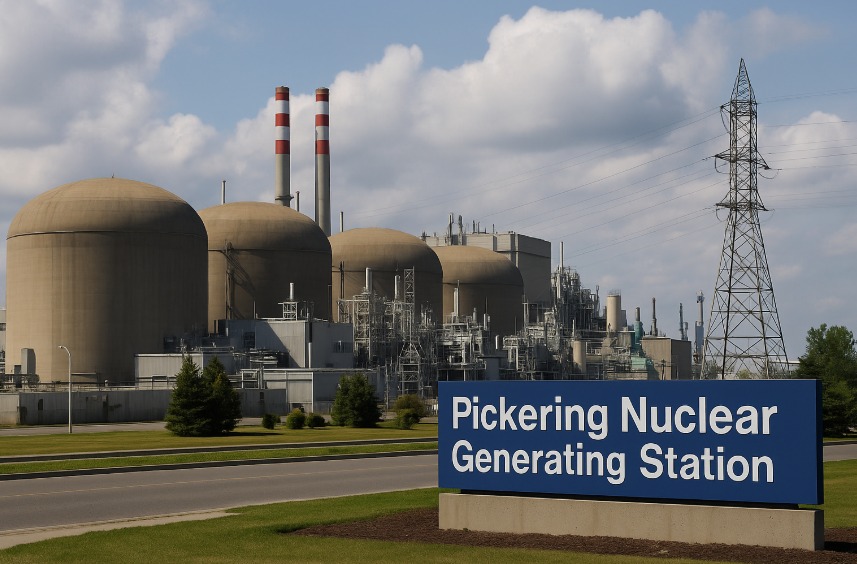
Ontario has approved a multibillion-dollar refurbishment of four reactors at the Pickering Nuclear Generating Station, a move the provincial government says will secure tens of thousands of jobs, bolster energy reliability, and strengthen the province’s position in global nuclear markets.
Energy and Mines Minister Stephen Lecce announced Wednesday that the government has given Ontario Power Generation (OPG) the green light to overhaul the station’s “B” units—reactors 5 through 8—in a project expected to extend the facility’s operating life by as much as 38 years. The work is slated to begin in early 2027, pending final licensing by the Canadian Nuclear Safety Commission (CNSC).
“For more than 50 years, nuclear power has been the backbone of Ontario’s energy grid, with the Pickering Nuclear Generating Station as one of the best-performing and continuously operating nuclear stations in the world,” Lecce said. “To deliver on our major jobs plan to get Canadians working, extending the life of the facility will create jobs for tens of thousands of skilled workers while we build up the Ontario supply chain and keep 90 per cent of our project spend in this country.”
The $26.8-billion project marks one of the largest energy infrastructure commitments in the province’s history. According to government estimates, refurbishment will create about 30,500 jobs during construction and sustain another 6,700 positions over the course of the station’s renewed operation. Officials say more than 90 per cent of all spending will remain in Canada, a key priority as Ontario positions itself to weather global supply chain disruptions and U.S. tariff pressures.
At peak output, the upgraded station is expected to generate up to 2,200 megawatts of electricity—enough to power roughly 2.2 million homes. Government projections estimate the refurbishment and ongoing operations will contribute $41.6 billion to Canada’s GDP.
The project follows a phased development process that has been underway since 2024, including engineering, design work, and early procurement of long-lead components. Once work begins, completion is targeted for the mid-2030s. OPG plans to use its established project model from the Darlington refurbishment, which the utility has repeatedly highlighted as an example of on-time, on-budget nuclear construction.
Nicolle Butcher, OPG’s president and CEO, said the new approval builds on decades of operational and project management experience. “By making this responsible investment into Pickering now, we ensure this clean energy workhorse will continue to power Ontario for future generations. The expertise developed during Darlington’s refurbishment, together with the skilled Pickering team, ensures we are ready to deliver another complex nuclear project—on time, on budget, safely, and with quality.”
Local officials also emphasized the economic impact for Durham Region. “Our government’s investment in the Pickering Nuclear Generating Station is key to strengthening our economy and standing as a leader in energy production,” said Peter Bethlenfalvy, MPP for Pickering-Uxbridge. “We are refurbishing infrastructure and creating more well-paying jobs for residents in Pickering and across Durham Region.”
Beyond power generation, the refurbishment is expected to secure decades of production of Cobalt-60, a globally significant medical isotope used in cancer treatments and in sterilizing medical equipment. The province has set a target to double isotope production over the next four years.
Industry leaders, municipalities, academic institutions, and labour groups voiced broad support. Kevin Ashe, mayor of Pickering, called the announcement a “landmark” decision that will “deliver clean, reliable power, create thousands of good jobs, and support local businesses.” Lesley Gallinger, CEO of Ontario’s Independent Electricity System Operator, said extending Pickering’s life is “crucial to meeting rapidly increasing demand for electricity, driven by electrification and economic growth in Ontario.”
Several organizations highlighted the project’s potential to reinforce Canada’s nuclear supply chain and advance Indigenous participation. OPG has committed to investing $100 million with Indigenous-owned companies over the life of the project. Sandy Taylor, president and CEO of CANDU Energy, said refurbishment will extend the life of a “made-in-Canada solution that not only powers homes and industry but strengthens communities across the province for generations to come.”
Business groups also welcomed the decision. Goldy Hyder, president and CEO of the Business Council of Canada, said nuclear power “drives growth, attracts investment, and creates a competitive economy,” and pointed to government efforts at “economic reconciliation with local Indigenous communities.” Daniel Tisch, head of the Ontario Chamber of Commerce, added that the plan “reinforces the long-term economic opportunity that nuclear energy delivers.”
Ontario’s nuclear strategy forms a core component of Energy for Generations, the province’s first integrated energy plan. With electricity demand forecast to rise sharply by 2050, the government says refurbishment—alongside new generation and storage projects—is essential to keeping power both affordable and reliable as the province grows.
As Lecce framed it: “This refurbishment signals that we are doubling down on Canadian technology, Canadian workers and the Canadian supply chain to protect our economy from global instability.”
