

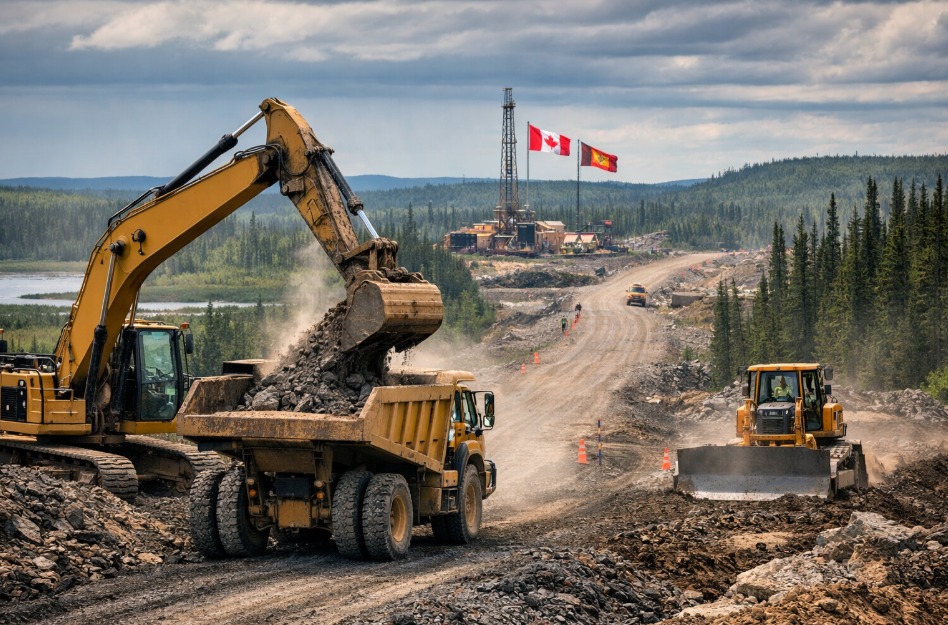
The Ontario government says it will fast-track construction of long-promised all-season roads to the Ring of Fire, aiming to complete key segments up to five years ahead of schedule in a bid to unlock billions in mineral development and position the province as a global critical minerals leader.
In a plan released Monday, the province confirmed construction will begin as early as June 2026, with the first roads expected to open by November 2030. The accelerated timeline is paired with new economic partnership agreements signed with Marten Falls First Nation and Webequie First Nation, as well as streamlined regulatory processes negotiated with Ottawa.
Premier Doug Ford framed the move as central to Ontario’s long-term economic strategy.
“Unlocking Ontario’s vast supply of critical minerals in the Ring of Fire is at the heart of our plan to protect Ontario and build a more competitive, resilient and self-reliant economy,” said Ford. “Today’s accelerated construction schedule and historic economic agreements with First Nations partners will see roads to the Ring of Fire finished five years ahead of schedule as we begin to deliver generational economic benefits to the region and all of Ontario.”
Located roughly 500 kilometres northeast of Thunder Bay and spanning about 8,000 square kilometres, the Ring of Fire region contains significant deposits of critical minerals used in electric vehicles, batteries, defence technologies and advanced manufacturing. The province estimates development could create more than 70,000 jobs and add $22 billion to Ontario’s economy over the next 30 years.
Under the revised construction schedule, the Webequie Supply Road will begin construction in June 2026 and open by November 2030, four years ahead of its previous timeline. The Marten Falls Community Access Road is scheduled to start in August 2026 and open by November 2031, also four years ahead of schedule.
Upgrades to the Anaconda and Painter Lake roads are expected to be completed by November 2030, two years earlier than planned. The Northern Road Link is slated to begin construction in spring 2028 and open by November 2031, five years ahead of schedule.
Together, the four segments will connect First Nations communities to the provincial highway network, improve access to essential goods and services, and provide year-round access to mining exploration and development sites.
The province is urging the federal government to match or exceed Ontario’s $1 billion infrastructure commitment and further streamline permitting processes. In December 2025, Ontario and Canada signed a co-operation agreement aimed at consolidating environmental approvals under a “one project, one process, one decision” framework to eliminate duplication.
Provincial officials argue the new regulatory environment maintains environmental standards while reducing uncertainty for investors. Ontario now ranks as the top low-risk jurisdiction for mining investment in Canada and second globally, according to the government.
Alongside the construction plan, Ontario signed Joint Statements of Economic Partnership with Marten Falls First Nation and Webequie First Nation, building on Community Partnership Agreements finalized in 2025. The agreements are designed to ensure First Nations participation in equity opportunities through the Indigenous Opportunities Financing Program and explore business ventures including aerodrome operations, accommodations and aggregate supply.
The province will also provide $2.5 million to support regional mineral-sector economic activity and fund a First Nations-led employment readiness survey, as well as collaborate on skills training initiatives.
Bruce Achneepineskum, Chief of Marten Falls First Nation, said the agreements are intended to support long-term community development.
“Our vision has always been to lead economic development within our traditional territories, and true reconciliation requires the resources to make that happen,” said Achneepineskum. “Through this agreement with Ontario for development planning, we are laying the groundwork for sustainable, Indigenous-led prosperity as the Ring of Fire advances. We are equipping our people with the tools to protect our interests, capitalize on business opportunities and drive long-term economic independence. This is about ensuring our community is ready to build, lead and thrive.”
Greg Rickford, Minister of Indigenous Affairs and First Nations Economic Reconciliation and Minister Responsible for Ring of Fire Economic and Community Partnerships, said the partnership model represents a shift in how resource projects are developed in the province.
“Through today’s economic partnership initiative, we set a new standard for how and why resources will be developed in the province of Ontario — with First Nations as full partners every step of the way. We are shaping the future of responsible resource and economic development, aligned through shared priorities with First Nations, industry and government.”
Finance Minister Peter Bethlenfalvy emphasized the broader economic implications for northern communities and the province.
“The Ring of Fire represents a generational opportunity to unleash economic prosperity, alongside First Nations communities and throughout the north. Together, we are advancing responsible resource development and related infrastructure that will create good-paying jobs and support long-term prosperity in the north and across the province. This approach is creating the conditions to make Ontario the most competitive place in the G7 to invest, create jobs and do business, while fostering strong regional economies and inclusive growth across northern communities.”
Energy and Mines Minister Stephen Lecce positioned the accelerated buildout as a strategic move for Canada’s economic security.
“After decades of talk, our government’s plan of action will finally unlock the Ring of Fire and supercharge Canada’s self-reliance. It is a historic day as we announce an accelerated plan to build the roads, along with the transmission and power, to create 70,000 Canadian jobs. Ontario is moving with speed, emerging as the top Canadian jurisdiction for mining investment, and now second on earth, because we are accelerating permitting and building roads, infrastructure and investor confidence as the world’s reliable partner.”
Transportation Minister Prabmeet Sarkaria added that more than 500 kilometres of all-season roads are part of the broader infrastructure strategy.
“Our government plans to accelerate construction of more than 500 kilometres of all-season roads leading to the Ring of Fire so we can unlock Ontario’s full economic potential and cement our position as a world leader in the critical minerals space. This work will create good-paying jobs and protect Ontario by building a stronger, more resilient north.”
The province also pointed to related investments, including $61.8 million announced in September 2025 for Geraldton’s Main Street Rehabilitation Project in Greenstone, which is expected to serve as a gateway to the Ring of Fire region.
With construction set to begin this summer, Ontario is betting that faster timelines, regulatory certainty and economic partnerships with First Nations will turn a decades-long vision into a cornerstone of the province’s resource economy.