

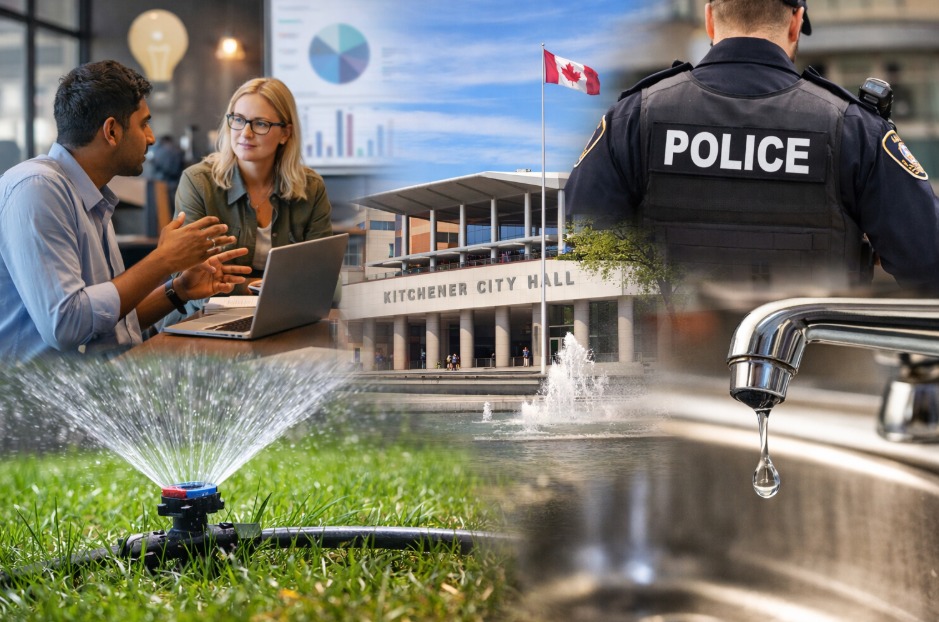
KITCHENER, Ont. — Kitchener city council endorsed a series of measures aimed at strengthening the city’s economic development efforts, modernizing municipal services and responding to regional infrastructure challenges during its March 2 meeting.
Among the key decisions were support for making the Pitch Kitchener innovation program permanent, approval of a new agreement with Waterloo Regional Police Service for municipal bylaw dispatching, and steps to address a regional water capacity constraint affecting development across the area. The city was also recognized nationally for its work in supporting professional planning staff.
Key decisions of Council is a summary of major discussion items presented at Kitchener City Council meetings and circulated following each meeting, with the official record contained in the meeting minutes.
City receives national employer recognition
The City of Kitchener was awarded the 2025 Employer of the Year Award in the public and municipal sector by the Canadian Association of Certified Planning Technicians (CACPT).
The national award recognizes organizations that demonstrate leadership in supporting professional planning staff and maintaining high standards within the planning technician field. According to the CACPT, the recognition reflects the organization’s mandate to promote professional excellence while highlighting municipalities that support workforce development.
The honour also acknowledges the city’s work in growth planning and service delivery, as well as its broader leadership among municipalities across Canada.
Municipal officials say the award reflects Kitchener’s continued investment in planning professionals and its role in managing development pressures as the region grows.
Council approves expansion of Pitch Kitchener
Council also voted to continue the Pitch Kitchener program after reviewing results from its inaugural pilot.
City staff reported strong participation from local entrepreneurs, industry partners and the region’s technology sector during the program’s first run. The initiative was designed to support early-stage innovators by providing a platform to present ideas and connect with resources and mentors.
Based on the pilot’s results, staff recommended the program become a recurring initiative.
Council endorsed that recommendation and approved a $100,000 allocation for the program in the city’s 2026 budget. Officials also directed staff to submit a funding request through the 2027 budget process to support future rounds of the program.
The initiative is tied to the city’s broader strategic commitment to fostering innovation and supporting the local entrepreneurial ecosystem. By connecting startups with partners and removing barriers to early-stage growth, the program aims to strengthen Kitchener’s reputation as a technology and innovation hub.
City officials say the program also reflects the municipality’s goal of “Stewarding a Better City Together,” a strategic priority focused on collaboration between city staff, businesses and community partners.
New bylaw dispatch agreement approved
Council approved entering into a formal agreement with Waterloo Regional Police Service (WRPS) to provide dispatch services for municipal bylaw enforcement.
The arrangement will be implemented jointly with the City of Waterloo, the City of Cambridge and the Township of North Dumfries.
Under the new system, a dedicated dispatch line focused specifically on municipal bylaw calls will be created. City officials say the change is intended to streamline service delivery and improve response times.
The annual cost for Kitchener is estimated at approximately $587,000 based on current call volumes.
The agreement replaces a dispatch arrangement that has been in place since 1996. The new approach became possible after amendments to the Police Services Act and direction from the WRPS police service boards to recover costs for non-core services, including dispatching for municipal bylaw enforcement.
Officials say the regional approach is expected to improve consistency in service delivery across participating municipalities.
City responds to regional water capacity constraint
Council also received an update on the city’s response to a water capacity constraint affecting the Mannheim Service Area, which supplies water to Kitchener, Waterloo and parts of Cambridge, Woolwich and Wilmot.
The City of Kitchener has activated a formal incident management response and deployed staff to assist with regional planning efforts.
Municipal staff are participating in the Region of Waterloo’s Technical and Planning Working Groups to provide engineering expertise, while also supporting regional communications efforts.
Despite the constraint, development activity in Kitchener is continuing under what officials describe as a careful, risk-based approach.
Regional staff are working with local municipalities to create an interim development framework that could allow up to 50% of confirmed but unbuilt water capacity expected to come online over the next five years to be used for development approvals.
The proposed approach is intended to maintain progress on housing construction while ensuring the long-term reliability of the water system.
City staff are reviewing development applications on a case-by-case basis, evaluating risks and opportunities associated with the current capacity limits.
If the interim framework is approved by regional council, Kitchener staff will present a detailed report outlining the potential impact on development applications currently in progress.
Emphasis on water conservation
City officials say water conservation will play a key role in managing the capacity challenge in the coming months and years.
Even as infrastructure projects expand supply, reducing peak demand—particularly outdoor water use during summer months—will be critical to restoring system resiliency.
Regional staff are reviewing enhanced conservation measures, while the City of Kitchener plans to support those efforts through public education and incentive programs.
Residents and businesses are being encouraged to participate in programs such as Water Efficient Technology (WET) incentives, follow outdoor water-use guidelines and take part in water-saving education initiatives offered through the Region of Waterloo.
More information on water conservation programs is available through the Region of Waterloo website.