

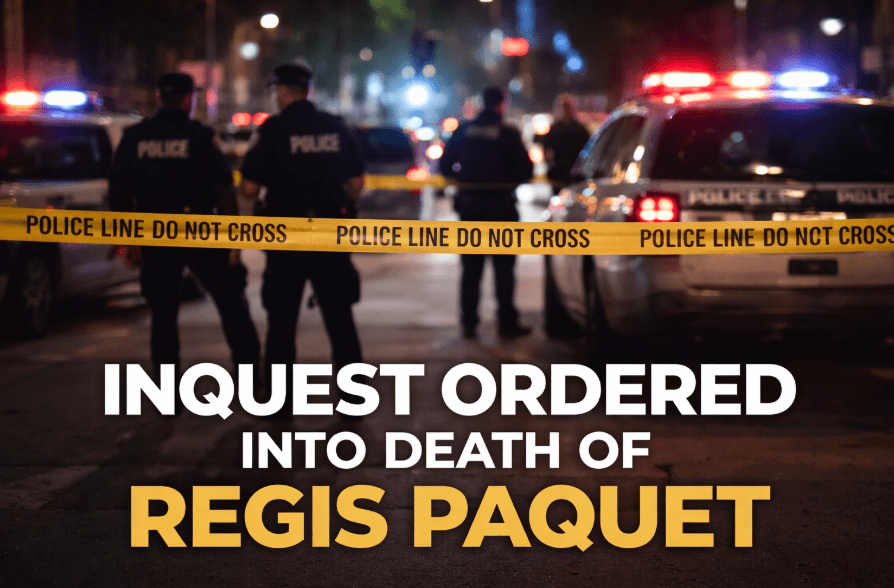
Provincial coroner says jury may recommend measures to prevent similar deaths
Details on timing and venue to be announced
An inquest will be held into the death of Regis Paquet, a 29-year-old woman who died following an interaction with police in Toronto in May 2020, Ontario’s Office of the Chief Coroner has announced.
Dr. Richard Wells, Regional Supervising Coroner for the Central Region, Toronto West Office, confirmed the decision in a statement released Thursday by the Ministry of the Solicitor General.
“Dr. Richard Wells, Regional Supervising Coroner, Central Region, Toronto West Office, has announced that an inquest will be held into the death of Regis Paquet.”
Ms. Paquet, described as a 29-year-old Canadian woman of Ukrainian, Black and Indigenous ancestry from Nova Scotia, died on May 27, 2020, after an interaction with officers from the Toronto Police Service earlier that same day.
“Ms. Paquet, a 29-year-old Canadian woman of Ukrainian, Black and Indigenous ancestry from Nova Scotia, died on May 27, 2020, following an interaction with officers from the Toronto Police Service on the same day.”
Scope of the inquest
Under Ontario law, a coroner’s inquest is a public proceeding designed to examine the circumstances surrounding a death. While it does not assign criminal or civil liability, it can result in recommendations aimed at preventing similar fatalities in the future.
“The inquest will examine the circumstances surrounding Ms. Paquet’s death. The jury may make recommendations aimed at preventing further deaths.”
The announcement signals a formal step toward public review, which often includes testimony from witnesses, experts, and involved parties. Inquests in cases involving police interactions can draw significant public attention, particularly when questions arise around use of force, mental health responses, or systemic issues.
Background and broader context
Although the release does not provide further details about the nature of the police interaction, deaths involving law enforcement frequently prompt calls for transparency and accountability. In Ontario, inquests are mandatory in certain types of deaths, including those involving individuals in custody or under specific forms of supervision, but they may also be called at the discretion of a coroner when deemed to be in the public interest.
Cases involving individuals from diverse or marginalized backgrounds, such as Ms. Paquet, often attract additional scrutiny from advocacy groups and community organizations, who may seek systemic reforms based on inquest findings.
The inclusion of Ms. Paquet’s Ukrainian, Black, and Indigenous heritage in the official release underscores the intersectional identity that may shape public and institutional responses to the case.
Next steps and timeline
Officials said further details about the proceedings have yet to be finalized.
“Further details regarding the inquest, including the date and venue, will be provided at a later date.”
Inquests can take months or even years to commence after being announced, depending on the complexity of the case, availability of participants, and procedural requirements. Once scheduled, proceedings are typically open to the public and may be closely followed by media, legal representatives, and community stakeholders.
Role of recommendations
At the conclusion of an inquest, a jury may issue non-binding recommendations directed at government bodies, police services, healthcare providers, or other institutions. These recommendations are intended to improve public safety and reduce the likelihood of similar deaths.
While organizations are not legally required to implement such recommendations, they often carry weight in shaping policy discussions and reforms. Past inquests in Ontario have led to changes in policing practices, mental health crisis response protocols, and institutional oversight mechanisms.
Public access to information
The province encourages members of the public to learn more about the inquest process through official resources.
“For more information about inquests, see: https://www.ontario.ca/page/coroners-inquests.”
As the case moves forward, attention will likely focus on the findings of the inquest and any resulting recommendations, particularly in the context of ongoing discussions around policing and accountability in Canada.