

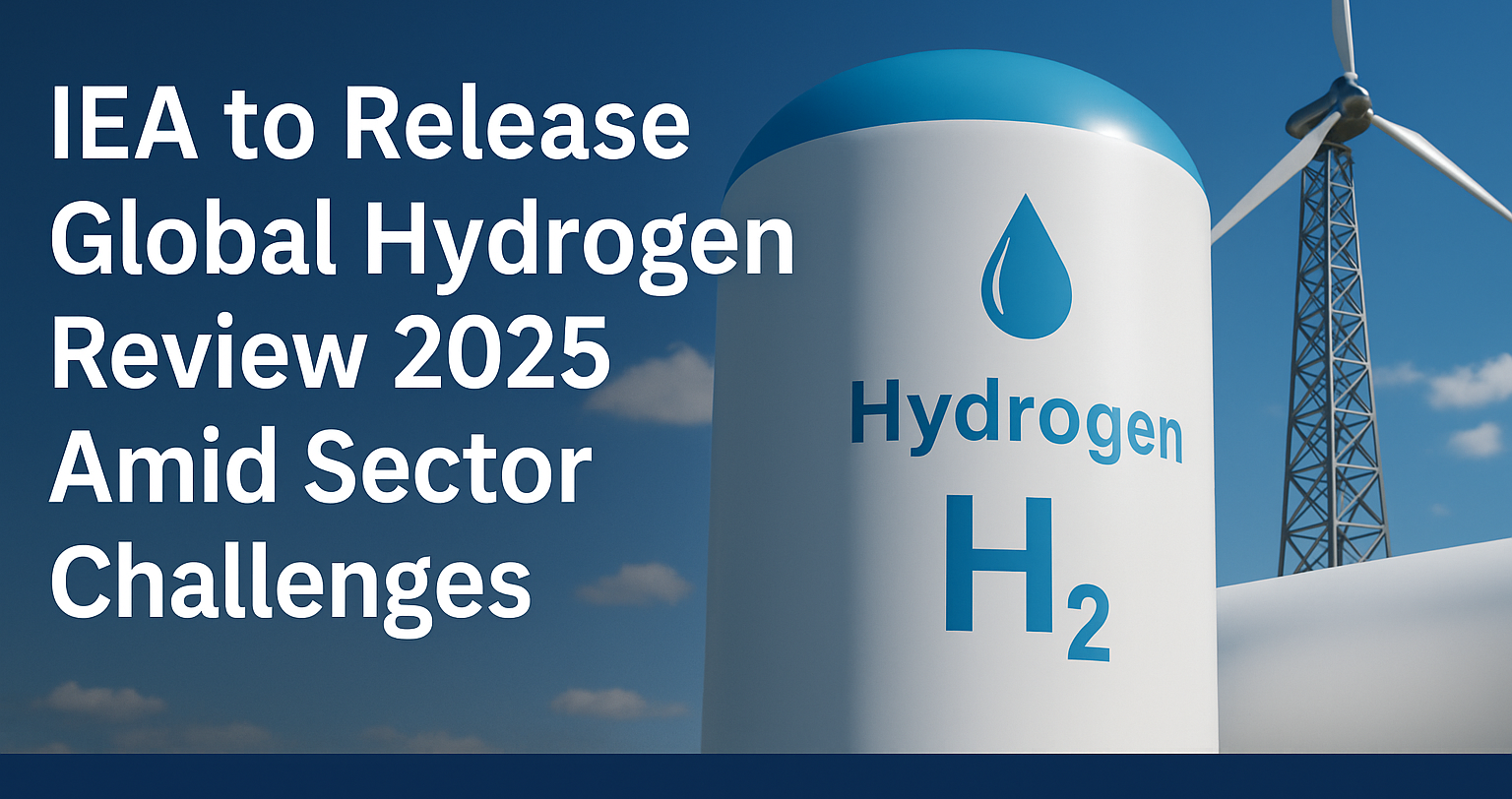
The International Energy Agency (IEA) is set to launch its Global Hydrogen Review 2025 on Friday, Sept. 12, offering governments, investors and industry stakeholders a detailed assessment of hydrogen’s role in the global energy transition.
The annual review, now in its fifth edition, has become a key resource for policymakers and businesses seeking to track developments in the hydrogen economy. According to the IEA, the 2025 edition provides the most up-to-date data on hydrogen production and demand worldwide, while also evaluating infrastructure, trade, regulatory frameworks and investment trends.
Assessing the state of hydrogen
The Global Hydrogen Review aims to paint a comprehensive picture of where hydrogen stands today and what is needed to accelerate its growth. The report examines the progress made across critical areas such as production technology, cross-border trade opportunities, policy development and private sector investment. It also considers the state of innovation and commercialization in the sector, identifying both advancements and ongoing gaps.
Crucially, the publication looks ahead to 2030, evaluating the global project pipeline at a time when the hydrogen sector is facing headwinds. Rising costs, supply chain bottlenecks, and questions over long-term policy support have created uncertainty for developers. Against this backdrop, the review highlights which initiatives are moving forward, which are stalled, and how governments and investors might bridge the gap.
Spotlight on Southeast Asia
In a new development, this year’s report features a dedicated chapter on Southeast Asia. The region, with its abundant renewable energy potential and growing demand for cleaner fuels, is increasingly viewed as a promising player in the low-emissions hydrogen market.
The report examines near-term opportunities for producing and using hydrogen and hydrogen-based products in Southeast Asia. It outlines the challenges of scaling up infrastructure and building regulatory frameworks, while also pointing to countries in the region that could emerge as exporters in the global hydrogen economy.
A new online tracker
Alongside the release of the review, the IEA will debut a digital tracker designed to expand access to hydrogen market intelligence.
The tracker will enable users to explore details of announced projects for low-emissions hydrogen production and infrastructure deployment. It will also provide data on production costs by region and technology type. Another key feature will be its comprehensive database of policy measures: more than 1,000 hydrogen-related regulations, incentives and targets announced or implemented worldwide since 2020.
According to the agency, this tool is intended to support governments, investors, researchers and companies by consolidating information that is often fragmented across different jurisdictions and industries.
Hydrogen in global energy systems
Hydrogen has long been viewed as a versatile fuel capable of reducing emissions across hard-to-abate sectors such as steel, cement and long-distance transport. While momentum has grown in recent years, the sector still accounts for only a fraction of global energy use.
The IEA’s review notes that progress has been uneven, with production costs remaining high and infrastructure deployment lagging behind expectations. Nevertheless, the agency argues that hydrogen remains a critical part of the pathway to achieving net-zero emissions by mid-century.
Policy and investment outlook
One of the key themes in the 2025 report is the role of government action. The IEA stresses that strong, coordinated policy frameworks will be essential to scaling up hydrogen production and creating market demand.
Industry observers have pointed to the importance of financial incentives, infrastructure investment and international cooperation to overcome the sector’s current challenges. The report’s inclusion of more than 1,000 policy measures worldwide underscores how rapidly governments are moving to define their approaches.
Looking forward
As the hydrogen sector grapples with rising costs and questions about economic viability, the IEA’s Global Hydrogen Review 2025 arrives at a critical juncture. For Canada and other energy-producing nations, the findings will be closely watched as governments weigh hydrogen’s potential to diversify economies, cut emissions and capture export opportunities.
The launch of both the review and the online tracker highlights the agency’s push to provide transparency and reliable data at a time when the global conversation on hydrogen is intensifying.
