

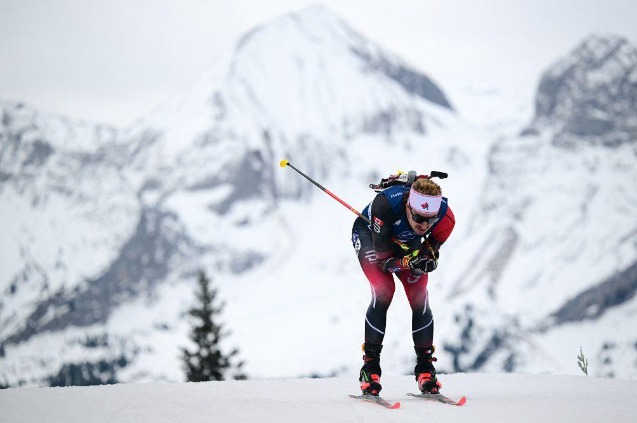
ANTHOLZ-ANTERSELVA, Italy — Canada will have four biathletes competing in upcoming Olympic pursuit races after Adam Runnalls led a trio of Canadian men and Benita Peiffer delivered a career-best performance in sprint competition at the Olympic Winter Games.
Runnalls, a 27-year-old from Calgary, set the pace for Canada in the men’s 10-kilometre sprint, finishing 31st with a time of 25:02.5. His result, built on a combination of efficient skiing and accurate shooting, secured his position among the top 60 athletes who advance to the 12.5-kilometre pursuit race.
“The skis were great today. I did my first lap with Zach (Connelly). It was perfect timing with him coming out of the range exactly as I started so we did good work together and were both able to put down a good ski time,” said Runnalls.
Biathlon sprint races require competitors to stop twice at a shooting range, aiming at five targets per visit. Each missed target results in a 150-metre penalty loop, testing both endurance and precision. Runnalls performed flawlessly in the prone position but missed one shot while standing.
“The shooting was really solid today. I just missed the follow through on that last shot,” he added. “I’m a little disappointed but also happy to have a good race. Things are looking good for the pursuit on Sunday.”
Runnalls will be joined in the pursuit by Ottawa’s Zachary Connelly, who finished 48th in 25:33.5 despite four missed shots, and Regina’s Logan Pletz, who placed 55th with a time of 25:46.7. Both athletes qualified under the Olympic format that advances the top 60 finishers.
Jasper Fleming of Squamish, B.C., finished 80th and did not advance.
The men’s sprint podium was dominated by European contenders, with France’s Quentin Fillon Maillet claiming gold in 22:53.1. Norway’s Vetle Sjaastad Christiansen secured silver in 23:06.8, while teammate Sturla Holm Laegreid took bronze in 23:09.0. All three medallists delivered perfect shooting performances, highlighting the importance of accuracy in the discipline.
On the women’s side, Canada’s Benita Peiffer was the lone athlete to advance, finishing 56th in the 7.5-kilometre sprint in 23:04.9. The Whistler, B.C., native’s performance marked both her Olympic debut and her best career finish.
“It is a bit crazy to have my best result at the Olympics and make the pursuit,” said Peiffer, who has been ill since the opening of the Games. “I wasn’t sure what was possible after being sick for a week in an endurance sport, but I’m really proud of myself. This is super exciting.”
Peiffer missed just one target in the prone stage and delivered a steady overall effort, crediting a balanced approach to shooting and skiing.
“I think sometimes when there is less pressure on your ski speed you are able to hone in on the shooting,” added Peiffer. “It is cool to have so many Canadian fans out here. It kind of feels like a regular World Cup but when you see the Olympic rings everywhere it is pretty special.”

The women’s sprint podium was led by Norway’s Maren Kirkeeide, who posted a winning time of 20:40.8 without a shooting miss. France’s Oceane Michelon took silver at 20:44.6, and compatriot Lou Jeanmonnot earned bronze in 21:04.5 despite one penalty.
Other Canadian women fell short of pursuit qualification. Nadia Moser of Whitehorse finished 61st after missing three standing targets. Calgary’s Pascale Paradis placed 67th following three prone misses, and Shilo Rousseau of Thessalon, Ont., finished 80th.
For Canada, the qualification of four athletes into pursuit races represents a solid showing in one of the Winter Games’ most demanding endurance sports. The pursuit format staggers start times based on sprint results, offering athletes an opportunity to improve their standings through head-to-head competition.
With three men and one woman advancing, Canada maintains a presence in both pursuit fields, as athletes look to build on their sprint performances against the world’s elite.