

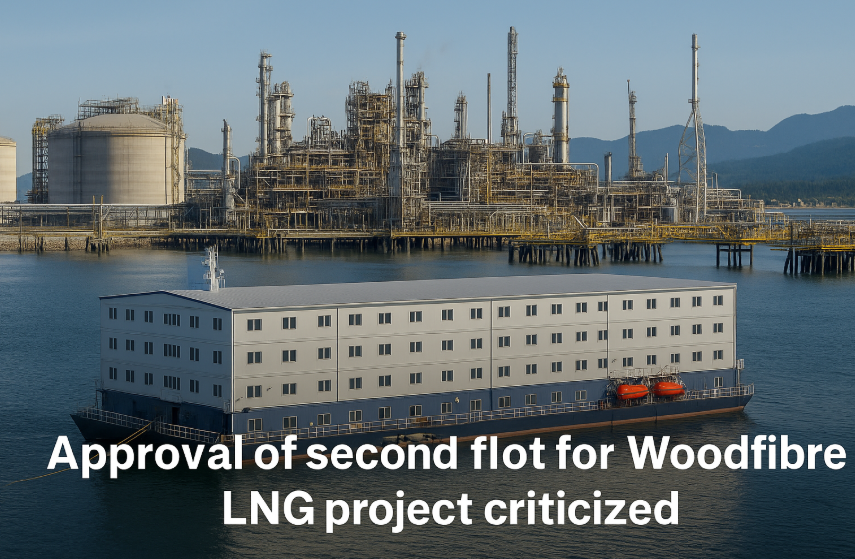
The approval of a second floating worker accommodation vessel for the Woodfibre LNG project has reignited debate over regulatory oversight, community impacts, and the future of liquefied natural gas development in British Columbia. The decision, announced this week, has drawn sharp criticism from My Sea to Sky, a regional environmental advocacy organization, which argues that the move reflects deeper systemic issues in Canada’s regulatory framework for major industrial projects.
The new floatel—intended to house additional workers during construction of the LNG facility near Squamish—marks a significant expansion of temporary workforce housing for the project. While Woodfibre LNG has promoted floating work camps as a means of reducing pressure on local housing supply, critics contend that the approach reflects a broader pattern of short-term planning and insufficient accountability.
In a statement released November 13, 2025, My Sea to Sky Executive Director Tracey Saxby said the approval underscores a regulatory system that she believes favours corporate interests over community needs.
“The approval of a second floating workcamp for Woodfibre LNG in Átl’ḵa7tsem / Howe Sound exposes Canada’s broken regulatory system, where the profits of a foreign-owned fossil fuel company are prioritized over the public interest,” Saxby said.
The Vancouver-based organization has opposed various elements of the LNG project for more than a decade. According to Saxby, concerns about worker accommodation, community safety, and cumulative environmental impacts were raised early in the project’s review process but were not adequately addressed. She says the latest decision reflects those longstanding gaps.
“My Sea to Sky warned regulators over eleven years ago that Woodfibre LNG’s plans for worker accommodation were inadequate given the lack of housing in Squamish. As a good corporate citizen, Woodfibre LNG could have invested in building legacy housing for Squamish that could help to relieve the current housing crisis. Instead, Woodfibre LNG opted for a cheap, temporary solution that provides no legacy benefit to local communities, and puts its workers at risk,” she said.
The group argues that the project’s reliance on short-term housing solutions highlights broader weaknesses in B.C.’s environmental assessment process. Saxby said the system has allowed industry assertions to move forward without sufficient scrutiny, leaving residents and local governments to manage long-term consequences.
“This outcome highlights the deep flaws in BC’s environmental assessment process, which allows industry claims to go unchallenged while our communities pay the price,” she said.
The Woodfibre LNG project has received provincial and federal approvals, and construction activities have accelerated in recent years. The company is backed by Pacific Energy, a subsidiary of Indonesian conglomerate RGE, which has positioned the project as a lower-emissions LNG export option due to its planned use of electric compressors powered by B.C. Hydro.
However, critics maintain that any expansion of fossil fuel infrastructure is incompatible with provincial and national climate objectives. Saxby’s statement also links the floatel approval to broader policy decisions by federal and provincial leadership, arguing that governments are moving too aggressively to advance LNG development.
“The fast-tracking of new fossil fuel infrastructure by Prime Minister Carney and Premier Eby is resulting in further deregulation of industry, by fast-tracking new fossil fuel infrastructure, weakening environmental protections, and renewing public subsidies for fossil fuel extraction,” she said.
The federal and provincial governments have promoted LNG as a key economic opportunity, emphasizing construction jobs, export revenues, and the potential for LNG to displace higher-emissions fuels in overseas markets. Industry groups have also argued that projects like Woodfibre LNG can support economic diversification and long-term investment in B.C.’s energy sector.
Opponents, however, say those benefits are overstated and that the risks—to local communities, ecosystems, and provincial finances—are substantial. Saxby argues that LNG expansion will ultimately impose costs on residents rather than delivering meaningful economic security.
“Expanding liquefied natural gas won’t bring prosperity or energy security to people in Squamish or in BC. Instead the costs associated with fossil fuel expansion are falling on everyday people in this province as profits flow to foreign-owned corporations,” she said.
The addition of a second floatel is expected to increase the project’s workforce capacity during peak construction, though neither regulators nor the project proponent have publicly released details on the vessel’s timeline or specific operational requirements. The company has previously stated that using marine-based housing reduces demand on local rental markets and minimizes the need for new land-based infrastructure.
As construction continues and regulatory approvals advance, the debate surrounding Woodfibre LNG remains a flashpoint in broader discussions about British Columbia’s energy strategy, its housing challenges, and the role of LNG exports in Canada’s economic future. The approval of the latest floatel is likely to intensify scrutiny from advocacy groups and policy analysts alike, particularly as governments consider long-term approaches to climate commitments and industrial development in the province.
If you’d like, I can also generate:
✅ a headline list,
✅ a shorter version (300–400 words),
✅ or a neutral business-focused summary for corporate readers.