

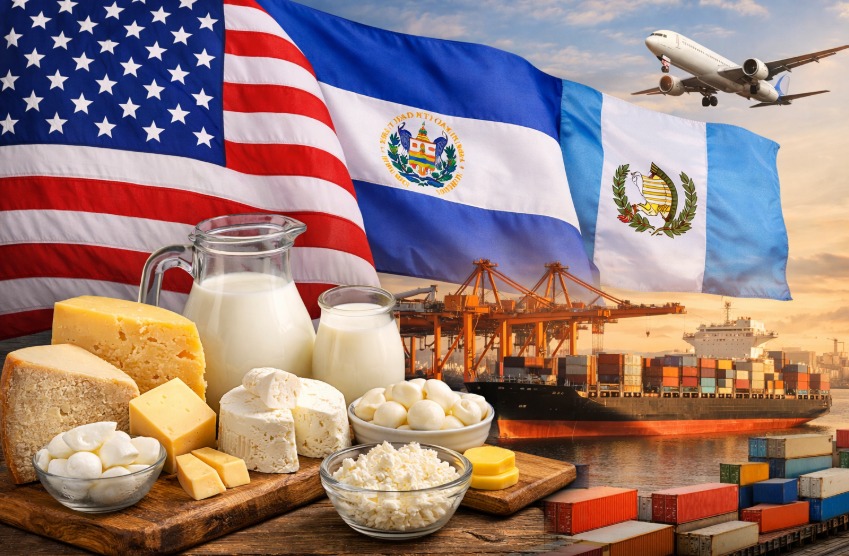
The United States has signed reciprocal trade agreements with El Salvador and Guatemala aimed at reinforcing long-standing market access for U.S. dairy exporters and preventing the introduction of new trade barriers, a move welcomed by major U.S. dairy and food industry groups this week.
The National Milk Producers Federation (NMPF), the U.S. Dairy Export Council (USDEC) and the Consortium for Common Food Names (CCFN) said the agreements strengthen regulatory certainty for U.S. agricultural exports, particularly dairy, in two key Central American markets. The deals are designed to build on existing trade commitments under the Central America–Dominican Republic Free Trade Agreement (CAFTA-DR), which already provides duty-free access for U.S. dairy products.
Under the new agreements, El Salvador and Guatemala have committed to address and prevent barriers to U.S. agricultural goods by recognizing U.S. regulatory oversight and accepting certificates issued by U.S. authorities. The commitments also include a prohibition on introducing facility registration requirements for U.S. dairy products and a pledge to streamline product registration processes. Industry groups say these measures are essential for maintaining predictable, transparent and fair access to both markets.
A central feature of the agreements is a commitment by both countries to ensure that market access for U.S. agricultural exporters will not be restricted based on the use of certain food names. Specifically, the agreements protect 38 widely used dairy terms — including parmesan, gruyere, feta and asiago — as well as 10 commonly used meat terms. The issue has become increasingly sensitive for exporters as some jurisdictions, particularly in Europe, have pushed to limit the use of what they consider geographically linked names.
“Securing durable market access and setting clear expectations with trading partners is essential for U.S. agriculture,” said Krysta Harden, president and CEO of USDEC. “This agreement builds on the success of CAFTA-DR and we thank the administration for fighting for the right of U.S. dairy exporters to compete fairly in the Salvadoran and Guatemalan market.”
U.S. dairy products already benefit from preferential access to El Salvador and Guatemala under CAFTA-DR, which entered into force more than a decade ago. Tariffs on U.S. dairy exports to the two countries phased out entirely over time and were fully eliminated in the past year. Industry groups say that outcome followed years of advocacy by USDEC and NMPF to ensure dairy was included in the agreement’s most liberalized tariff treatment.
The new agreements are intended to safeguard those gains by preventing the emergence of non-tariff barriers that could undermine the commercial value of tariff-free access. From an industry perspective, regulatory requirements and naming restrictions can be just as disruptive to trade as duties, particularly for perishable and highly regulated products such as dairy.
“For dairy farmers, these agreements help to keep doors open to U.S. products,” said Gregg Doud, president and CEO of NMPF. “By protecting hard-won access and preventing new barriers from taking hold, the agreements support demand for U.S. milk and dairy products and strengthen the economic outlook for farm families across the country.”
The protection of common food names was a key priority for CCFN, which has long argued that widely used product terms should remain available to producers that meet established standards, regardless of geography. The group framed the agreements as a counterweight to efforts by European authorities to expand protections for geographic indications in export markets.
“As European authorities increasingly seek to confiscate common food names across Latin America, the agreements unequivocally protect 38 common cheese names and 10 generic meat terms and send a clear signal by preserving our producers’ right to label their products with terms that have been used for generations in El Salvador and Guatemala,” said Jaime Castaneda, executive director of CCFN.
Looking ahead, NMPF, USDEC and CCFN said they will continue working with the Office of the United States Trade Representative and other federal agencies to monitor implementation of the agreements. The organizations emphasized that follow-through will be critical to ensuring El Salvador and Guatemala fully meet their commitments and that U.S. dairy exporters continue to benefit from open, predictable access to the region’s growing consumer markets.
