

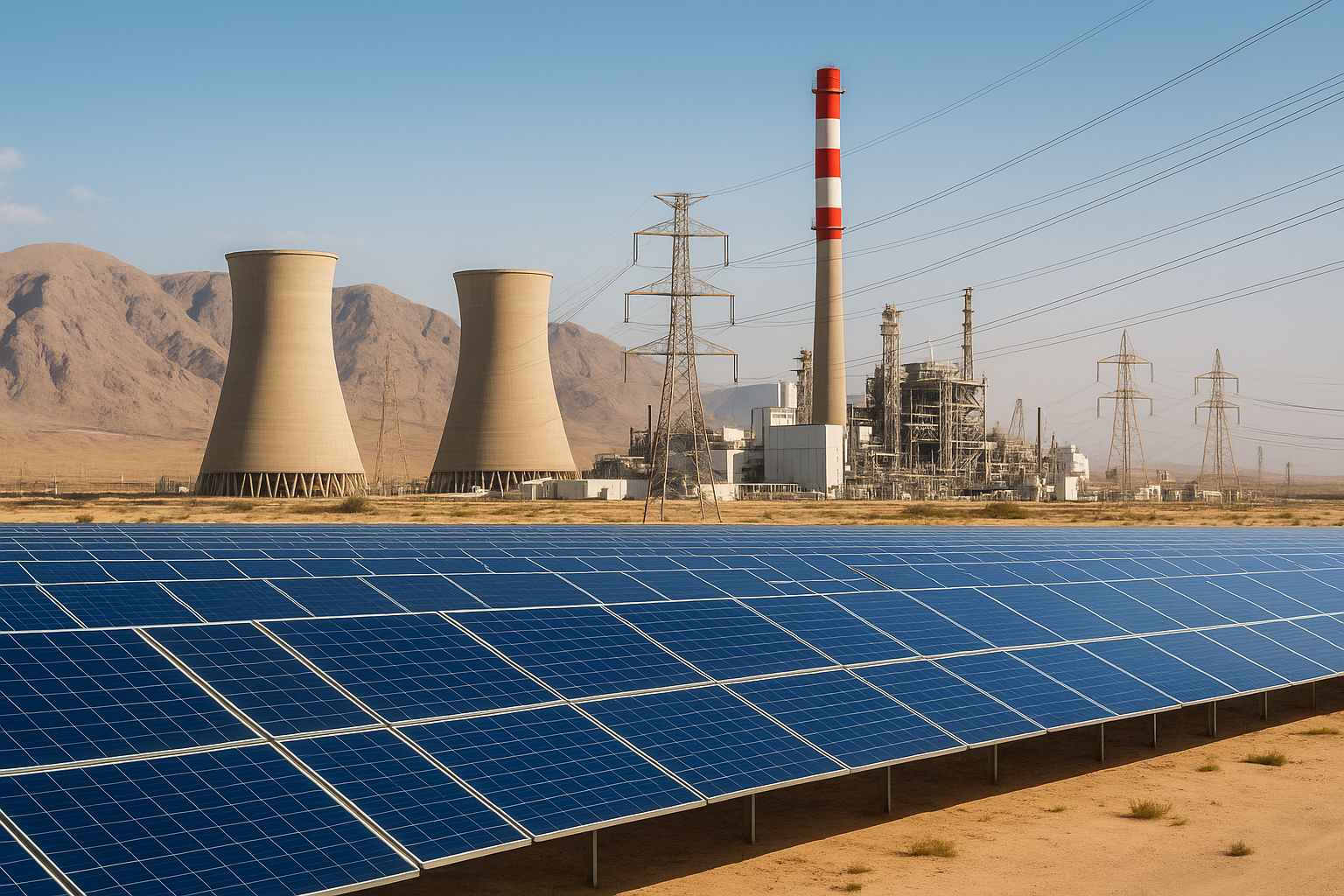
Electricity demand in the Middle East and North Africa (MENA) is set to continue its steep climb as soaring populations, rising incomes, and an intensifying need for air conditioning and water desalination reshape the region’s energy landscape, according to new analysis from the International Energy Agency (IEA).
In a report released Monday, The Future of Electricity in the Middle East and North Africa, the Paris-based agency said electricity consumption in the region has tripled since 2000, trailing only China and India in global growth. By 2035, demand is projected to increase by another 50 per cent under current policy settings, with cooling and desalination alone accounting for roughly 40 per cent of the anticipated rise.
Shifting energy mix
Today, oil and natural gas dominate the region’s power generation, providing more than 90 per cent of total electricity supply. But governments are moving to reduce oil’s role in electricity production, and that shift is expected to accelerate.
The IEA forecasts that natural gas will account for half of all demand growth to 2035, cutting oil-fired generation from about 20 per cent of supply today to just 5 per cent. Meanwhile, solar photovoltaic capacity is expected to expand tenfold by 2035, boosting renewables’ share of the region’s generation mix to roughly 25 per cent. Nuclear energy is also poised for a strong expansion, with installed capacity projected to triple.
“The region has long been a cornerstone of the global energy system,” the report notes, “but its own demand trajectory underscores the urgency of diversifying energy supplies and investing in resilient infrastructure.”
Broader global implications
The IEA’s analysis comes as global oil and gas producers face another challenge: the accelerating decline in output from existing fields. A companion report, The Implications of Oil and Gas Field Decline Rates, warns that depletion is gathering speed, particularly as producers lean more heavily on shale and deep offshore projects.
The study, based on production data from 15,000 fields worldwide, found that nearly 90 per cent of annual upstream oil and gas investment is now required simply to offset declines, leaving only a small portion to meet new demand.
“Our Executive Director Fatih Birol described decline rates as ‘the elephant in the room for any discussion of investment needs in oil and gas,’” the IEA said in its release. “The industry has to run much faster just to stand still.”
Without steady investment, the report warns, the global market could lose volumes equivalent to the combined production of Brazil and Norway each year.
High-level diplomacy
The release of the reports coincides with an active round of international meetings by Dr. Birol, who travelled to New York and Washington, D.C. last week for the United Nations General Assembly and Climate Week.
In Washington, he met with U.S. Energy Secretary Chris Wright to discuss oil, liquefied natural gas, critical mineral supply chains, and the role of nuclear energy. In New York, he sat down with U.K. Energy Secretary Ed Miliband to review recent emissions trends and co-chaired a high-level dialogue on priorities for the COP30 climate summit in Brazil next year.
Birol also met with Canada’s Minister of Energy and Natural Resources, Tim Hodgson, ahead of Toronto’s G7 Energy and Environment Ministers’ Meeting in October. Hodgson, whose country holds the G7 presidency for 2025, stressed that critical mineral supply chain security would be a top priority for Canada.
Growing regional urgency
The IEA’s findings on MENA echo a broader theme in its recent work: fast-rising electricity demand in emerging economies. The agency noted that Southeast Asia’s power consumption grew at nearly twice the global average last year and is expected to double again by 2050, driven by industrial growth and urbanization.
For the Middle East and North Africa, however, the pressures are especially acute. Scorching temperatures and limited water resources mean electricity demand for cooling and desalination will continue to grow faster than in most other regions, forcing governments to juggle energy security, emissions targets, and infrastructure resilience.
“The trends we are seeing in the region are a microcosm of the challenges facing the global energy system,” the IEA said. “How countries respond will have implications far beyond their borders.”
