

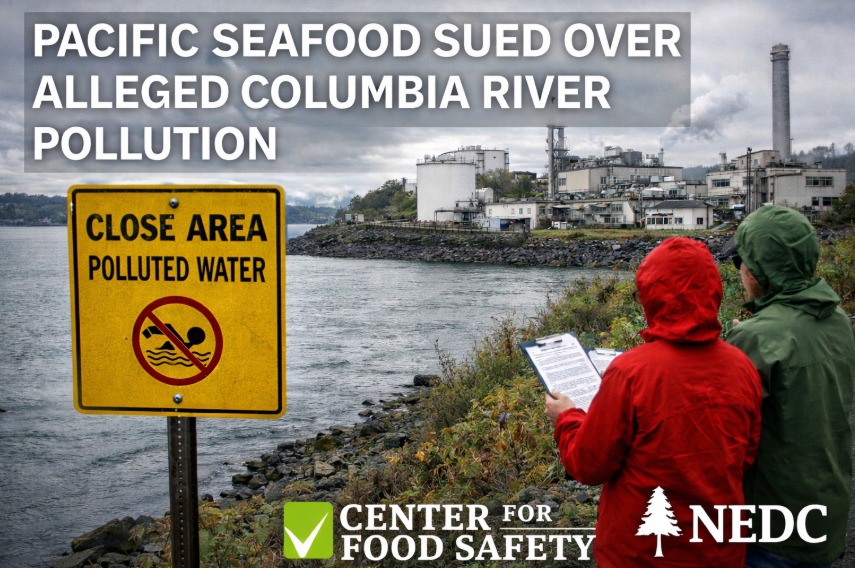
Clean water advocacy groups have filed a federal lawsuit against Pacific Seafood, alleging that one of its Oregon facilities has repeatedly violated pollution limits and monitoring requirements tied to discharges into the Columbia River.
The legal action, brought by the Center for Food Safety (CFS) and the Northwest Environmental Defense Center (NEDC), targets the Pacific Bio Products facility in Warrenton, Oregon, which is owned by seafood and aquaculture company Pacific Seafood. The complaint alleges more than three years of ongoing pollution, with violations stretching back to April 2022.
The lawsuit was filed late Tuesday in Portland and follows a formal notice letter sent in October, which is required before citizen groups can launch a Clean Water Act case. In that letter, the organizations alleged repeated breaches of the facility’s discharge permit issued by the Oregon Department of Environmental Quality, including failures related to pollution discharge limits, monitoring and reporting.
According to the complaint, Pacific Bio Products has violated its permit at least 6,180 times since April 2022. The groups allege that many of the violations were severe, including repeated exceedances involving chlorine levels.
Among the most significant claims are allegations of monthly average total residual chlorine discharges exceeding 4,000% of the permit’s limits. The complaint also points to a reported incident as recently as August 2025, when the facility allegedly discharged more than 73,000% of the permit’s daily chlorine limit.
CFS said the alleged breaches reflect a long-running pattern that has shifted the costs of operations onto the local environment and nearby communities.
“Pacific Seafood has unlawfully and irresponsibly offloaded the costs of its operations onto the environment and local community for years,” said Kingsly A. McConnell, Staff Attorney at Center for Food Safety. “Polluting industrial aquaculture facilities like this one significantly damage the environment and public health. Through this lawsuit, we are demanding accountability.”
The organizations argue that the impacts extend beyond the technical breaches of a permit, affecting the public’s ability to use and enjoy the Columbia River and its surrounding areas. In the complaint, CFS and NEDC say their members’ ability to live and recreate near the facility has been “seriously curtailed” by the repeated violations.
The plaintiffs also allege that continued non-compliance undermines their ability to fulfil their missions, stating that the facility’s refusal to follow its permit requirements prevents the groups from carrying out their education and advocacy work.
The Warrenton facility produces bulk seafood products, including fishmeal and shrimp and crab shell products, which are used as—or in—aquaculture and livestock feed, pet food additives, and fish oils. The groups said they are representing themselves and are also represented by FarmSTAND and the Law Office of Karl G. Anuta, P.C.
NEDC said the case is based in part on reported discharge data that, it claims, shows repeated permit violations over a prolonged period.
“For years, Pacific Seafood has reported discharge data showing it is consistently violating pollution limits in its Clean Water Act permit,” said Jonah Sandford, Executive Director of the Northwest Environmental Defense Center. “These pollution limits are in place to protect sensitive fish and aquatic life, as well as communities that depend on a healthy Columbia River. The hundreds of violations alleged in the Complaint show that the facility is causing real harm to this treasured ecosystem that must be stopped.”
The lawsuit also comes amid broader scrutiny of industrial aquaculture and seafood processing operations in North America, where environmental groups have raised concerns about wastewater discharges, fish escapes, chemical use and the impacts on local ecosystems.
Pacific Seafood and its subsidiaries are described by the plaintiffs as a leading market force in confined industrial fish farming operations. The complaint alleges the company has been polluting the Columbia River for years across multiple facilities, despite public claims about sustainability.
The filing follows separate legal action earlier this year involving other Pacific Seafood-related operations. In July, the Center for Food Safety and Wild Fish Conservancy, alongside Kampmeier & Knutsen, PLLC, filed a lawsuit against another Pacific Seafood-owned company alleging multiple Clean Water Act violations at three commercial net-pen aquaculture facilities on the Columbia River raising rainbow trout.
FarmSTAND, which is acting as counsel in the Warrenton case, said enforcement action is necessary when alleged long-term pollution continues unchecked.
“The law demands that this facility face consequences for many years of egregious pollution of the Columbia River,” said Holly Bainbridge, Senior Staff Attorney at FarmSTAND and counsel for the groups bringing today’s action. “The industrialized form of aquaculture championed by Pacific Seafood can only continue to grow if no one enforces the law, making citizen suits like this one essential in this moment.”
The complaint also outlines broader concerns about industrial aquaculture’s environmental and socioeconomic effects, particularly for communities with longstanding fishing traditions, including Indigenous fishing cultures. The groups argue that facilities can discharge large volumes of untreated waste into waterways, including excess nutrients, heavy metals, antibiotics and chemicals.
They also point to the risks of fish spills and escapes caused by equipment failure, human error or weather. Escaped fish, they argue, can harm wild populations such as salmon by competing for habitat and food, spreading disease, and reducing genetic diversity through inbreeding—effects that can have lasting ecological consequences.
Pacific Seafood has not provided a response in the release to the specific allegations. The lawsuit will proceed through the U.S. legal system, where the plaintiffs may seek court-ordered compliance measures and penalties under the Clean Water Act.
