

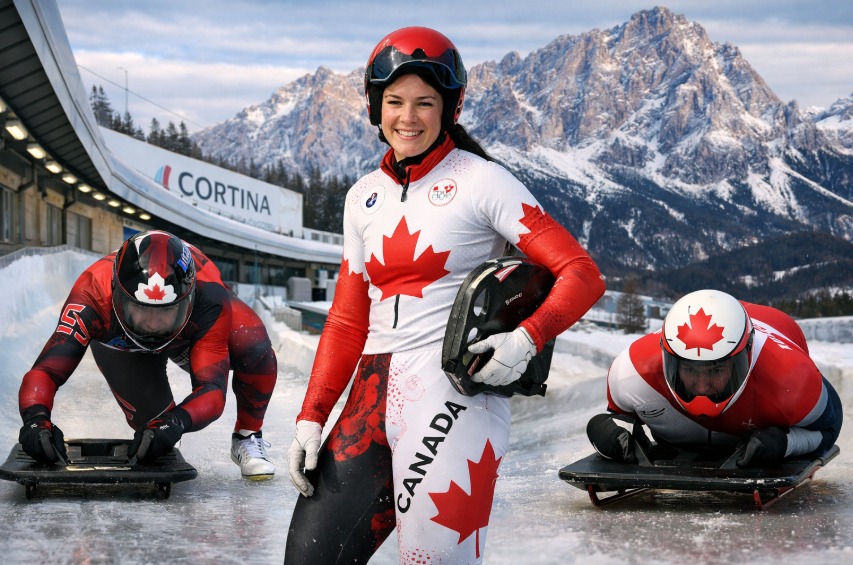
CORTINA, Italy — Canada’s skeleton team delivered a performance defined as much by experience and mentorship as by results this week, with veteran Jane Channell and Olympic rookie Hallie Clarke finishing outside medal contention in a demanding four-run Olympic race that underscored the unforgiving margins of elite sliding sport.
Channell, competing in her third Olympic Games, finished 18th with a combined time of 3:52.96, while Clarke, 21, placed 19th in 3:53.02 at the technically challenging 1,445-metre track in Cortina d’Ampezzo. The competition, staged amid the dramatic peaks of the Dolomites, rewarded consistency across four heats — something both Canadians struggled to maintain.
Channell entered the final day in 15th but slipped three positions after two uneven closing runs.
“There is never a race, unless you win it, that you don’t always want more. There were mistakes, but I did the best I could do,” said Channell on the finish dock. “Overall, it was a fantastic Olympics. To have our family and friends back here watching and the setting in the Dolomites can’t get any better.”
For Clarke, the competition represented both a learning experience and a glimpse of her future potential. After a shaky opening run, she rebounded with stronger performances, including a personal best in her final descent.
“Obviously, I was a bit disappointed,” said Clarke. “I am really proud of how I picked it up today. I had a huge ‘PB’ on the last run so if there is a way to finish my first Olympics it is on that.”
Clarke entered the Games with strong credentials as a two-time World Cup medallist and the only athlete to simultaneously hold senior and junior world championship titles in skeleton — achievements that have positioned her as a key figure in Canada’s next competitive cycle.
“This whole quad I have learned a lot. There has been a lot of highs and a lot of lows,” added Clarke. “This result is unfortunately one of the lows. It’s never what you want in an Olympics, but I’ll chalk this up to more experience that I will bring with me into the next quad.”
While Canada’s women finished mid-pack, the podium was dominated by European veterans. Austria’s Janine Flock captured gold with a combined time of 3:49.02, leading all four runs in a commanding display. Germany’s Susanne Kreher took silver in 3:49.32, followed by teammate Jacqueline Pfeifer, who earned bronze in 3:49.46.
Canada also fielded a young competitor in the men’s race, where Josip Brusic finished 24th with a combined time of 3:52.32. The 23-year-old from Okotoks, Alta., showed flashes of promise, including a personal best in his third run, before losing ground in his final descent.
“I came here in a development mindset,” said Brusic. “I really came here for experience and to get better for next time. I’m going to use everything that I have learned here today to fuel me for the next four years and attack it when I get back here.”
Britain’s Matt Weston won the men’s gold medal in 3:43.33, while Germany’s Axel Jungk secured silver and compatriot Christopher Grotheer took bronze.
Beyond the standings, Canada’s showing reflected a program in transition. Channell, 37, has played a pivotal role mentoring younger sliders such as Clarke and Brusic, helping guide Canada’s rebuilding effort and providing leadership at their first Olympic Games.
“To be a part of their Olympic journey and their beginnings, I am really grateful for the opportunity,” said a tearful Channell. “I can’t wait to see how they will continue to perform and what the next generation will do.”
Her role is not finished yet. Channell is scheduled to compete once more at these Games in the mixed team event alongside Brusic, offering another opportunity to contribute both competitively and as a mentor.
For Canada, the results fell short of podium ambitions, but the experience gained by its younger athletes may prove critical as the country looks ahead to future international competitions and the continued development of its skeleton program.