

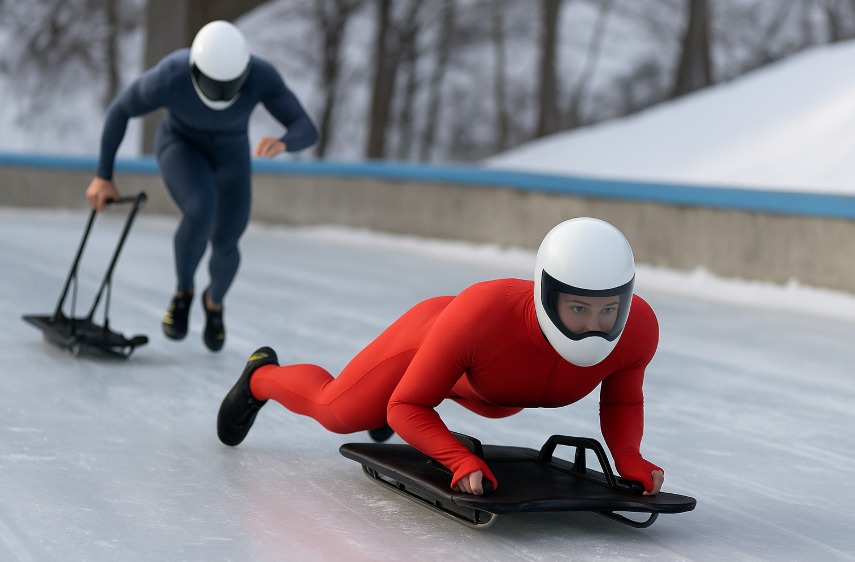
Channell and Clarke to Lead Senior Team into 2026 Olympic Push
CALGARY — Canada’s national skeleton program is accelerating into the 2025–26 Olympic season with a newly named roster, an expanding talent pipeline, and renewed confidence in a team-first, high-performance culture.
Bobsleigh Canada Skeleton (BCS) confirmed its senior and development lineups just days before competition begins, setting the tone for a season the organization describes as pivotal to rebuilding the sport’s national presence and competitiveness on the world stage.
Two-time Olympian Jane Channell and reigning world champion Hallie Clarke will anchor the Senior Skeleton Team as the athletes begin their road to the 2026 Olympic Winter Games. Both are set to open their World Cup seasons on November 21 in Cortina, Italy — the same track slated to host the Olympic event.
Channell, 37, of North Vancouver, enters the season as one of the fastest starters in the sport and a multi-time World Cup medallist. Clarke, a 21-year-old from Brighton, Ont., surged into global prominence last year by becoming the first athlete in skeleton history to simultaneously hold both the Senior and Junior World Championship titles.
The pair will “carry the torch for the Canucks on the elite international stage,” according to BCS, and both have signalled their intention to convert their strong momentum into Olympic qualification. Channell is targeting her third Olympic appearance, while Clarke — already a two-time World Cup silver medallist — is chasing her first.
Head coach and technical lead Joe Cecchini said the newly named roster reflects a strengthened culture and a unified sense of purpose.
“We have worked hard to strengthen our team dynamics and build a shared vision of what it means to be part of the National Skeleton Program. This season will continue to challenge us, unite us, and push the standard of Canada’s skeleton program forward,” Cecchini said.
He emphasized the importance of development at every level to the program’s resurgence.
“Our goal is to achieve our performance objectives as a supportive team, knowing that success at every level sets the benchmark for what the Canadian Skeleton Team represents. Every athlete in our system plays a vital role in shaping our success, and we are proud of each member of the National Team and our extended athlete group as they continue to chase their performance goals.”
Development Pathway Expands Through National Recruitment Drive
In addition to its senior athletes, BCS named Josip Brusic of Okotoks, Alta., to its Development Skeleton Team. Brusic will split his season between the North American Cup and World Cup circuits as he continues climbing the development ladder.
Cecchini’s coaching staff includes former Olympian Kevin Boyer, who brings a decade of experience as a national team athlete, and Micaela Widmer, a former national competitor now serving as development lead. Together, the coaching group is overseeing what BCS describes as its most ambitious recruitment and development strategy to date.
A major contributor has been the organization’s partnership with RBC Training Ground, which has helped identify a record number of prospective athletes for camps and introductory driving schools. As a result, BCS will field 16 athletes on the North American Cup circuit this season — one of the largest development groups in its history.
The men’s group includes Massimo Ardizzoni (Vancouver), Malik Carasco (Mississauga, Ont.), Linus Cornelius (Calgary), Dion Charles (Guelph, Ont.), Zander Greco (St. Albert, Alta.), Ryan Kuehn (Calgary), Ethan Phillips (Windsor, Ont.), Andrew Piderbeisky (Calgary), Sebastien Regnier (Winnipeg, Man.), and Adam Scott (Victoria).
The women’s contingent features Emily Bateman (Desbarats, Ont.), Payton Byrne (Halifax, N.S.), Indy Dorscheid (Grand Prairie, Alta.), Brielle Durham (Ottawa), Julia Hamilton (Barrie, Ont.), and Madeline Parra (Fort Saskatchewan, Alta.).
Three additional athletes were named to the National Athlete Pool — a group working toward key performance thresholds and eligible for international racing opportunities when quota spots become available. That group includes Grace Dafoe (Calgary, Alta.), Kyle Donsberger (Regina, Sask.), and Brayden Posyluzny (Lethbridge, Alta.).
Cecchini said the growing depth is a promising indicator of the sport’s future.
“This is an exciting time in our program’s history with a strong and growing junior movement. We are committed to supporting the development of all athletes in our pathway,” he said.
“This collective group of athletes have created a supportive high-performance daily training and competitive environment that is committed to working hard and being competitive internationally. We look forward to continuing to watch their development and to celebrating their progress throughout this important season.”
Canada’s top athletes will take to the start ramps this week, with Channell and Clarke opening the World Cup season in Cortina on November 21, while a dozen Canadian athletes begin the North American Cup campaign November 20–21 on home ice at the Whistler Sliding Centre.