

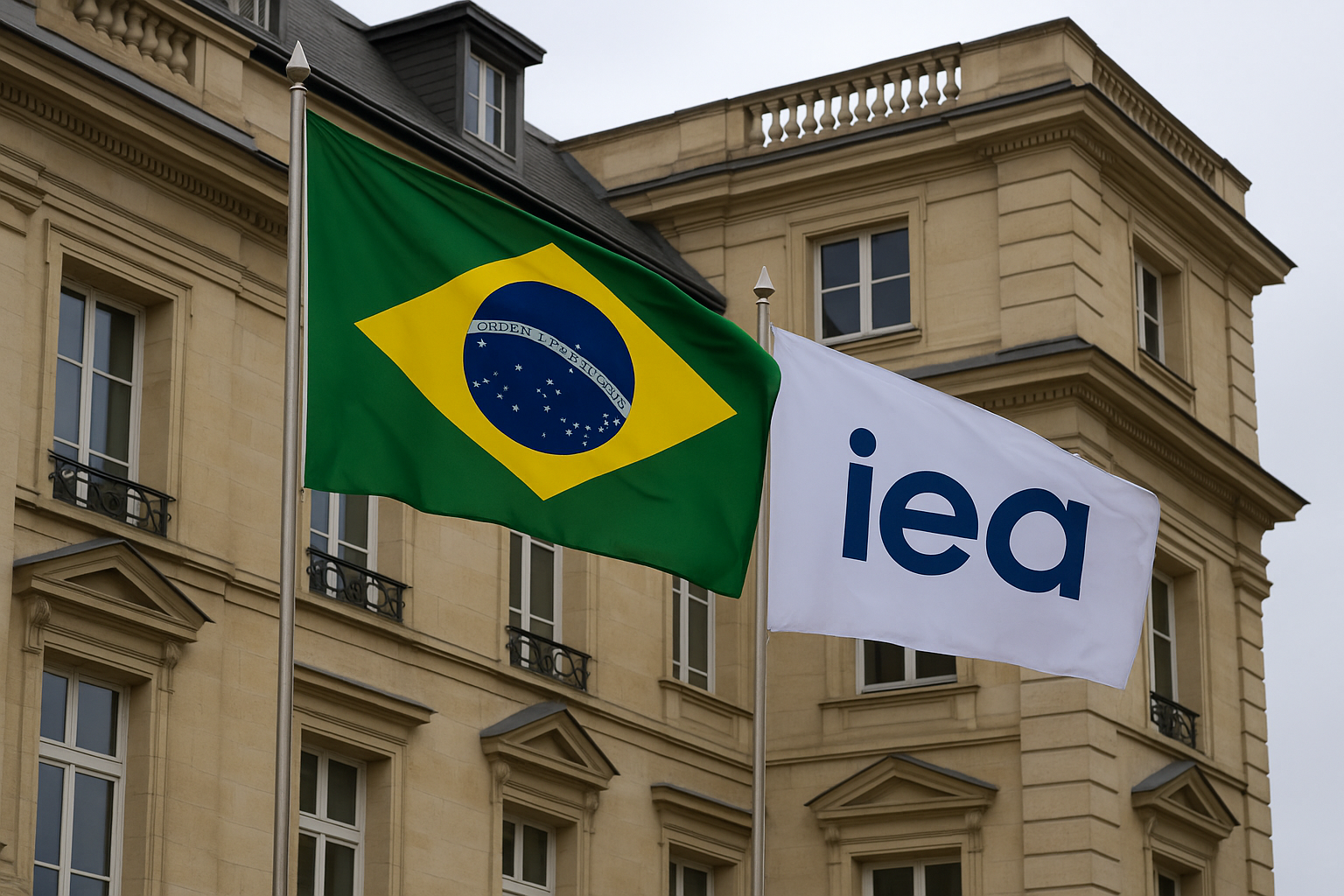
Paris — Brazil has formally requested to join the International Energy Agency (IEA) as a full member, marking a significant shift in global energy governance and further cementing the country’s role as a key player in international energy markets.
The request was delivered in Paris on Tuesday by Ambassador Sarquis J.B. Sarquis to IEA Executive Director Fatih Birol. The move was accompanied by a joint letter from Brazil’s Minister of Foreign Affairs, Mauro Vieira, and Minister of Mines and Energy, Alexandre Silveira, outlining Brazil’s intention to begin the formal accession process.
“Let us convey to you the appreciation of the Brazilian government for the partnership with the International Energy Agency, which has significantly contributed to advancing energy policies in Brazil over the years,” the Ministers said in the letter. “Recognising the challenges that lie ahead in the energy landscape and the strategic support that the IEA provides to its member countries … [we are] pleased to inform you that our government would like to initiate accession procedures to the IEA as a full member.”
Strengthening a Longstanding Partnership
Brazil’s cooperation with the Paris-based agency stretches back more than a decade, with the South American nation joining as an Association country in 2017. Since then, the two sides have collaborated on issues ranging from energy security to data collection and policy analysis. This year, the IEA conducted a comprehensive review of Brazil’s energy policies, further deepening the relationship.
The letter submitted Tuesday emphasized Brazil’s unique position in the global energy system. As “a net oil exporter” with a “diversified energy mix and its increasing leading role in the use of clean and renewable sources,” the country believes its membership would contribute to both the agency’s work and broader international cooperation on energy issues.
Recognition from the IEA
Birol welcomed the development, calling it an important step for the agency.
“I am very happy to have received the formal request from Ministers Vieira and Silveira for Brazil to become a full IEA Member, a major development for international governance that builds on many years of deepening cooperation across a wide range of energy issues,” Birol said. “Brazil is a cornerstone of the global energy system today and its importance is only set to increase in the years ahead. We look forward to discussing next steps with Brazil and our Member governments.”
If admitted, Brazil would become the first Latin American nation to achieve full IEA membership, adding to the agency’s current roster of 32 member states. Four other countries are also in the process of accession, while 13 hold Association status.
Global Context
The timing of Brazil’s request underscores its broader ambitions on the world stage. With more than 210 million people, the country is Latin America’s largest economy and one of its most influential voices on climate and energy issues. It currently holds the Presidency of COP30, the United Nations climate conference, and recently concluded its year-long presidency of the G20 in 2024.
Brazil’s energy profile is particularly notable in a global environment marked by volatility in oil markets and growing calls for climate action. While it remains one of the world’s leading oil exporters, the country also generates the bulk of its electricity from low-emission sources, including hydropower, biofuels, and an expanding portfolio of wind and solar. This dual role as both a fossil fuel producer and renewable energy leader has made Brazil a unique case study in energy transitions.
Implications for International Energy Security
Full membership in the IEA would provide Brazil with a seat at the table in shaping global energy policy at a time when energy security and the clean energy transition are top priorities for governments worldwide. The agency, founded in the wake of the 1970s oil crisis, serves as a key forum for coordinating policy responses, gathering and sharing energy data, and advising on pathways toward net-zero emissions.
For Canada and other IEA members, Brazil’s accession could mean closer collaboration on resource development, renewable energy deployment, and climate commitments. With its vast natural resources and growing renewable capacity, Brazil’s inclusion is expected to strengthen the collective capabilities of the agency.
While the formal accession process can take several years, observers note that Brazil’s long-standing cooperation with the IEA and its alignment with the agency’s priorities may accelerate negotiations. If successful, Brazil’s membership would mark a new chapter in both the agency’s history and in the country’s role as a global energy power.
