

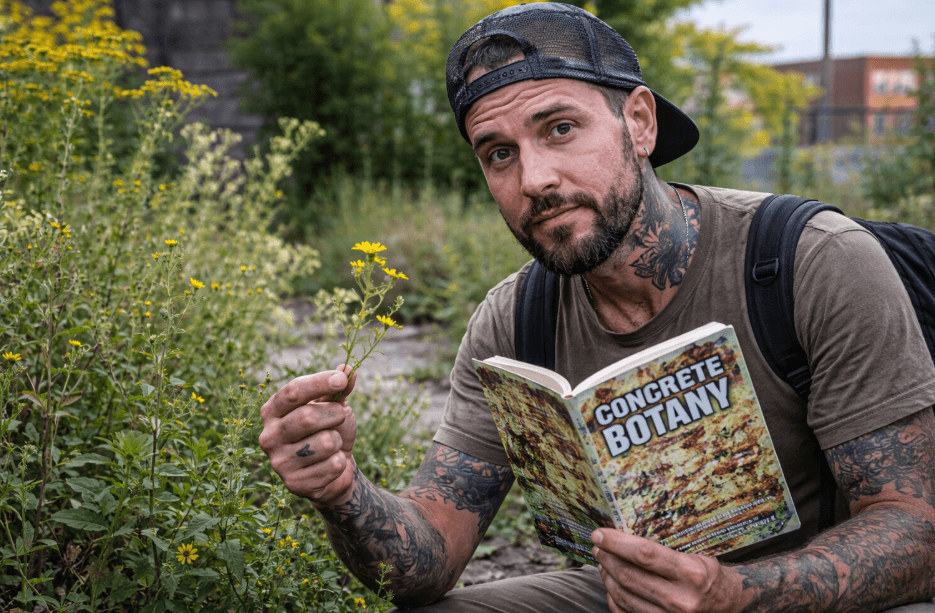
Viral educator reframes urban weeds as resilient survivors in a human-altered world
Joey Santore, the outspoken creator behind the viral educational channel Crime Pays but Botany Doesn’t, is bringing his unconventional take on plant ecology to print with the release of his debut book, Concrete Botany: The Ecology of Plants in the Age of Human Disturbance (Quarto, April 7).
Known for his blunt delivery and deep botanical knowledge, Santore has built a global following by challenging conventional ideas about plants—particularly those dismissed as weeds. In his new book, he expands that message, positioning urban and disturbed environments as critical ecosystems that reflect both the resilience of nature and the scale of human impact.
Santore—dubbed “Botany’s Badass” by Outside—aims to shift public perception about the plants growing in overlooked spaces. Rather than treating them as nuisances, he presents them as highly adaptive species that have evolved to survive in environments shaped by industrialization, urbanization, and climate pressures.
A blend of field guide, commentary and environmental call-to-action
Concrete Botany combines elements of a traditional field guide with cultural critique and ecological advocacy. Santore draws attention to the plant life found in places often ignored—abandoned lots, roadside verges, and sidewalk cracks—arguing that these environments serve as real-time laboratories for understanding evolution and ecological change.
The book explores how certain plant species have thrived under conditions of repeated disturbance, from construction to pollution. By doing so, Santore reframes these species not as ecological outliers but as indicators of broader environmental shifts.
At the same time, he encourages readers to reconsider their role in shaping plant ecosystems. The book suggests that ecological restoration does not have to begin in remote wilderness areas but can start in everyday settings such as backyards, sidewalks, and neighbourhood parks.
Timing aligns with growing interest in native plant ecosystems
The release of Concrete Botany coincides with increased public attention on environmental issues, particularly during April, when both Earth Day and National Native Plant Month are observed. This timing underscores the relevance of Santore’s message as interest in native plant gardening and biodiversity restoration continues to grow across North America.
Santore’s work taps into a broader movement among homeowners, municipalities, and environmental groups seeking to replace ornamental or invasive species with native plants that better support local ecosystems. However, he also challenges simplified narratives around invasive species, urging readers to understand the complex dynamics created by human-altered landscapes.
By highlighting the adaptability of so-called weeds, Santore introduces nuance into discussions that are often framed in binary terms of native versus invasive, instead emphasizing ecological function and resilience.
From punk roots to global audience
A self-taught botanist and former Chicago punk, Santore represents a non-traditional voice in science communication. His rise to prominence through Crime Pays but Botany Doesn’t reflects a broader shift in how audiences engage with educational content—favoring authenticity, humor, and accessibility over formal presentation.
His videos, often filmed in rugged outdoor settings, feature candid, fast-paced explanations of plant biology and ecology. This approach has resonated with a wide audience, helping to demystify complex scientific concepts while maintaining a strong emphasis on accuracy.
Santore has also expanded his reach through television appearances, including segments on WIRED’s Plant Support and WTTW’s Chicago Tonight, where he brings his distinctive mix of humour and scientific insight to mainstream viewers.
Reframing the plants at our feet
At its core, Concrete Botany is an attempt to change how people see the natural world in their immediate surroundings. Rather than viewing cities and developed areas as ecological voids, Santore presents them as dynamic environments where plant life continues to evolve and adapt.
By encouraging readers to pay closer attention to the plants growing in everyday spaces, Santore positions urban ecology as both accessible and relevant. His message suggests that meaningful environmental awareness does not require travel to remote landscapes but can begin with observing what is already present.
As environmental concerns increasingly intersect with urban living, Santore’s perspective offers a reframing of both the problem and the opportunity—highlighting resilience in unexpected places while calling for more thoughtful interaction with the ecosystems people inhabit daily.