

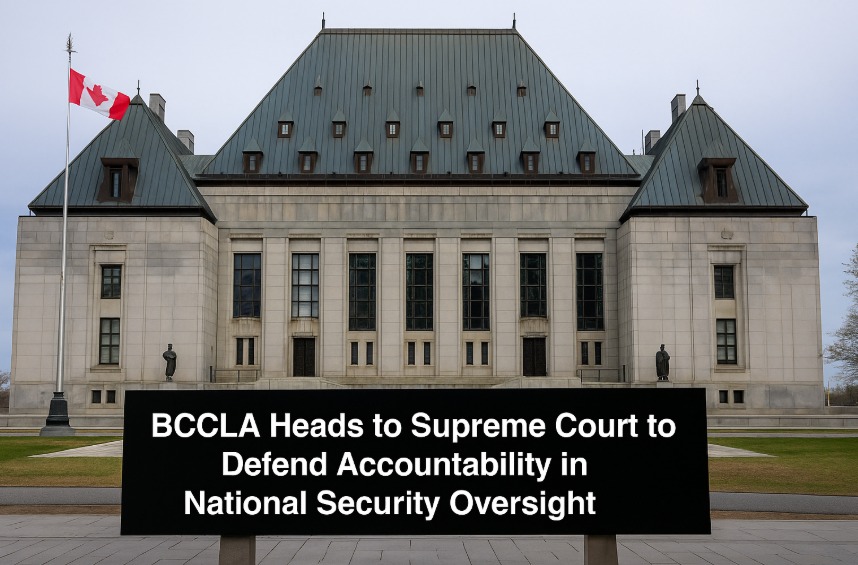
OTTAWA, ON — The BC Civil Liberties Association (BCCLA) will appear before the Supreme Court of Canada this week in a landmark constitutional case examining the limits of parliamentary privilege and transparency in national security oversight.
From November 5 to 6, 2025, the association will intervene in Alford v. Canada, a case that challenges the constitutionality of Section 12 of the National Security and Intelligence Committee of Parliamentarians Act (NSICPA). The provision in question allows for criminal penalties — including imprisonment — for members of Parliament who disclose classified information obtained through their oversight roles.
The BCCLA argues that such restrictions undermine the fundamental principles of parliamentary accountability and freedom of expression that underpin Canada’s democratic system. The hearings will take place at the Supreme Court of Canada, located on unceded Anishinabe Algonquin Territory in Ottawa.
A Constitutional Challenge Rooted in Oversight
The dispute originated when Ryan Alford, a law professor at Lakehead University, filed a constitutional challenge to Section 12, arguing that Parliament overstepped its authority by limiting the constitutionally protected right of freedom of speech and debate within Parliament without formally amending the Constitution.
Alford’s challenge was initially successful at the trial level, where the court found that the impugned provision conflicted with parliamentary privilege — a centuries-old legal doctrine protecting legislators from prosecution for statements made in the course of parliamentary work. However, the decision was later overturned by the Ontario Court of Appeal, prompting Alford and supporting organizations, including the BCCLA, to take the issue to the nation’s highest court.
The BCCLA, appearing as an intervener, will focus its arguments on the broader principles of accountability and transparency in national security oversight. The organization contends that these principles are essential to democratic governance and must be protected through the maintenance of robust parliamentary privilege.
Defending Accountability and Transparency
“Accountability and transparency are at the core of the constitutional protection of parliamentary privilege,” the BCCLA stated in its media advisory. The group’s legal team will argue that the Supreme Court must interpret the NSICPA in a manner that upholds these foundational values — particularly given the sensitive nature of national security operations and their impact on civil liberties.
The National Security and Intelligence Committee of Parliamentarians (NSICOP) was established in 2017 to provide oversight of Canada’s intelligence and security agencies, including the Canadian Security Intelligence Service (CSIS), Royal Canadian Mounted Police (RCMP), and Canada Border Services Agency (CBSA). While the committee was designed to strengthen transparency in the country’s national security framework, the accompanying confidentiality provisions — which make it a criminal offence to disclose certain information — have raised concerns among legal scholars and civil liberties advocates.
The BCCLA argues that these restrictions could deter members of Parliament from exposing serious wrongdoing, such as rights violations or misuse of power within Canada’s intelligence community.
“Members of Parliament should not face potential imprisonment for acting as whistleblowers if they expose serious wrongdoing on the part of Canada’s national security apparatus,” the association said.
A Timely Case Amid Expanding Security Powers
The case comes as the federal government moves to expand the authority of intelligence and law enforcement agencies through proposed legislation such as Bill C-2, which seeks to extend CSIS and police powers in response to new security challenges.
Vibert Jack, Litigation Director for the BCCLA, emphasized the heightened importance of oversight in this context.
“Meaningful oversight of our national security and intelligence organizations is critical for the protection of everyone’s rights in Canada,” said Jack. “With the government’s recent efforts to drastically expand the powers of police and CSIS through Bill C-2, it is more important than ever to have transparency and accountability.”
The organization maintains that weakening parliamentary privilege in the area of national security oversight would set a dangerous precedent, potentially limiting Parliament’s ability to hold executive and security agencies accountable to Canadians.
Legal Representation and Broader Implications
The BCCLA is represented by Michael Fenrick and Mannu Chowdhury of Paliare Roland Rosenberg Rothstein LLP, a Toronto-based firm with a record of involvement in constitutional and public law litigation.
Observers note that the outcome of the case could have far-reaching implications for both parliamentary democracy and Canada’s national security framework. If the Supreme Court rules in favour of restoring parliamentary privilege protections, the decision may reinforce legislators’ independence from executive interference and reaffirm the constitutional safeguards surrounding speech in Parliament.
Conversely, upholding the current provisions could further entrench secrecy within Canada’s intelligence oversight regime, heightening concerns about the balance between transparency and security.
A Test of Democratic Accountability
For the BCCLA and other civil society organizations, Alford v. Canada represents a defining test of Canada’s constitutional architecture. As government agencies continue to expand their surveillance and enforcement capabilities, the association argues that protecting parliamentary independence and ensuring transparency in oversight are vital to maintaining public trust.
The Supreme Court’s ruling, expected in 2026, will help clarify the boundaries between national security confidentiality and parliamentary privilege, shaping the future of democratic accountability in Canada’s evolving security landscape.
