

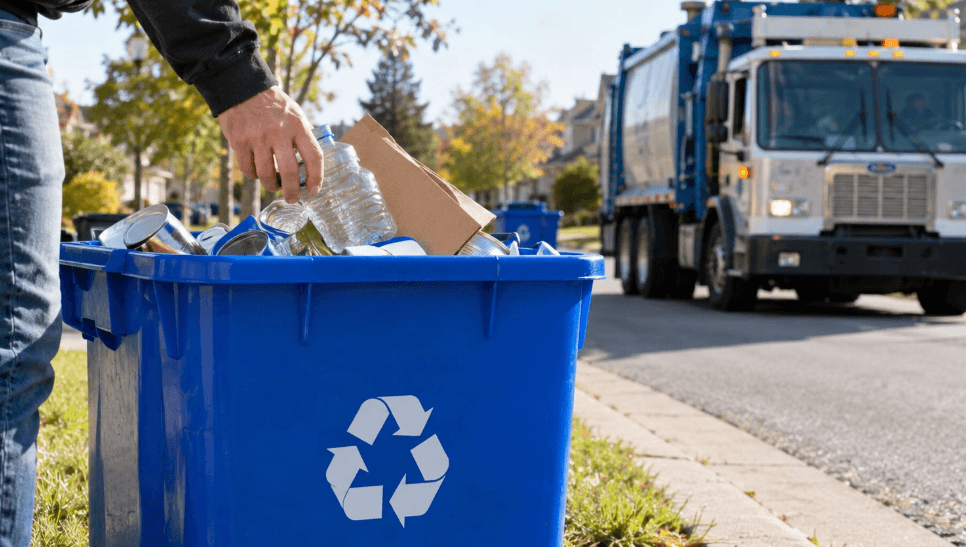
TORONTO, The Ontario government is proposing legislative and regulatory changes to its provincewide Blue Box recycling program aimed at improving financial transparency, strengthening accountability and making recycling costs more predictable for businesses responsible for packaging and paper products.
The proposed measures would introduce greater oversight of producer responsibility organizations (PROs), establish clearer reporting requirements and address rising operating costs while maintaining recycling services for more than five million households across Ontario.
The announcement comes as businesses face continued economic uncertainty, including pressure associated with U.S. tariffs, prompting the provincial government to pursue measures intended to reduce regulatory burdens and support investment.
Ontario Seeks Greater Oversight of Recycling Costs
Ontario’s Blue Box program has transitioned to a producer-funded and operated model, under which businesses that supply packaging and paper products are responsible for financing collection and recycling services.
Multiple producer responsibility organizations compete to deliver these services on behalf of participating businesses.
However, increasing program costs have raised concerns about financial predictability and the long-term sustainability of the system.
“Our government is committed to a Blue Box system that ensures Ontario’s small- and medium-sized businesses have the tools they need to forecast and manage their costs more effectively,” said Todd McCarthy, Minister of the Environment, Conservation and Parks. “By bringing greater transparency and accountability to the program, these measures will help deliver more predictability and more sustainability for the long term — while ensuring that producers, and not taxpayers, remain responsible for the waste they create.”
Proposed Legislation Would Address Producer Fees
Under proposed amendments to the Resource Recovery and Circular Economy Act, Ontario would gain authority to regulate contractual arrangements between producers and PROs.
This could include oversight of fees charged for collecting, transporting and processing recyclable materials.
The government says the proposed framework is intended to establish more consistent contract terms, improve cost disclosure and reduce unexpected financial obligations for participating businesses.
Greater fee predictability could be particularly important for smaller companies operating with limited financial flexibility.
The legislation would require approval before the proposed changes could take effect.
New Reporting and Collection Standards Under Consideration
Ontario’s Ministry of the Environment, Conservation and Parks also plans to consult recycling industry stakeholders, producers, PROs and the public on additional regulatory measures.
Transparency and Operational Efficiency
The consultation will examine stronger financial reporting requirements to provide businesses with clearer information about recycling fees and operating expenditures.
Officials will also consider standardized service requirements, including how recycling carts and bins are allocated to households.
These measures are intended to improve accessibility for residents while allowing recycling organizations to identify operational efficiencies.
Another area under review involves the future collection of flexible plastic packaging, which can be more difficult to recycle than conventional paper and rigid containers.
The province has not announced a final timeline for implementing these potential collection changes.
Ontario Reviews Blue Box Governance Structure
Beyond financial and operational reforms, the government is considering changes to the program’s administrative structure.
One option involves replacing the current administrator with a new independent administrator to strengthen accountability and minimize potential conflicts of interest.
The proposed reforms follow measures introduced in September 2025 to stabilize recycling costs and reduce administrative requirements.
Those earlier changes included gradually phasing in recovery targets for flexible plastics, giving participating businesses and recycling operators additional time to adjust.
Business Competitiveness Remains a Government Priority
The province has positioned the proposed Blue Box reforms within its broader strategy to reduce business costs and maintain Ontario’s competitiveness amid economic uncertainty.
“Ontario’s competitiveness depends on creating an environment where businesses can invest, grow and create jobs. By reducing red tape and helping to lower unnecessary costs, we are building the most competitive, resilient and self-reliant economy in the G7.”
– Andrea Khanjin
Minister of Red Tape Reduction
Ontario’s recycling system currently serves more than five million households. Brand owners, importers and retailers are responsible for funding and operating the program, rather than municipal taxpayers.
Residents in communities with Blue Box services can also recycle materials from a standardized provincial list of eligible paper, packaging and single-use products.
The proposed changes are intended to preserve those services while giving businesses greater visibility into program expenditures.
Their eventual impact will depend on the final legislation, regulatory requirements and consultation outcomes, including whether stronger financial oversight can contain costs without compromising recycling performance across the province.
Discover more from Wire Service Canada
Subscribe to get the latest posts sent to your email.