

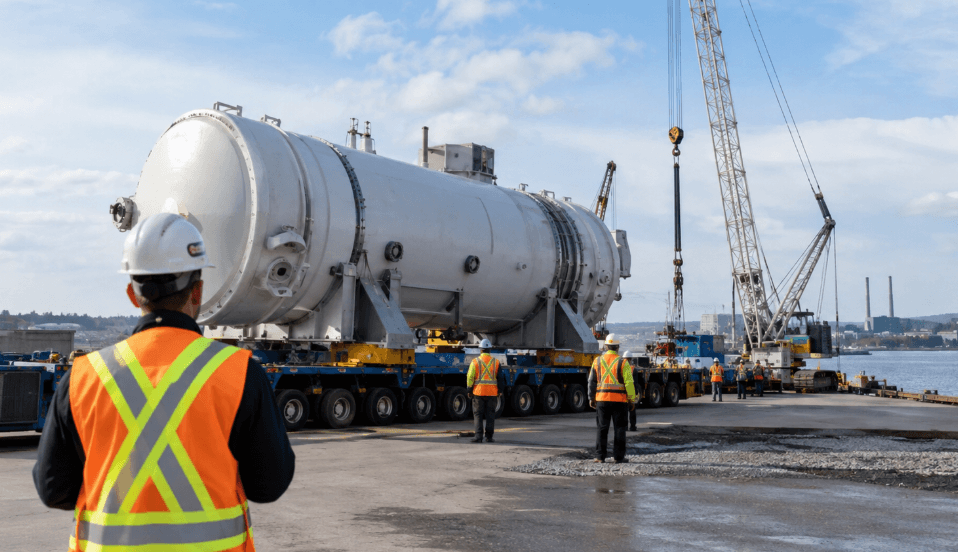
Ontario’s nuclear supply chain is set to play a central role in a new energy project in New Brunswick, with BWXT Canada selected to fabricate and deploy advanced reactor technology for what is planned to become Canada’s first Transportable Nuclear Power Plant.
The 50-megawatt Indigenous-led pilot project in Belledune, New Brunswick, is expected to create more than 150 jobs during development and approximately 40 permanent positions once operational. The facility is designed to provide reliable baseload electricity for as many as 40,000 homes.
Ontario Nuclear Expertise to Support New Brunswick Energy Project
Ontario Energy and Mines Minister Stephen Lecce and New Brunswick Deputy Premier René Legacy announced the selection of Ontario-based BWXT Canada for the project.
The facility will use the BWXT Advanced Nuclear Reactor, or BANR, technology as part of a Transportable Nuclear Power Plant developed by Prodigy Clean Energy.
“Ontario is a world leader in nuclear technology, from building the G7’s first grid-scale small modular reactor to delivering major nuclear refurbishment projects ahead of schedule and under budget,” said Stephen Lecce, Minister of Energy and Mines. “We’re building on that legacy and proud to announce that Ontario’s nuclear supply chain is being harnessed to build Canada and the G7’s first commercial Transportable Nuclear Power Plant. This is the future of reliable, clean energy for remote and northern communities – including mines – connecting them to reliable baseload power virtually anywhere. Ontario’s nuclear expansion plan will create 150,000 jobs, securing our position as a global leader in the development of next generation nuclear technology.”
Unlike conventional nuclear generating stations, transportable nuclear plants are designed to be largely built off site before being transported to locations where electricity is required.
The approach could expand the use of nuclear power in northern and remote communities, Indigenous communities, industrial operations and grid-connected sites where conventional energy infrastructure can be challenging or costly to develop.
Indigenous-Led Facility Planned for Belledune
Under agreements with Pabineau First Nation and Eel River Bar First Nation, the pilot is expected to establish a First Nations-owned commercial power generation facility and energy innovation campus in Belledune.
Plans also include a centralized hub for operations, maintenance and workforce training that could support a future fleet of transportable nuclear power plants. An Indigenous Energy Innovation Visitor Centre is also planned.
“By launching the first Indigenous-led nuclear project in Canada and building the supply chain in New Brunswick, we are showcasing the strength and leadership of the province, First Nations, and our nuclear-trained workforce,” said René Legacy, Deputy Premier and Minister of Finance, Treasury Board and Energy. “I am encouraged by potential for this innovative project to drive significant economic growth in the region and provide clean energy for communities across New Brunswick, throughout Canada, and around the world. Northern New Brunswick has a rich industrial history, and the quality of work has always been first class. Our workers are ready to contribute – to help make this deployment a success.”
Companies Target Wider Market for Transportable Nuclear Power
BWXT and Prodigy see the New Brunswick project as a potential foundation for broader commercial deployment.
“The BWXT team is designing BANR to meet a variety of real-world heat and electricity demands that currently cannot be met without the use of carbon-emitting sources with complex fuel logistics. By joining forces with Prodigy and integrating BANR with Prodigy’s transportable platform design, we are truly expanding BWXT’s horizons for future customers while reinforcing Canada’s role at the forefront of innovative, deployable advanced nuclear energy solutions.”
– John MacQuarrie, President of Commercial Operations, BWXT
“BWXT’s BANR is a best-in-class advanced nuclear technology with a credible pathway to delivering the G7’s first commercially operating Transportable Nuclear Power Plant. This Canadian pilot will serve as the reference to deploy a BANR-TNPP fleet across Northern, industrial and global energy markets.”
– Mathias Trojer, President and CEO, Prodigy Clean Energy
Kinectrics is also supporting the program with engineering and regulatory expertise.
“We are supporting this Canadian-led program with the engineering depth, regulatory insight and proven delivery experience needed to advance Prodigy’s TNPPs to commercial implementation. We bring scale and trust to the project’s supply chain, combining decades of Canadian nuclear expertise with strong manufacturing capabilities, qualified facilities and skilled people with a demonstrated track record.”
– John D’Angelo, President and CEO, Kinectrics
Ontario Expands Nuclear Investment as Electricity Demand Rises
The project comes as Ontario increases investment in nuclear generation under its integrated energy strategy, Energy for Generations. Provincial initiatives include refurbishment work at the Darlington and Pickering nuclear generating stations and development of a grid-scale small modular reactor.
Ontario says its broader nuclear expansion could create 150,000 jobs and contribute $800 billion to the Canadian economy. The province’s existing nuclear sector supports approximately 80,000 jobs across more than 200 companies, while more than 90 per cent of nuclear project spending remains in Canada.
The Independent Electricity System Operator forecasts Ontario electricity demand could increase by as much as 90 per cent by 2050, driven by population growth, housing development, electrification, advanced manufacturing and expansion of critical-minerals supply chains.
Nuclear generation currently supplies roughly half of Ontario’s electricity. The Belledune project could now provide another test of how Canadian nuclear expertise can be adapted to smaller, transportable systems intended for communities and industrial operations that require dependable power in locations where traditional infrastructure is difficult to deploy.