

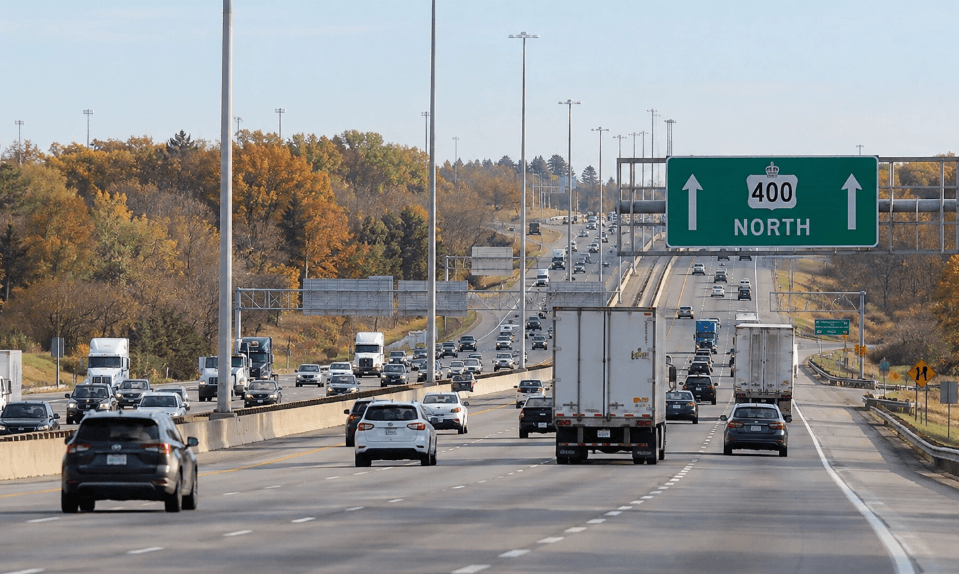
Ontario is moving ahead with another major expansion of Highway 400, awarding a detailed design contract for an 11-kilometre stretch that will widen the highway from six to 10 lanes between Highway 9 and the future Bradford Bypass, also known as Highway 425.
The project is intended to increase capacity along one of the province’s busiest transportation and commercial corridors, while improving traffic flow for commuters and the movement of goods through the Greater Toronto Area and beyond.
AECOM Awarded Highway 400 Design Contract
AECOM has been awarded the detailed design contract for the expansion. Plans call for one additional general-purpose lane and one high-occupancy vehicle (HOV) lane in each direction.
The new HOV lanes will connect with the existing network south of Highway 9, extending dedicated carpool capacity farther north. Design work will also cover culverts, drainage and storm sewers, lighting, signage and interchange ramps.
“Under the leadership of Premier Ford, our government is building the highway capacity Ontario needs to tackle gridlock and keep our economy moving,” said Prabmeet Sarkaria, Minister of Transportation. “Advancing the widening of Highway 400 will help get drivers where they’re going faster, strengthen a critical trade corridor and keep people and goods moving in the Greater Toronto Area.”
Expansion Builds on Previous Highway 400 Work
The province recently completed the widening of nine kilometres of Highway 400 between Major Mackenzie Drive and King Road. Ontario is also replacing the Dunlop Street bridge in Barrie to accommodate future widening of the highway.
Stephen Lecce, MPP for King-Vaughan, said the latest project represents the next stage of the province’s expansion plans.
“We cut the gas tax by 10 cents per litre, at the very time that we completed a 10-lane expansion of highway 400 — saving you time and money. Less than a year ago, Ontario completed the widening of Highway 400 from Major Mackenzie Drive in Vaughan to Highway 9 in King. We are taking the next step forward by expanding Highway 400 north of Highway 9, reducing debilitating gridlock for families in King and Vaughan.”
Susan Lahey, MPP for York-Simcoe, highlighted the highway’s importance for commuters.
“For families and commuters across York-Simcoe, Highway 400 is an essential part of getting to work, getting home, and staying connected to communities across the region. Widening this important corridor will reduce commute times, improve traffic flow, and support the continued growth of our communities. I’m pleased to see our government is taking this important next step.”
Businesses Point to Highway 400’s Economic Importance
Highway 400 serves as a major north-south route connecting communities in southern and northern Ontario. The corridor supports commuters and tourism while carrying significant commercial traffic and goods across the province.
Abdus Samad, vice president of government affairs and strategic initiatives at the Vaughan Chamber of Commerce, said congestion creates direct costs for businesses.
“For Vaughan businesses, congestion on Highway 400 means delayed shipments, higher costs and longer commutes for employees. This announcement is an important step toward strengthening a corridor our manufacturers, distributors and other employers rely on. We welcome the province’s investment in the transportation capacity needed to support business growth and keep Ontario competitive.”
Steven Crombie, senior director of public affairs at the Ontario Road Builders’ Association, said congestion has broader economic consequences.
“Highway 400 is one of Ontario’s most important economic corridors, connecting communities and moving people and goods across the province. With congestion costing Ontario more than $56 billion annually, widening this critical stretch of Highway 400 will help reduce gridlock, improve the movement of goods and support Ontario’s continued growth. ORBA welcomes this important step toward construction and looks forward to working with the government to deliver the infrastructure Ontario needs.”
Part of Ontario’s $31-Billion Transportation Program
The Highway 400 project forms part of Ontario’s broader $31-billion investment to build, repair and expand highways, roads and bridges across the province. Other major projects include Highway 413, the Bradford Bypass and the Garden City Skyway twin bridge.
Major construction on the Bradford Bypass began in May 2026. The planned highway will ultimately connect Highway 400 and Highway 404, creating another east-west transportation link through the fast-growing region north of Toronto.
Raly Chakarova, executive director of the Toronto and Area Road Builders Association, said the Highway 400 expansion could also support employment in Ontario’s construction sector.
“Continuing the expansion of Highway 400 is an important investment for the transportation network the Greater Toronto Area needs. Building this infrastructure also means building opportunity here at home, creating skilled jobs and supporting Ontario contractors, suppliers, and the broader construction workforce.”
With detailed design now advancing, the Highway 400 widening represents another step in Ontario’s long-term effort to increase transportation capacity around the GTA while supporting population growth, commercial traffic and regional economic activity.