

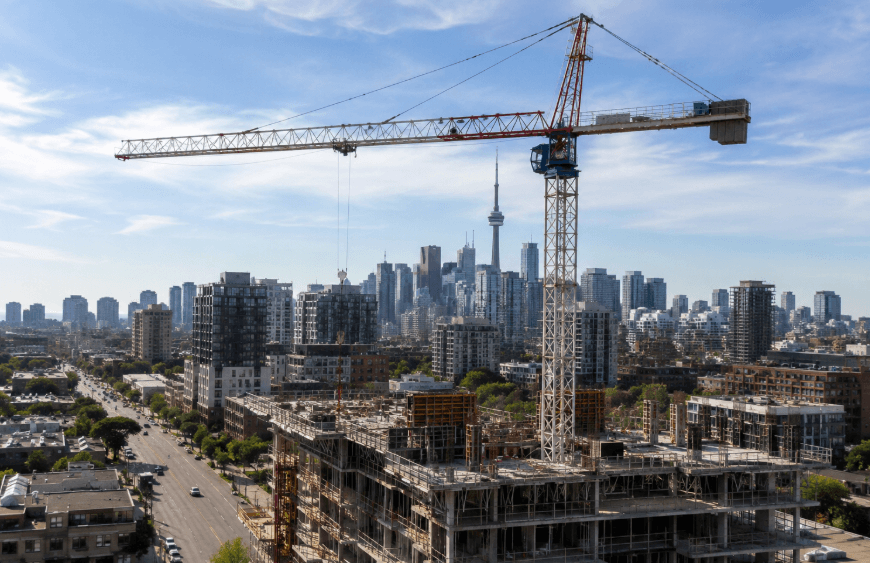
Funding agreement expected to unlock 44,000 new homes while reducing construction costs by up to $83,000 per unit
TORONTO — The federal and Ontario governments have committed up to $1.5 billion to the City of Toronto through the Development Charge Reduction Program (DCRP), a move aimed at accelerating housing construction, lowering development costs and supporting critical infrastructure projects across Canada’s largest city.
The announcement was made Monday by Ontario Premier Doug Ford, federal Housing and Infrastructure Minister Gregor Robertson and Toronto Mayor Olivia Chow.
The funding recognizes Toronto’s commitment to reducing development charges by between 40 and 60 per cent across a range of residential housing types for a minimum of three years. The governments say the measure is intended to improve project viability, stimulate housing construction and support infrastructure needed to accommodate future growth.
“Our government is doing everything we can to lower costs for families, keep workers on the job and get shovels in the ground faster on new homes,” said Premier Ford. “Combined with our historic 13 per cent cut to the HST on new homes, today’s agreement will lower the cost of building new homes by more than $200,000 in Toronto, getting more shovels in the ground and creating thousands of good-paying construction jobs in the process.”
Development charge cuts expected to unlock thousands of homes
Toronto estimates that reducing development charges and investing in housing-enabling infrastructure will help unlock more than 44,000 new housing units while providing approximately $1.95 billion in relief for homebuilders.
According to government estimates, development charge reductions alone will generate approximately $83,000 in savings on the construction of a new single or semi-detached home.
“Together, we’re building Ontario and Canada strong,” said Minister Robertson. “By partnering with Ontario, the federal government is helping speed up housing construction by lowering upfront costs and investing in housing-enabling infrastructure projects — building strong, resilient communities that boost housing supply and drive economic opportunities.”
The reduced development charge rates will apply differently depending on housing type. Ownership and rental projects with larger units, including single-detached, semi-detached and multi-bedroom apartments, will receive a 60 per cent reduction. One-bedroom and bachelor units will receive a 40 per cent reduction.
The reductions are subject to approval by Toronto City Council and must remain in effect for at least three years under program requirements.
“People should be able to afford a home in our city. Today’s announcement will make that easier while creating tens of thousands of good jobs in Toronto,” said Mayor Chow. “Through our strong partnership with the provincial and federal government, we’re reducing the cost of building new homes and ensuring the city can keep investing in the infrastructure we need to support communities.”
Infrastructure investments tied to housing growth
The $1.5 billion funding commitment is expected to support a broad range of infrastructure projects designed to facilitate housing development throughout Toronto.
Planned investments include the purchase of additional buses to accommodate growing transit demand, modernization of Line 2 signalling to improve service frequency, watermain expansions in the Lower Don Lands and south Leslieville, and major transportation upgrades across the city.
Other proposed projects include the Liberty Village New Street initiative, reconstruction of the Scarlett Road railway bridge overpass, widening of Steeles Avenue East, improvements to John Street’s pedestrian corridor, the Broadview Avenue south extension, and a new road connection extending Tradewind Avenue north to Sheppard Avenue East.
The funding forms part of a broader Canada-Ontario Partnership to Build announced earlier this year. In March 2026, the two governments agreed to provide a combined $8.8 billion over 10 years for infrastructure investments across Ontario. The federal share will be delivered through the Build Communities Strong Fund.
The partnership also includes the temporary removal of the full HST on new homes between April 1, 2026, and March 31, 2027. Governments estimate the measure could save homebuyers up to $130,000 on a newly built home, in addition to savings generated through development charge reductions.
Industry groups welcome affordability measures
The announcement drew support from municipal leaders, housing organizations and industry groups that have long argued development charges are a major contributor to rising housing costs.
Ontario Municipal Affairs and Housing Minister Rob Flack said, “We know that it costs too much and takes too long to build new homes in Ontario. Our government will continue to work with our municipal and federal partners to break down these barriers and get more homes built.”
Scott Andison, chief executive officer of the Ontario Home Builders’ Association, described the agreement as a practical response to housing supply challenges.
“Today’s announcement is a significant step toward restoring housing affordability and getting more homes built in Toronto,” Andison said. “By reducing development charges by 40 to 60 per cent and providing $1.5 billion in support to the City of Toronto, governments are helping remove one of the biggest barriers to housing delivery.”
Similarly, Dave Wilkes said the initiative would improve project viability and increase residential construction activity throughout the city.
Industry advocates have repeatedly pointed to development charges as one of the largest government-imposed costs embedded in new housing. Supporters of the DCRP argue that lowering those charges, while funding the infrastructure municipalities need to support growth, could help improve affordability and accelerate housing construction at a time when Toronto continues to face significant housing supply pressures.
The Development Charge Reduction Program will provide funding over the next decade, with municipalities required to contribute at least 10 per cent of project costs and maintain qualifying development charge reductions to remain eligible.