

Innovative Stroke Care Helps Maple Ridge Resident Recover and Reduce Future Risk
A Maple Ridge man who suffered a stroke at just 37 years old is sharing his experience as physicians at Royal Columbian Hospital highlight the role of advanced technology and innovative treatment in reducing the risk of future strokes among younger patients.
Collin Smith vividly remembers the morning his life changed.
“It was last fall and I was warming up our car while my wife buckled our daughter into her car seat,” says the 37-year-old Maple Ridge resident.
“My fingers started going numb and my face felt like it was drooping,”
Smith was quickly treated by the regional stroke team at Royal Columbian Hospital. Initial assessments suggested he may have experienced a transient ischemic attack (TIA), commonly referred to as a “mini-stroke,” in which blood flow to the brain is temporarily interrupted and symptoms generally disappear within 24 hours.
However, further investigations revealed a more serious diagnosis. Physicians determined that Smith had suffered a stroke and discovered he also had a patent foramen ovale (PFO), a small opening between the upper chambers of the heart that failed to close after birth.
While PFOs are relatively common and often harmless, they can increase the risk of stroke by allowing small blood clots to bypass the lungs and travel directly to the brain.
Heart Defect Linked to Stroke Risk in Younger Adults
According to specialists at Royal Columbian Hospital, identifying and treating PFOs can significantly reduce the likelihood of recurrent strokes in younger patients.
“We know that PFO is linked to stroke in relatively young adults,” says Dr. Razi Khan, interventional cardiologist at Royal Columbian Hospital. “If we can detect and close PFOs and monitor the effectiveness of doing so, we can reduce the risk of subsequent stroke in people under 60 by 40-to-50 per cent over the course of their lifetime.”
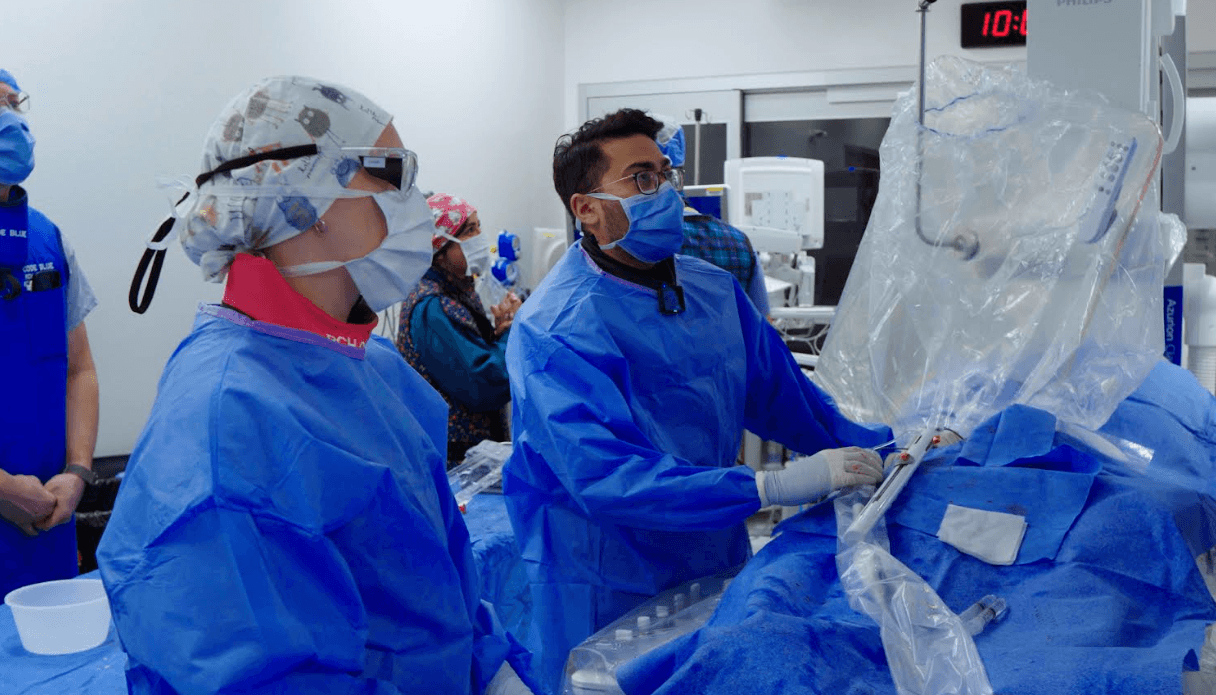
On April 29, Dr. Khan and Dr. Greg Walker, an interventional neurologist, led a procedure to close the opening in Smith’s heart using a small implanted device often described as resembling an Oreo cookie.
The minimally invasive procedure was performed while Smith remained awake. During the intervention, clinicians employed advanced robotic-assisted transcranial Doppler technology, known as robotic TCD, to monitor blood flow to the brain in real time.
AI and Robotics Enhance Detection and Treatment
The robotic TCD system combines artificial intelligence and robotic technology to provide highly sensitive monitoring of blood flow. Clinicians say it can detect even very small openings around the heart that may be missed by more conventional diagnostic methods.
The technology allows physicians to evaluate whether any residual blood flow continues to pass between the right and left sides of the heart following a repair procedure, a phenomenon known as residual shunting.
“Robotic TCD helps us better understand the communication between the left and right side of the heart—known as residual shunting—and by eliminating it, we can more effectively reduce the risk of future strokes,” says Dr. Walker. “It also eliminates the need for more invasive testing.”
Royal Columbian Hospital is among the first healthcare facilities in Canada to incorporate the technology into stroke care, reflecting a growing trend toward using AI-supported diagnostic tools to improve patient outcomes.
Donor Support Helps Bring New Technology to Patients
Hospital officials say philanthropic support played a key role in making the advanced equipment available.
“Every donation helps create opportunities to advance patient care through innovation,” says Jeff Norris, president and CEO, Royal Columbian Hospital Foundation. “The transcranial doppler used in Collin’s care was made possible through donor support and is one example of how philanthropy helps equip Royal Columbian Hospital with the tools and technology needed to deliver specialized treatments and improve outcomes for patients.”
The investment comes as healthcare providers prepare for growing demand for stroke services across the region.
Fraser Health currently sees 37 per cent of all stroke occurrences in British Columbia, and that share is expected to rise to 40 per cent by 2040, underscoring the need for advanced treatment options and continued innovation in stroke prevention and recovery.
Looking Ahead After Recovery
Following his treatment and recovery, Smith says he is grateful for the medical advances that were available when he needed them most.
The successful closure of the PFO has significantly reduced his risk of experiencing another stroke and may also provide benefits for other aspects of his health.
“Technology is moving so quickly,” he says. “It’s a relief to know that this may help prevent a future stroke and possibly even assist with some of my other health issues.”
For Smith, what began as a frightening and unexpected medical emergency has become a reminder of how rapidly evolving healthcare technologies, combined with expert clinical care, can improve outcomes and help patients move forward with confidence.
Discover more from Wire Service Canada
Subscribe to get the latest posts sent to your email.