

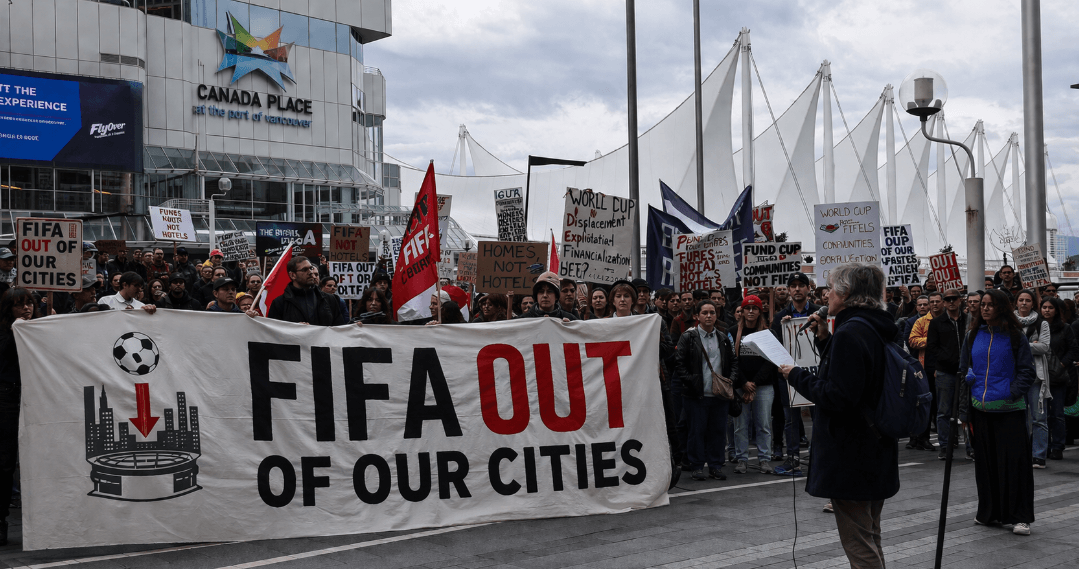
Demonstrators raise concerns over housing, labour, and human rights amid World Cup preparations
Rally coincides with FIFA Congress at Vancouver Convention Centre
Hundreds of demonstrators gathered outside Canada Place in Vancouver on Wednesday, voicing opposition to the social and economic impacts of FIFA’s upcoming World Cup events as delegates convened privately at the nearby Vancouver Convention Centre for the 76th FIFA Congress.
The protest, organized by an Anti-FIFA coalition, took place on the unceded territories of the Musqueam, Squamish and Tsleil-Waututh Nations. Participants criticized the international governing body for its alleged role in exacerbating housing instability, labour concerns, and human rights issues locally and abroad.
Speakers at the rally argued that preparations for the 2026 FIFA World Cup are already placing strain on vulnerable communities. They pointed to displacement, increased policing, and restrictions on public space as early indicators of broader impacts expected as the tournament approaches.
“The presentation of a ‘clean’ and ‘welcoming’ environment for tourists depends on an organized campaign of displacement and criminalization,” says Laura Macintyre, Staff Lawyer at Pivot Legal Society. “Vancouver’s residents are being kicked out of already precarious housing on Granville Street, told they can’t shelter in the two-kilometre radius surrounding BC Place, and consistently displaced by police and bylaw, all to try to sanitize the City’s image.”
Labour groups join protest amid contract disputes
Demonstrators marched to the Pan Pacific Hotel, where they joined members of UNITE HERE Local 40 in calling for improved wages and working conditions for hospitality staff. The action comes as hotels in the city are expected to see increased revenues during the World Cup period.
Organizers emphasized that workers, including those in precarious employment and informal sectors, would face heightened pressures during the event. Concerns were also raised about the treatment of sex workers and street vendors, particularly in areas such as the Downtown Eastside.
Broader pattern of impacts tied to mega sporting events
Speakers at the rally said Vancouver’s experience reflects a broader global pattern tied to major sporting events. They cited data from the 2025 FIFA Club World Cup, where FIFA’s human rights reporting mechanism recorded 145 violations, including 82 categorized as severe.
Locally, critics pointed to decisions such as the City of Toronto ending an emergency shelter contract to accommodate FIFA-related bookings, as evidence of the competing priorities host cities face.
FIFA has required host cities to submit human rights action plans for the 2026 tournament. However, coalition members argue that Vancouver’s draft plan, released in February, lacks meaningful accountability or new protections.
Despite acknowledging risks associated with increased tourism, including strain on housing and public services, the draft plan largely relies on existing systems, which advocates say are already inadequate. Coalition representatives also said their requests to consult with the city’s Host Committee since mid-2024 have been repeatedly declined.
Housing, surveillance, and public health concerns intensify
Organizers highlighted what they described as immediate and tangible impacts already underway. Approximately 300 residents are expected to lose housing as three single-room occupancy hotels on Granville Street are slated to close ahead of FIFA events.
Advocacy groups also report increased enforcement actions against street vendors in the Downtown Eastside, alongside the installation of roughly 200 new surveillance cameras tied to FIFA requirements. The sharing of surveillance data with private contractors has raised privacy concerns among civil liberties advocates.
Public health risks were also a key theme. Vancouver continues to face a toxic drug supply crisis, now entering its tenth year as a declared public health emergency. Critics warn that increased tourism, combined with expanded policing, could further destabilize access to already limited harm-reduction services.
The closure of the only overdose prevention site in the downtown core earlier this year has added to concerns about the city’s readiness to manage increased demand during the tournament.
Public spending under scrutiny
The financial cost of hosting World Cup matches has also drawn criticism. City estimates released in June 2024 placed the cost of hosting seven matches between $532 million and $624 million, excluding additional expenses related to BC Place Stadium.
Advocates argue that such spending comes at a time when essential services, including affordable housing and social supports, remain underfunded.
“While all levels of government are stating there is no funding for the social safety net — including desperately needed affordable housing — we see hundreds of millions of dollars being poured into playing host to the World Cup and tourists,” says Chantelle Spicer, Co-Director of the BC Poverty Reduction Coalition. “We are here to remind people that our city is not a playground or destination — Vancouver and other World Cup host cities must be for people first.”
Housing crisis adds urgency to debate
The protest comes against the backdrop of a worsening housing crisis in Metro Vancouver. More than 5,200 individuals were recorded as experiencing homelessness in 2025, marking a 141 per cent increase since 2005. Evictions accounted for nearly half of homelessness cases, according to recent regional data.
As FIFA preparations continue, the debate over the balance between global events and local needs is expected to intensify, with further scrutiny likely from both community groups and policymakers in the months ahead.