

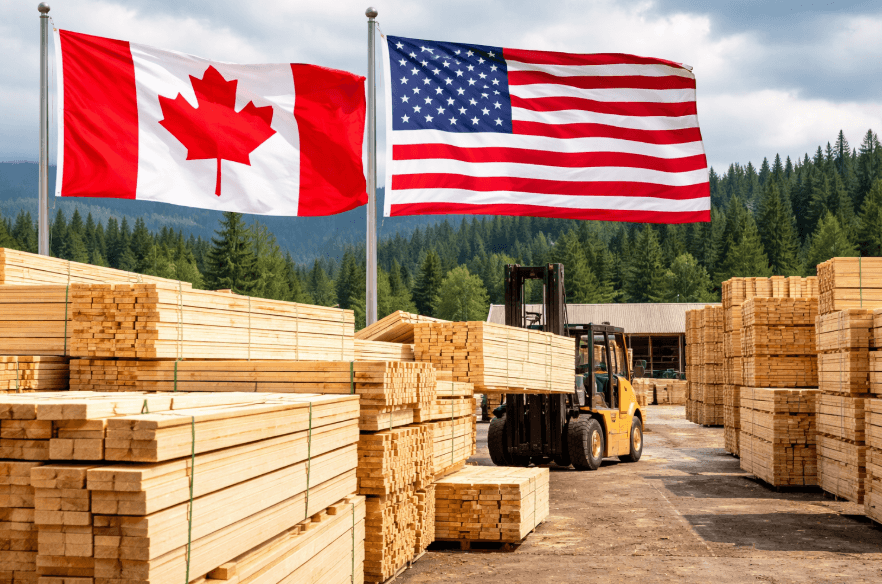
Province calls tariffs unjustified as cross-border trade tensions persist
Ministers say removal of duties key to affordability, supply chains and economic stability
Toronto — The Ontario government is renewing its call for the complete elimination of U.S. duties on Canadian softwood lumber, even as early signals from American regulators suggest a possible reduction in tariff rates later this year.
In a joint statement released Thursday, Associate Minister of Forestry and Forest Products Kevin Holland, Minister of Natural Resources Mike Harris, and Minister of Economic Development, Job Creation and Trade Vic Fedeli responded to a preliminary indication from the U.S. Department of Commerce that duties—currently around 35 per cent—could decline.
While acknowledging the potential for short-term relief, Ontario officials emphasized that any continuation of tariffs remains unacceptable and economically harmful.
“Ontario’s forest sector has a global reputation as a leader in the G7 in the production of high-quality wood and wood products. People and businesses in Canada and the United States alike rely on Ontario-made softwood lumber to build homes and critical community infrastructure.”
The ministers framed the issue as one that extends beyond trade policy, pointing to broader economic consequences affecting housing affordability, supply chains and productivity on both sides of the border.
“While this preliminary indication suggests some relief for softwood lumber producers later this year, Ontario remains firm that duties are unwarranted and not supported by the evidence. We continue to call for the full removal of all duties that raise costs for both American and Canadian families. These ongoing duties and tariffs reduce productivity, disrupt supply chains, drive up the cost of construction and make housing less affordable.”
Economic and industry implications
Ontario’s forestry sector is a significant contributor to the provincial economy, supporting thousands of jobs in rural and northern communities. The continued imposition of U.S. duties has long been a point of contention, with Canadian officials arguing that the tariffs unfairly penalize domestic producers and distort market dynamics.
Industry stakeholders have consistently warned that elevated duties increase costs for builders and developers, particularly in the United States, where Canadian lumber plays a crucial role in residential construction. Analysts note that any reduction in tariff rates could offer temporary financial relief, but uncertainty around long-term trade policy continues to weigh on investment decisions.
The province’s latest statement underscores a broader concern that partial measures—such as reduced tariff rates—do not address the underlying dispute. Instead, Ontario is advocating for a comprehensive and durable agreement that eliminates duties entirely.
Cross-border trade tensions remain
The softwood lumber dispute has been a recurring issue in Canada-U.S. trade relations for decades, with periodic negotiations failing to produce a lasting resolution. The current duties stem from U.S. claims that Canadian producers benefit from unfair subsidies, a position that Canadian governments at both federal and provincial levels have repeatedly rejected.
Ontario’s ministers reiterated the importance of collaboration and mutual economic benefit, positioning the issue as one that requires joint action rather than unilateral measures.
“Trade and cooperation make our two countries stronger, safer and more prosperous. We urge the United States to work with Canada on a fair and long-term resolution in support of workers, families and businesses on both sides of the border.”
Looking ahead
With the U.S. Department of Commerce expected to finalize its decision later this year, attention will turn to whether the anticipated reduction in duties materializes—and how both countries respond.
For Ontario, the message remains consistent: any continuation of tariffs is viewed as a barrier to economic growth and affordability. Provincial officials are expected to continue working with federal counterparts and industry leaders to press for a negotiated settlement.
Until then, uncertainty surrounding softwood lumber trade is likely to persist, leaving producers, builders and policymakers navigating a complex and evolving cross-border landscape.
Discover more from Wire Service Canada
Subscribe to get the latest posts sent to your email.