

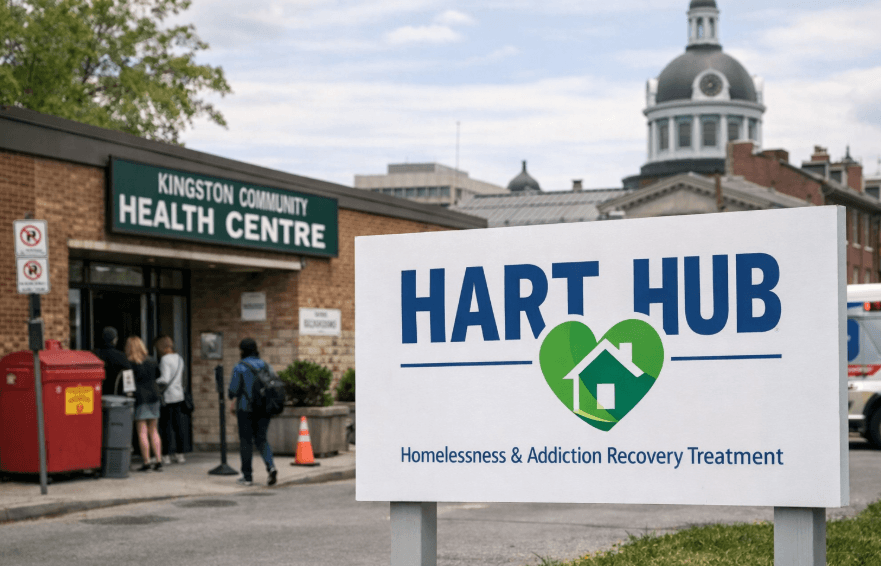
Province shifts focus from supervised consumption to treatment-based care
KINGSTON, Ont. — The Ontario government will close the province’s last remaining provincially funded drug injection site in Kingston and replace it with a new Homelessness and Addiction Recovery Treatment (HART) Hub, marking a significant shift in its approach to addiction services toward treatment and recovery.
The transition, announced by the Ministry of Health on April 10, will see the current site cease operations on Sept. 30, 2026, with the new HART Hub opening the following day to ensure uninterrupted care.
The move is part of the province’s broader strategy to address addiction while responding to community concerns about public safety linked to supervised consumption sites. It also expands Ontario’s HART Hub network from 28 to 29 locations, backed by increased funding that now exceeds $560 million.
“Our government is focused on real solutions that provide those struggling with addiction the supports they need to break the tragic cycle of addiction,” said Sylvia Jones, Deputy Premier and Minister of Health. “The new HART Hub in Kingston will connect vulnerable residents with the resources they need to rebuild their lives while protecting Ontario communities from dangerous behaviour driven by the increase and open use of illegal drugs.”
Increased funding and expanded services
The province is doubling its annual investment in the Kingston site to $6.3 million, with the new hub designed to deliver a broader range of integrated services. These include mental health and addiction treatment, primary care, supportive housing, employment assistance and other social services.
Officials say the hub will be tailored to local community needs, with planning input from regional stakeholders.
The Kingston transition aligns with earlier provincial actions, including the removal of funding for seven injection sites located in communities that already had HART Hubs, as well as legislation passed in 2024 banning such sites within 200 metres of schools and child-care centres.
Policy shift toward recovery-focused care
The government has emphasized that HART Hubs will not offer supervised drug consumption, safer supply programs or needle exchange services, instead prioritizing recovery-oriented treatment and long-term stabilization.
Data released by the province indicates that existing HART Hubs have already recorded more than 100,000 client interactions, with over 250 individuals accessing supportive housing and recovery-focused services.
The expansion also includes a commitment to add nearly 900 supportive housing units across Ontario—more than 300 above the original target—to help individuals transition to stable living conditions.
“The transition to a HART Hub in Kingston reflects our commitment to meeting people where they are and represents another important step forward for mental health and addictions care in Ontario. By providing recovery-focused treatment, we are making it easier for individuals to access life-changing support while keeping our communities safe,” said Vijay Thanigasalam, Associate Minister of Mental Health and Addictions.
Local and provincial support for the transition
The Kingston Community Health Centre, which currently operates the supervised consumption site, will wind down services as part of the transition.
Provincial officials say the change reflects both local feedback and broader system goals outlined in Ontario’s long-term mental health strategy, including the “Your Health” plan and the Roadmap to Wellness initiative.
Under the Roadmap to Wellness, Ontario has committed $3.8 billion over 10 years to expand mental health and addiction services, aiming to build a more integrated and accessible system.
“It is important that we acknowledge mental illness and addictions as a health condition like any other, that requires treatment. HART Hubs provide just that, treatment and a path to wellness. Already, we have seen great success with HART Hubs and I congratulate the City of Kingston for embracing this new service,” said John Jordan, MPP for Lanark–Frontenac–Kingston and Parliamentary Assistant to the Minister of Health.
Transition reflects broader system overhaul
The Kingston announcement underscores a broader transformation in how Ontario delivers addiction services, shifting away from harm reduction models toward treatment-first approaches.
Since April 2025, nine Consumption and Treatment Services sites have already transitioned into HART Hubs, reflecting what the province describes as a successful model for connecting individuals to care while addressing public safety concerns.
As the Kingston site prepares to close later this year, provincial officials maintain that continuity of care will remain a priority, with the new HART Hub expected to begin operations immediately after the shutdown.
The transition marks a pivotal moment in Ontario’s evolving addiction strategy, with the government betting on expanded treatment infrastructure as the cornerstone of its response to the province’s ongoing substance use crisis.
Discover more from Wire Service Canada
Subscribe to get the latest posts sent to your email.