

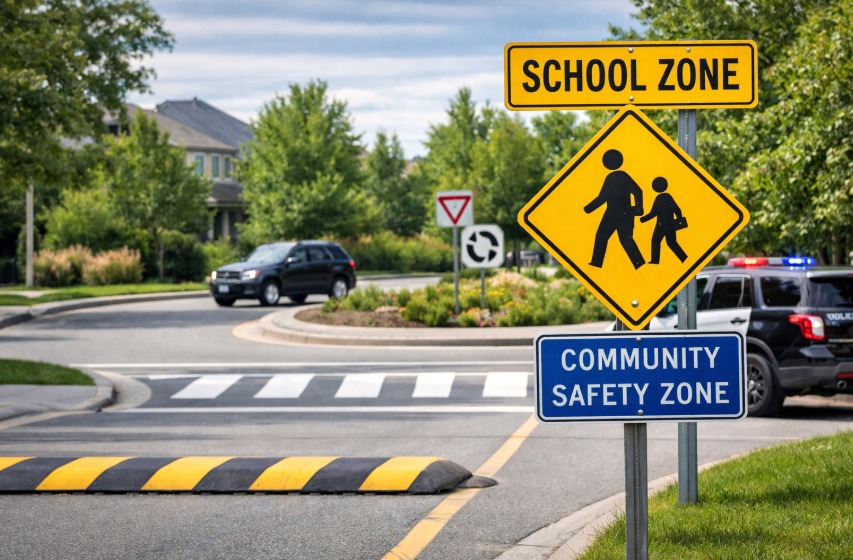
The Ontario government is opening a new intake of funding under its $210-million Road Safety Initiatives Fund (RSIF), offering municipalities additional support for traffic-calming projects in school and community safety zones following the province’s ban on municipal speed cameras.
The next application window opens February 19, 2026, the Ministry of Transportation said Thursday. The funding is intended to help municipalities implement what the province describes as proven safety measures that do not increase costs for drivers or taxpayers.
“Our government is protecting Ontario by keeping costs down for drivers while ensuring our roads remain among the safest in North America,” said Prabmeet Sarkaria, Minister of Transportation. “This additional funding through the Road Safety Initiatives Fund will give municipalities the tools they need to invest in infrastructure that reduces speeding in real time, rather than issuing speeding tickets weeks after violations occur.”
The RSIF was first launched in November 2025, shortly after the province enacted legislation banning municipal automated speed enforcement cameras. The $210-million program included $42 million in immediate funding for eligible municipalities.
All municipalities that previously operated municipal speed camera programs are eligible to apply for support through the fund. More than 40 municipalities across Ontario had automated speed enforcement programs before the provincial ban took effect on November 14, 2025.
The government has positioned the fund as part of its broader affordability agenda, arguing that speed cameras had increasingly become revenue-generating tools rather than safety measures. The ban was formalized through the Building a More Competitive Economy Act, which received Royal Assent on November 3, 2025, and prohibited the use of municipal speed cameras as of November 14, 2025.
In announcing the new intake, the province emphasized infrastructure-based approaches to traffic safety, including speed bumps, raised crosswalks, roundabouts and high-visibility signage. Funding can also support increased targeted police enforcement in school and community safety zones where speed cameras were previously deployed.
Provincial data cited in the release underscores the scale of ticketing under former automated enforcement programs. In the City of Toronto, a single speed camera issued more than 65,000 tickets and generated nearly $7 million in fines prior to 2025. The City of Vaughan issued 30,000 tickets over a three-week period before scrapping its program in September 2025. In the Region of Waterloo, 55,000 tickets were issued during the first six months of its speed camera program.
Overall, the government said Ontarians were charged millions of dollars in fines under municipal speed camera initiatives.
The province argues that physical traffic-calming infrastructure reduces speeding at the point of infraction, rather than penalizing drivers after the fact. Measures such as raised crosswalks and roundabouts are designed to slow traffic through road design, while enhanced signage and police presence are intended to improve compliance in high-risk areas, particularly around schools.
For municipalities, the additional RSIF funding provides an opportunity to offset costs associated with transitioning away from automated enforcement systems. Infrastructure upgrades can require upfront capital expenditures, particularly in densely populated urban areas where road redesign may involve construction and engineering work.
The government also highlighted Ontario’s long-term road safety record. For 25 years, the province’s roads have ranked among the safest in North America, with one of the lowest fatality rates per 10,000 licensed drivers.
The Ministry of Transportation has not specified how much funding will be available in this latest intake, but the remaining balance of the $210-million envelope will be distributed to eligible municipalities through the application process.
Municipalities seeking funding must submit proposals outlining planned traffic-calming measures and how they will enhance safety in school zones and designated community safety zones. The ministry has indicated that projects aligned with the fund’s objective of reducing speeding without imposing additional financial burdens on drivers will be prioritized.
The latest announcement reinforces the province’s shift toward infrastructure-based enforcement and away from automated ticketing systems, a move the government says balances public safety with affordability concerns.
Applications for the new round of RSIF funding open February 19.