

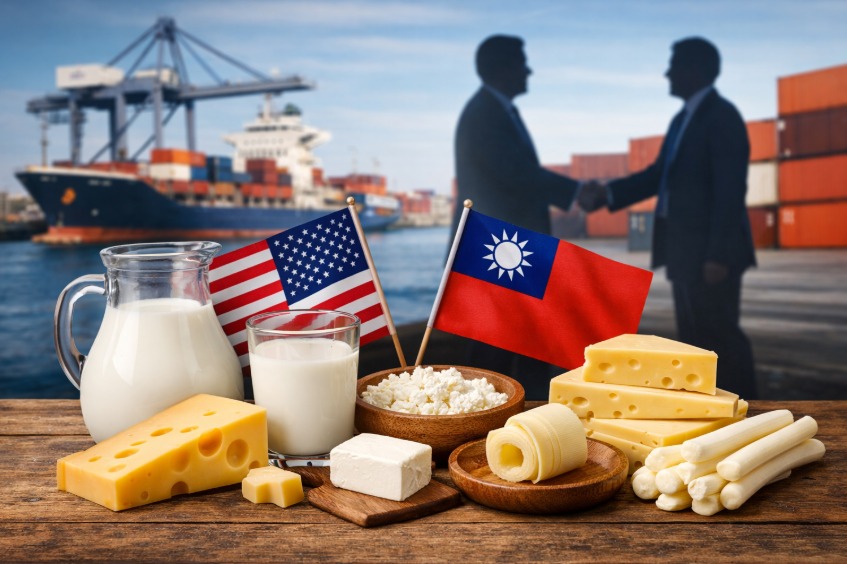
A newly signed trade agreement between the United States and Taiwan is poised to significantly expand U.S. dairy exports by eliminating tariffs on all American dairy products and addressing potential non-tariff barriers that could restrict trade flows.
Industry groups representing U.S. dairy producers and exporters hailed the deal as a major breakthrough for a high-value Asian market that has become increasingly important to American farmers. Taiwan ranks as the third-largest export destination for U.S. fluid milk, underscoring the commercial significance of the agreement.
The pact, signed late Tuesday, removes tariffs across the full spectrum of U.S. dairy products and incorporates commitments aimed at preventing regulatory or technical barriers that could otherwise undermine trade. Together, those measures are expected to improve the competitive position of American dairy suppliers relative to other global exporters.
“Taiwan is a trusted partner and a high-value market for U.S. dairy,” Krysta Harden, president and CEO of USDEC, said. “This agreement improves our competitiveness compared to other suppliers and provides assurances that nontariff barriers will not hinder the expansion of U.S. dairy exports. USDEC looks forward to continuing work with the Taiwanese government and the domestic industry to increase dairy consumption and grow the United States’ contribution to supplying Taiwan’s fluid milk and other dairy needs.”
The agreement builds on sustained engagement between U.S. dairy representatives and Taiwanese counterparts. Last year, delegations from the National Milk Producers Federation (NMPF) and the U.S. Dairy Export Council (USDEC) travelled to Taiwan to advocate for dairy’s inclusion as a priority in trade negotiations. During that visit, the groups signed a Memorandum of Understanding with the Dairy Association of Taiwan to strengthen market development efforts and improve information sharing.
Industry leaders say the agreement reflects a broader push by the U.S. administration to expand agricultural market access through bilateral trade deals.
“The agreement with Taiwan builds on the incredible momentum we’ve seen from the Administration in securing new trade agreements around the world,” Gregg Doud, president and CEO of NMPF, said. “Each deal to reduce barriers and expand market access strengthens American dairy farms and the communities they support.”
Beyond tariff reductions, the deal also addresses intellectual property concerns that have been a longstanding issue for U.S. dairy exporters. In particular, the agreement includes commitments to safeguard the use of common food names — a contentious topic in global agricultural trade, where geographical indication rules can restrict how certain product names are used in export markets.
“Taiwan is an important market for the United States, and the commitments to protect common names included in this agreement preempt third countries like the European Union from abusing intellectual property tools to monopolize generic terms and take away U.S. export opportunities,” Jaime Castaneda, executive director of CCFN, said. “We cannot thank Ambassador Greer, Ambassador Callahan and the entire negotiating team enough for prioritizing this issue and ensuring our exporters can continue using the terms known by consumers around the world.”
The Consortium for Common Food Names (CCFN), along with NMPF and USDEC, said it will work closely with officials in both Washington and Taipei to ensure swift implementation of the agreement.
The National Milk Producers Federation, based in Arlington, Va., represents dairy farmers and the cooperatives they own, with member cooperatives producing more than two-thirds of U.S. milk. The U.S. Dairy Export Council is a non-profit membership organization representing producers, processors, cooperatives and exporters, with a mandate to enhance global competitiveness and expand international sales of U.S. dairy products.
For Taiwan, the agreement reinforces access to a stable and diversified dairy supply at a time when food security and supply chain resilience remain top priorities across Asia. For U.S. producers, the removal of tariffs and reduction of regulatory uncertainty could translate into stronger export volumes and deeper penetration into one of the region’s more dynamic consumer markets.
While the long-term trade impact will depend on implementation and market conditions, industry groups say the agreement marks a significant milestone in strengthening bilateral agricultural ties and opening new growth avenues for American dairy exports.
Discover more from Wire Service Canada
Subscribe to get the latest posts sent to your email.