

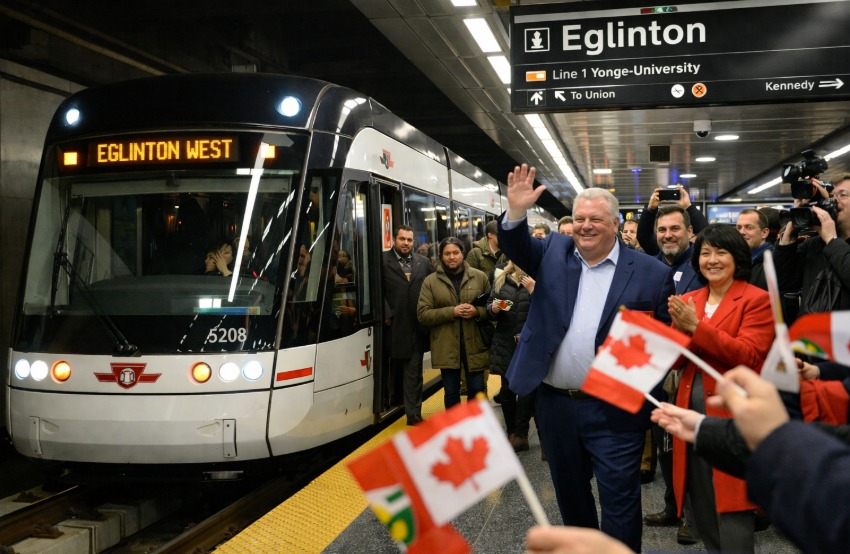
The Ontario government has officially opened the long-awaited Eglinton Crosstown Light Rail Transit (LRT), marking a major milestone in Toronto’s transit network and the province’s broader infrastructure agenda aimed at easing congestion, cutting commute times and supporting economic growth.
The 19-kilometre line, also known as Line 5 Eglinton, will begin operating under the Toronto Transit Commission on Feb. 8, 2026. To mark the launch, the province is offering free service on opening day. Once fully operational, the line is expected to carry more than 123,000 riders each weekday and reduce travel times between Kennedy Station and Mount Dennis Station by nearly one hour.
“Completion of the Eglinton Crosstown is a major milestone for commuters in the GTA, connecting hundreds of thousands of people from east to west to fast, affordable and reliable public transit,” said Premier Ford. “Our government has the largest plan to build in Canadian history. We will continue to invest in new roads, highways and transit, to support workers and families in every corner of our province.”
The Crosstown includes 25 stations and stops, running primarily along Eglinton Avenue, with more than 10 kilometres of the route underground. It connects to 68 bus routes, three TTC subway stations and two GO rail lines, positioning it as a key east-west transit spine through midtown Toronto. Riders will also benefit from Ontario’s One Fare program, which allows transfers between the LRT, GO Transit and participating local transit agencies on a single fare.
Transportation Minister Prabmeet Sarkaria said the project reflects the province’s strategy to link transit investment with economic competitiveness. “Our government is protecting Ontario by making historic investments in public transit to fight gridlock and connect more people to housing and jobs,” he said. “The Eglinton Crosstown LRT will cut travel times across the city by 60 per cent, helping riders get where they need to go quickly and safely and fuelling our economy for years to come.”
Operationally, the opening will be phased. On opening day, trains will run from 6 a.m. to 11 p.m., with service every four minutes and 45 seconds during peak periods. Over the first six months, service levels will gradually increase, following standard international practice for new LRT systems. After that ramp-up period, trains are expected to operate as frequently as every three minutes and 30 seconds during peak hours, from 5:30 a.m. to 2:30 a.m.
Toronto Mayor Olivia Chow emphasized affordability and service reliability as the line comes online. “The Eglinton LRT will connect people and communities across the city, helping thousands commute each day and reducing congestion on our roads,” she said. “The opening will be phased and service levels will increase over time, alongside greater signal priority for the LRT. As Mayor, I am committed to keeping the TTC affordable by freezing fares for three years running while increasing service levels, and by introducing fare capping this year.”
From a project delivery standpoint, the Crosstown represents one of the most complex transit builds in Toronto’s history. The line achieved substantial completion on Dec. 5, 2025, following a successful Revenue Service Demonstration, and was transferred to the TTC for full operations. Key provincial agencies and private-sector partners, including Metrolinx and Infrastructure Ontario, oversaw delivery alongside major contractors such as Aecon Group Inc..
“We appreciate the patience of commuters, businesses and the broader community who have been waiting for too long for this day,” said Metrolinx President and CEO Michael Lindsay, calling the opening “a significant milestone for Toronto.”
The Crosstown is also part of a larger pipeline of transit expansion across the region. Construction is already underway on the Eglinton Crosstown West Extension, which will add nine kilometres of track from Mount Dennis to Renforth Drive. More broadly, Ontario is investing nearly $70 billion in what it describes as the largest transit expansion in North America, including the Ontario Line, the Scarborough Subway Extension and the Yonge North Subway Extension.
For businesses and workers across Toronto, the opening of Line 5 is expected to improve access to jobs, reduce travel uncertainty and support growth along one of the city’s busiest corridors. After years of delays and construction disruption, the start of service signals a turning point—transforming a long-promised project into a functioning piece of the region’s economic infrastructure.
Discover more from Wire Service Canada
Subscribe to get the latest posts sent to your email.
