

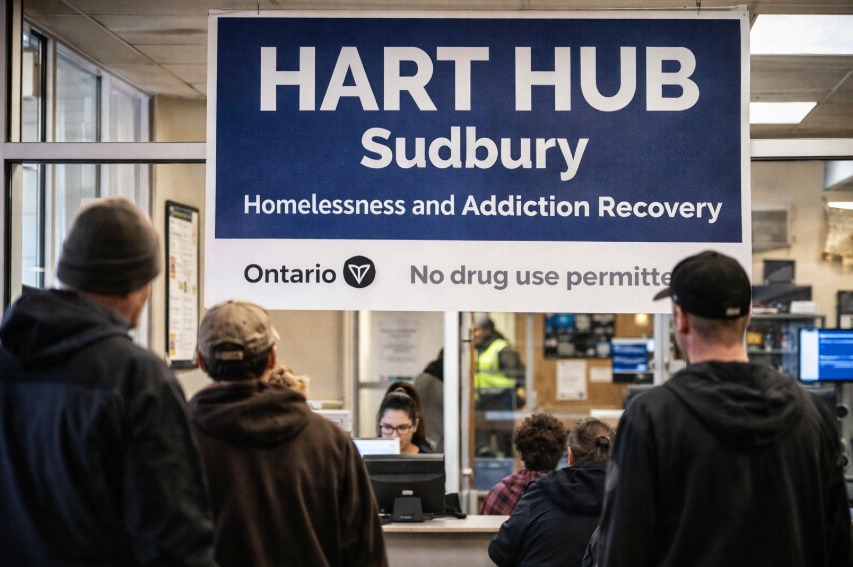
Ontario Expands Mental Health and Addiction Care With New HART Hub in Sudbury
Ontario has opened a new Homelessness and Addiction Recovery Treatment (HART) Hub in Sudbury, expanding access to integrated mental health, addiction and housing supports as part of a province-wide effort to strengthen community safety and recovery services.
The Sudbury location is one of 28 HART Hubs being rolled out across Ontario under an almost $550 million provincial investment aimed at supporting people experiencing housing instability, mental health challenges and substance use disorders. The initiative is positioned as a cornerstone of Ontario’s broader mental health and addictions strategy, with a focus on treatment, recovery and long-term stability.
“We are building a stronger, more connected system of mental health and addictions care that better reflects the needs of communities and focuses on lasting recovery,” said Vijay Thanigasalam, Associate Minister of Mental Health and Addictions. “The opening of this new HART Hub will ensure that people struggling with mental health and addictions challenges in the Greater Sudbury area can access compassionate care and support services that prioritizes their path to recovery and strengthen community safety.”
Integrated Care Model Targets Local Needs
HART Hubs are designed to bring multiple services together under one coordinated model, connecting individuals to primary care, mental health treatment, addictions services, social supports and employment assistance. The approach is intended to reduce fragmentation in care delivery and improve outcomes for people with complex needs.
The Sudbury HART Hub will begin delivering services on February 17, 2026, operating from 105 Elm St. Health Sciences North will serve as the lead agency, working in partnership with the City of Greater Sudbury, Shkagamik-Kwe Health Centre, Monarch Recovery Services, the Canadian Mental Health Association – Sudbury/Manitoulin and the Northern Initiative for Social Action (NISA).
Through this collaborative network, the Hub will offer services tailored to local demand, including mental health and addictions care, primary health services, mobile outreach, supportive and transitional housing, and social supports such as peer assistance and skills-based programming.
Focus on Recovery and Housing Stability
A central component of the HART Hub model is its emphasis on recovery-oriented care and housing stability. Province-wide, the program is expected to add close to 900 supportive housing units, more than 300 above the original target, helping individuals transition into stable, long-term accommodation.
Unlike some previous harm-reduction models, HART Hubs do not offer safer supply, supervised drug consumption or needle exchange programs. The province has stated that the hubs are focused specifically on treatment and recovery, alongside broader social and health supports.
The Sudbury hub also reflects a broader transition underway across Ontario. As of April 1, 2025, nine existing Consumption and Treatment Services sites successfully transitioned into HART Hubs, expanding the scope of services while maintaining an emphasis on community safety. Additional hubs are now opening in communities across the province.
Alignment With Provincial Health Strategy
The expansion of HART Hubs aligns with Ontario’s Your Health: A Plan for Connected and Convenient Care and builds on the Roadmap to Wellness, the province’s long-term framework for mental health and addictions services. Through the Roadmap to Wellness, Ontario is investing $3.8 billion over 10 years to close service gaps and build what the government describes as a world-class system.
Further funding commitments include $303 million over the next three years, announced as part of Budget 2025, to support community-led mental health programs delivered at the local level.
The province has also prioritized culturally appropriate care within the HART Hub framework. Two Indigenous-led hubs are included in the 28-site expansion, located in Kenora and the Sault Ste. Marie/Blind River/Sagamok region, and are being delivered in partnership with Indigenous service organizations.
Local Leaders Welcome the Investment
Municipal leaders in Sudbury have welcomed the opening of the downtown hub, pointing to the benefits of centralized, coordinated services for individuals facing complex challenges.
“The opening of the downtown HART Hub marks a major step forward in how we support people facing homelessness, mental health challenges, and addiction in our community. We’re grateful to the Provincial Government for its partnership and investment in this work and for recognizing that bringing services together in one place strengthens access to care and improves outcomes for individuals in need in Greater Sudbury,” said Paul Lefebvre, Mayor of Sudbury.
Strengthening Community Outcomes
With the launch of the Sudbury HART Hub, Ontario continues to advance a system-wide approach to mental health and addiction care that prioritizes recovery, integration and housing stability. As more hubs come online, the province is positioning the model as a long-term solution to some of the most pressing social and public health challenges facing communities across Ontario.
Discover more from Wire Service Canada
Subscribe to get the latest posts sent to your email.
