

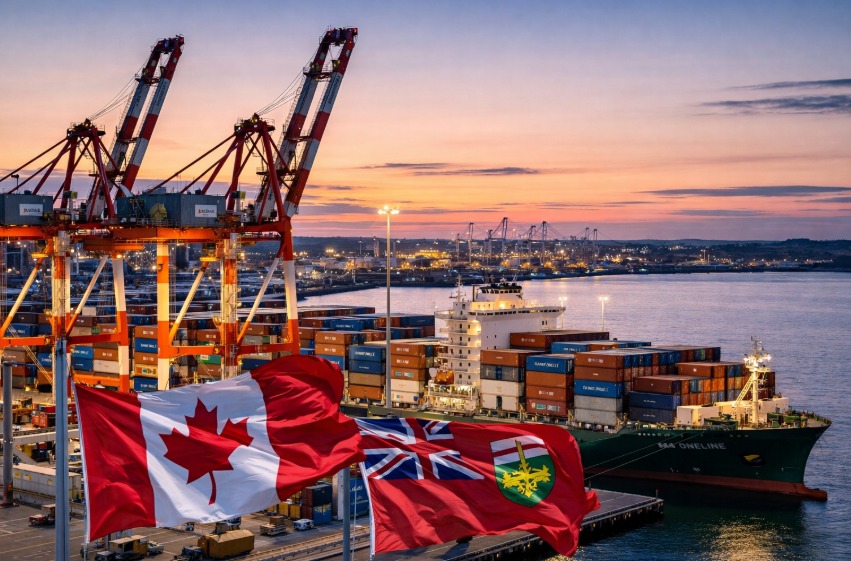
Ontario exporters more than doubled the volume of goods shipped through New Brunswick’s Port Saint John in 2025, underscoring a growing interprovincial push to diversify Canada’s trade routes and reduce exposure to U.S. tariffs.
According to provincial officials, the total volume of Ontario goods exported through Port Saint John to international markets rose by 153 per cent last year compared with 2024. The increase reflects coordinated efforts by Ontario and New Brunswick to strengthen domestic trade links and open new pathways for Canadian products to reach global markets.
Ontario Premier Doug Ford and New Brunswick Premier Susan Holt met in Ottawa on Tuesday with representatives from Port Saint John and industry stakeholders to mark the growth and reaffirm commitments to interprovincial cooperation.
“The work we are doing to unlock free trade within Canada and get Canadian products to new markets around the world is at the heart of our plan to protect Ontario from tariffs and economic uncertainty,” Ford said. “Ontario is proud to lead the country in tearing down barriers to interprovincial free trade, signing agreements with 10 provinces and territories, including New Brunswick. As we do so, we’re also supporting the construction and expansion of critical nation-building infrastructure such as pipelines, rail lines, highways and ports, including vital trading hubs like Port Saint John.”
The surge in shipments through the New Brunswick port highlights how Canadian companies are increasingly re-routing supply chains in response to trade tensions with the United States. Provincial leaders say the shift also demonstrates the strategic value of investing in ports, rail lines, highways and other transportation infrastructure that allow goods to move efficiently across the country and overseas.
Holt said the results position Port Saint John as a key national gateway for exporters beyond Atlantic Canada. “The Port of Saint John is Ontario’s port to the world,” she said. “New Brunswick has seen a 153 per cent increase in exports from Ontario moving through Port Saint John and that momentum is only picking up. New Brunswick is proud to be a gateway to international markets and support free trade within Canada. This partnership strengthens Canada’s economy by connecting Ontario exporters to global markets through a modern, efficient and reliable gateway right here in New Brunswick. It delivers economic stability today while building long-term opportunity for workers, businesses and communities across the country.”
Data released by the provinces show that most Ontario goods shipped through the port in 2025 were destined for markets outside the United States. Of the 8,083 twenty-foot equivalent units exported, 4,153 TEUs went to Europe, 1,306 to Asia, 954 to the Caribbean, 733 to South America and 670 to Central America. Vehicles, forestry products, agricultural goods and metals accounted for the largest share of exports.
Port Saint John President and Chief Executive Officer Craig Bell Estabrooks said recent infrastructure upgrades have strengthened the port’s role in Canada’s trade network. “Today’s conversation with Premier Holt and Premier Ford reaffirmed how Port Saint John contributes to Canada’s broader nation-building vision,” he said. “With newly modernized infrastructure and unparalleled connectivity, we’re proud to fuel job growth in Southern New Brunswick and offer all of Ontario new, reliable supply chain pathways.”
The export growth coincides with Ontario’s broader efforts to reduce interprovincial trade barriers. The province recently published draft regulations aimed at mutual recognition of goods and services from other Canadian jurisdictions, a move intended to cut red tape and accelerate market access. The Ontario government estimates that regulatory duplication costs the Canadian economy up to $200 billion annually.
Ontario has also signed memoranda of understanding with 10 provinces and territories to improve labour mobility and regulatory alignment. “Ontario has taken unprecedented action to expand interprovincial trade and diversify our international exports, and the rapid increase in Ontario goods moving through Port Saint John demonstrates that our targeted efforts are working,” said Vic Fedeli, the province’s minister of economic development, job creation and trade.
To support these initiatives, Ontario is investing $30 billion in roads, highways and other transportation infrastructure to ensure manufacturers and shippers can access new trade gateways such as Port Saint John.
Ontario remains Canada’s largest interprovincial trading market, with two-way trade in goods and services with other provinces and territories exceeding $324 billion in 2024. Provincial officials say continued collaboration through the Canadian Free Trade Agreement and related initiatives will be central to building a more resilient national economy as exporters seek growth beyond traditional markets.
