

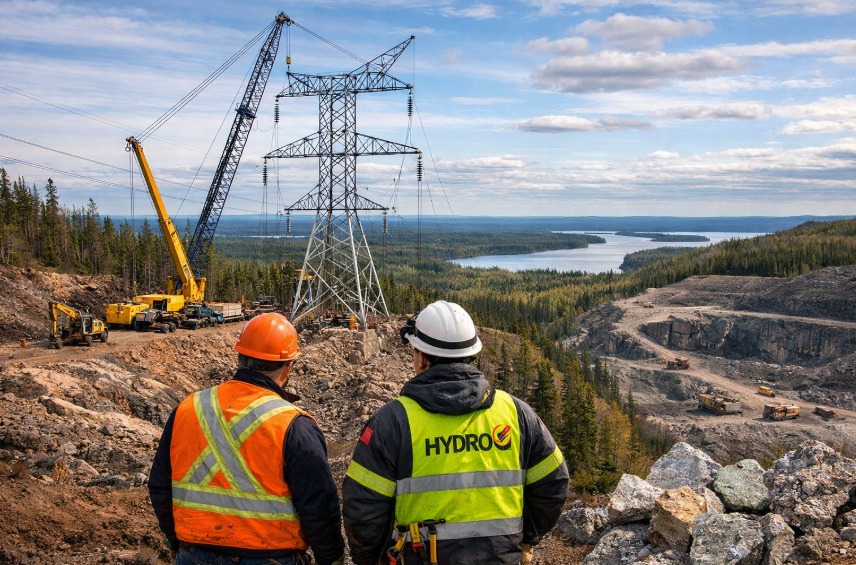
The Ontario government has formally designated the Greenstone Transmission Line as a priority infrastructure project, moving to accelerate construction of a new high-voltage electricity corridor intended to unlock large-scale mining development in the Ring of Fire and support long-term economic growth in northern Ontario.
The province announced Tuesday that Hydro One has been selected to develop and construct the 230-kilometre transmission line, which will run from Nipigon Bay to the vicinity of Aroland First Nation. Once completed, the line is expected to provide the energy backbone required for future mining projects and growing northern communities, while reducing reliance on diesel generation.
The announcement was made in Etobicoke by Energy and Mines Minister Stephen Lecce and Indigenous Affairs and First Nations Economic Reconciliation Minister Greg Rickford, alongside several First Nations leaders whose communities are directly connected to the project.
The Greenstone Transmission Line is projected to create more than 7,000 jobs and forms part of Ontario’s broader strategy to strengthen domestic supply chains, expand critical minerals development, and boost economic activity in the North. According to the province, 93 per cent of project costs to date have remained within Canada, supporting Canadian workers and suppliers.
“Last year, our government took action to bolster our self-reliance by reducing the permitting timelines by 50 per cent to build mines faster, along with a new processing fund to end the ripping and shipping of our resources abroad,” said Stephen Lecce, Minister of Energy and Mines. “We are putting Canada first by accelerating a plan to create 70,000 jobs supporting the Ring of Fire. With President Trump’s economic assault on our country, Ontario is officially giving the greenlight to build the Greenstone Transmission Line, delivering the energy backbone and infrastructure to unlock the Ring of Fire’s vast mineral potential. Ontario has what the world needs as a reliable and stable democratic partner, and that is why we are unlocking one of the largest undeveloped, high-grade deposits of critical minerals on earth.”
Electricity demand in northern Ontario is forecast to rise by 81 per cent by 2050, driven by population growth, electrification initiatives, and industrial expansion, including mining for critical minerals. The Greenstone line, expected to be in service by 2032, will enable between 350 and 700 megawatts of additional hydroelectric and other generation capacity.
The project is a key component of Ontario’s Integrated Energy Plan and builds on earlier initiatives, including the Northern Ontario Connection Study and the Reducing Diesel Reliance Initiative. Since unveiling its energy plan, Ontario has approved approximately 600 kilometres of new transmission infrastructure across the province.
“Through the designation of the Greenstone Transmission Line as a priority project, our government is expediting the construction of this critical 230-kilometre line connecting First Nations and Northern communities to clean power that will reduce reliance on diesel, advance economic reconciliation and unlock the Ring of Fire,” said Greg Rickford, Minister of Indigenous Affairs and First Nations Economic Reconciliation and Minister Responsible for Ring of Fire Economic and Community Partnerships. “As outlined in our Shared Prosperity Agreement with Aroland First Nation, we are working in lockstep with First Nations leadership to power the North, supercharging economic growth and meet electricity demands for generations to come.”
Ontario committed $70 million toward advancing the project through the Aroland–Ontario Shared Prosperity Agreement. Indigenous communities will also be eligible to participate through Hydro One’s First Nations Equity Partnership Model, which includes shared decision-making and up to 50 per cent ownership of the transmission line.
First Nations leaders described the project as a major step toward improved reliability and economic opportunity in the region.
“The Greenstone Transmission Reinforcement Project will bring much-needed infrastructure improvements to the region. As my community continues to develop, we will benefit from improved electricity reliability and increased capacity to support future growth and economic opportunities. Our partnership with Hydro One will be a meaningful step towards economic reconciliation — helping us create generational wealth while building the electrical infrastructure our community and local economy need to thrive,” said Chief Yvette Metansinine of Animbiigoo Zaagi’igan Anishinaabek.
Chief Joseph Gagnon of Aroland First Nation said unreliable power has long constrained growth. “We are very proud to work with our fellow communities to develop the Greenstone Transmission Line. Our community and the communities we are working with have been plagued by unreliable and inadequate energy resources for our region limiting growth and opportunities. This will create more reliable energy for our membership and eventually to the communities to the North.”
Industry groups, municipalities, and economic organizations also welcomed the announcement, citing the importance of transmission infrastructure for mining investment, community development, and long-term competitiveness. The province estimates development in the Ring of Fire could support more than 70,000 jobs and generate approximately $22 billion in economic output over 30 years.
Construction of the single-circuit 230-kilovolt line, designed to accommodate a future second circuit, will connect the East-West Tie near Nipigon Bay to new stations near Longlac and Aroland First Nation. Provincial officials say regulatory steps taken through orders-in-council and directives to the Ontario Energy Board are intended to reduce delays and provide certainty as the project moves forward.
