

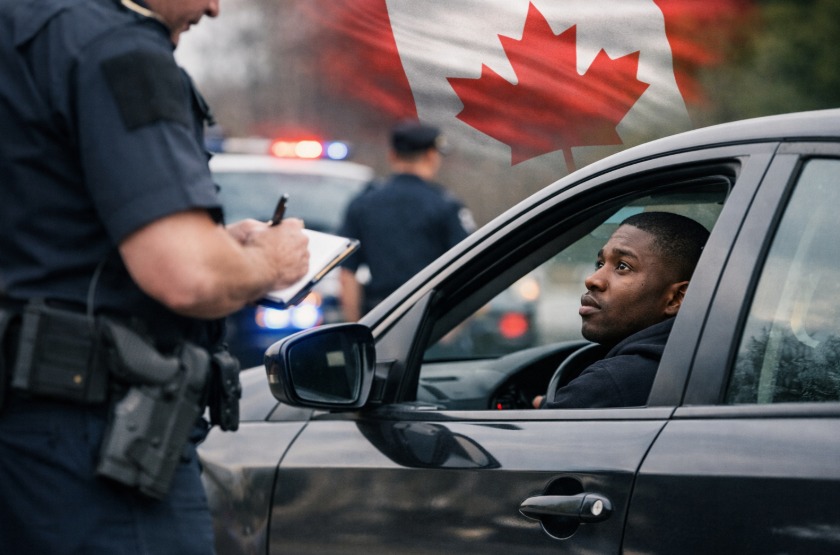
OTTAWA — The BC Civil Liberties Association (BCCLA) is intervening at the Supreme Court of Canada this week in a closely watched case that could reshape police authority to conduct random traffic stops across the country, particularly in light of evidence about racial profiling and its impacts on Black Canadians.
The civil liberties group will present oral arguments as an intervenor in Attorney General of Quebec v. Luamba, a two-day hearing focused on whether police powers to stop drivers without any specific suspicion of an offence are constitutional when such discretion is linked to discriminatory outcomes — a phenomenon commonly described as “driving while Black.”
At the centre of the case is Joseph-Christopher Luamba, a Black man who argued he was subjected to racial profiling through multiple traffic stops. In the lower courts, Mr. Luamba succeeded in proving that the so-called “random” stops violated three key protections under the Canadian Charter of Rights and Freedoms: Section 7, which protects life, liberty and security of the person; Section 9, which guarantees freedom from arbitrary detention; and Section 15, which protects equality rights.
A trial judge found that racial profiling can operate as an unconscious bias that influences police decision-making, particularly where officers have broad discretion and statutory safeguards are limited. The judge concluded that this dynamic contributes to the overrepresentation of Black people in traffic stops. That ruling was largely upheld by the Quebec Court of Appeal, setting the stage for a national debate now before the country’s top court.
The BCCLA says the Supreme Court’s decision will have implications beyond Quebec, touching on how Canadian law balances road safety enforcement with constitutional rights — especially when policing practices produce unequal burdens on racialized communities.
In its intervention, the BCCLA argues that liberty rights under Section 7 must be understood in their broader social context. The association contends that random traffic stops infringe the liberty of racialized people by restricting their freedom of movement and undermining psychological integrity when individuals are intercepted on the basis of race.
The organization also maintains that random stops conducted outside of structured roadblocks are arbitrary and not consistent with the principles of fundamental justice. According to the BCCLA, these stops lack a rational connection to improving road safety, while enabling discretionary practices that can lead to discriminatory outcomes.
“Contrary to what the Quebec government wants to argue, this case is not about brief, innocuous detentions on the side of the road,” stated Ga Grant, BCCLA Litigation Staff Counsel. “The trial judge was right to find that this case is about permitting the continued social oppression of Black and racialized people by the state. It is about substantive equality and fundamental freedom for Black people in Canada to move around without racism. We hope that the Court will uphold the trial decision and set a landmark precedent limiting racism in “driving while Black” and the types of unlimited discretionary powers that enable racism.”
The case has drawn attention from civil liberties advocates and legal observers because random vehicle stops have long been a common policing tool used to check for impaired driving, licensing compliance, and other traffic-related offences. However, critics argue that the practice can become a gateway to discriminatory policing when stops are initiated without objective grounds and without meaningful oversight.
In the lower court proceedings, the trial judge’s findings emphasized that discretion, when left “unfettered,” creates conditions in which unconscious bias can shape enforcement decisions. The result, the court found, is not simply inconvenience, but a measurable and harmful pattern of unequal treatment.
The Supreme Court is now being asked to determine whether the legal framework governing these stops can withstand Charter scrutiny, and whether constitutional protections require clearer limits on when and how police can detain drivers without cause.
For the BCCLA, the case is framed as a test of how constitutional rights operate in real-world conditions, where equality and liberty are intertwined. The association’s position is that the harms of racial profiling are not incidental to the analysis, but central to whether the state can justify these police powers under the Charter.
The BCCLA is represented in the intervention by Vincent Larochelle and Ga Grant, BCCLA staff counsel.
A decision in Attorney General of Quebec v. Luamba is expected to provide guidance to police services and governments on the constitutional boundaries of discretionary traffic enforcement — and could influence future challenges involving racial profiling and arbitrary detention across Canada.
