

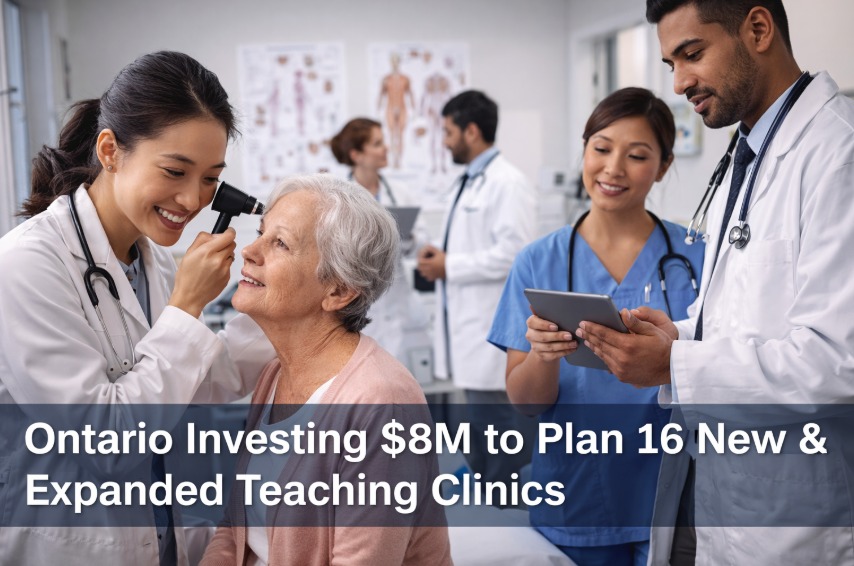
The Ontario government is investing up to $8 million to support planning for 16 new and expanded primary care teaching clinics across the province, as it pushes to connect more residents with a regular primary care provider and ease pressure on the health-care system.
The funding, announced Tuesday by the Ministry of Health, is part of Ontario’s broader $2.1 billion Primary Care Action Plan, which aims to connect everyone in the province to primary care by 2029. The government says the new and expanded clinics will help train the next generation of clinicians while expanding patient access to team-based care.
“These new primary care teaching clinics will further protect our health-care system by training the next generation of primary care clinicians, right here in Ontario,” said Sylvia Jones, Deputy Premier and Minister of Health. “This builds on our government’s unprecedented investments in primary care that will ensure anyone who wants to connect to a primary care clinician can have reliable access to primary care, no matter where they live.”
Each clinic will receive up to $500,000 in planning support, with the province working alongside Ontario’s medical schools to develop sites that train family medicine residents in interprofessional, team-based environments. The teaching clinics will also involve other health-care professionals, including nurse practitioners, physician assistants and registered nurses, according to the release.
The province says the clinics will combine direct patient care with hands-on learning, and are expected to connect an additional 300,000 people to primary care once operational. Initial sites are targeted to open in 2027-28, with further expansion planned afterward.
“Hands-on learning is critical to ensuring our health care students can hit the ground running and provide exceptional care upon graduation,” said Nolan Quinn, Minister of Colleges, Universities, Research Excellence and Security. “The new and expanded primary care clinics will not only equip our future doctors and nurses with the skills they need to thrive, but also connect more people in Ontario to compassionate health care, close to home.”
The government said the planning grants are part of a broader investment of up to $300 million—also within the $2.1 billion action plan—focused on building new and expanded community-based primary care teaching clinics in areas with high rates of “unattachment,” meaning residents who do not have a regular primary care clinician.
Alongside the 16 planned sites, the province said two new primary care teaching clinics at Toronto Metropolitan University will bring the total number of new and expanded clinics announced to 18.
Ontario currently has 39 primary care teaching clinics, where medical residents typically train for two or more years before graduating, the government said.
The newly identified teaching clinic locations are linked to medical schools across the province, including McMaster University sites in Milton and Niagara; NOSM University locations in Thunder Bay, Sudbury, Sault Ste. Marie, Timmins and North Bay; Queen’s University sites in Oshawa, Kingston and Belleville; a University of Ottawa location in Central Ottawa; two University of Toronto sites in Scarborough; and Western University locations in London East, Sarnia and Woodstock.
The government also positioned the teaching clinic expansion as part of its broader workforce strategy, pointing to investments in medical school education and recruitment efforts designed to increase the supply of primary care professionals.
“This investment in critical infrastructure will strengthen team-based primary care in Ontario,” said Dr. Jane Philpott, Chair of Ontario’s Primary Care Action Team. “These new teaching clinics will train the next generation of family physicians, nurse practitioners, physician assistants and other health professionals to work in teams while delivering vital care to patients who currently lack access.”
The announcement comes as provinces across Canada continue to face pressure from physician shortages and growing demand for primary care, with Ontario focusing on models intended to increase access while improving continuity of care.
The Ministry of Health said Ontario has already taken steps to expand capacity, including adding over 130 new and expanded primary care teams and nearly 20,000 new physicians since 2018, including an increase of more than 14 per cent in family doctors.
The government also said it has made progress on reducing the Health Care Connect waitlist, which it said was cleared as of Jan. 1, 2025. As of this week, the province said that waitlist has been reduced by more than 75 per cent.
The move was welcomed by several health-sector organizations, including hospitals and physician groups, which highlighted the role teaching clinics can play in both training and patient access.
“As an academic hospital, Women’s College Hospital is deeply committed to advancing primary care education and training the clinicians of the future. Strengthening team-based, hands-on learning environments is essential to preparing family physicians and other clinicians to deliver exceptional, connected care from day one. This work is foundational to building a strong and sustainable health system, and we are proud to play a leading role in shaping its future. ”
- Heather McPherson
President & CEO, Women’s College Hospital
“The Ontario Medical Association welcomes the government’s investment in primary care teaching clinics. Expanding these clinics will give the next generation of family doctors practical, hands-on experience delivering care directly to patients. We look forward to seeing how this investment strengthens physician-led primary care and improves patient access across the province.”
- Dr. Zainab Abdurrahman
President, OMA
“The Ontario College of Family Physicians (OCFP) is encouraged to see the provincial government continue to invest in solutions that will increase access to care for Ontarians. Primary care teaching clinics provide important opportunities for future family physicians to train in team-based environments. This is an important step toward supporting family physicians to thrive in practice and ensuring that patients can access the comprehensive care they need.”
- Dr. Jobin Varughese
President, Ontario College of Family Physicians
“NPAO welcomes the investments that expand the education and training capacity for Nurse Practitioners (NPs), who are essential in providing high-quality, patient-centered primary care. Supporting teaching clinics ensures that the next generation of NPs can train in team-based environments that reflect the realities of modern primary care. As leaders in delivering primary care with a proven track record of working effectively alongside other healthcare professionals to provide the highest possible standard of care, NPs are ideally suited to benefit from innovative learning models such as these. NPAO is encouraged by the expansion of support for nursing students and others, which will support the recruitment necessary to meet the needs of Ontarians. We look forward to working with the provincial government to advance meaningful attachment and future investments that support NPs and healthcare capacity in Ontario.”
- Dr. Michelle Acorn
CEO, NPAO
Ontario said the teaching clinics form part of its broader health strategy under Your Health: A Plan for Connected and Convenient Care, aimed at expanding the workforce and improving access to care closer to home over the long term.
Discover more from Wire Service Canada
Subscribe to get the latest posts sent to your email.
