

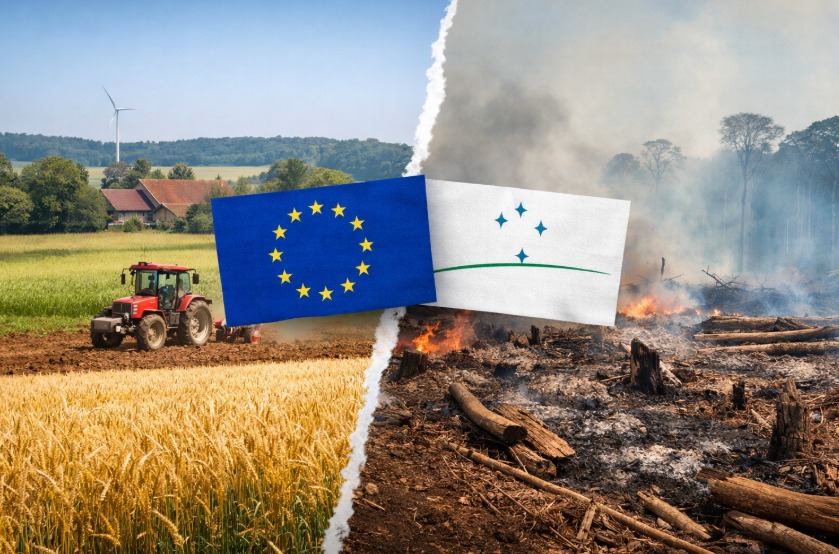
European Green Party leaders are warning that the long-awaited EU-Mercosur trade agreement, endorsed by European Union member states after a quarter-century of negotiations, risks undermining European farmers, accelerating environmental damage and weakening the EU’s climate commitments at a time of heightened global economic uncertainty.
The endorsement comes against a backdrop of growing geopolitical instability, renewed trade tensions driven by U.S. tariffs under former president Donald Trump, and increasing pressure on Europe to diversify its international economic relationships. Supporters of the agreement argue that deeper ties with South America’s Mercosur bloc — which includes Brazil, Argentina, Uruguay and Paraguay — are strategically necessary to secure supply chains and expand export markets.
But leaders of the European Green Party say the deal, as currently structured, falls short of the standards Europe should demand from its trade partners and could entrench economic and environmental risks on both sides of the Atlantic.
In recent months, European policymakers have stressed the need for new and reliable partnerships to navigate an increasingly fragmented global economy. The Greens acknowledge that closer cooperation with Mercosur countries is important, but argue that such partnerships must be grounded in high social, labour and environmental standards, as well as mutual respect between trading partners.
According to the party, even with additional safeguards and side arrangements negotiated by some EU member states, the agreement does not adequately address concerns around deforestation, labour rights and environmental protection. They warn it could deepen existing social and ecological harm, particularly in Mercosur countries where agricultural expansion has been closely linked to forest loss.
Vula Tsetsi, co-chair of the European Green Party, said the party has consistently raised alarms about the deal’s broader impacts.
‘The European Greens have long raised serious concerns about the EU-Mercosur agreement, including its impact on deforestation, labour rights and environmental protections. The structure of this deal risks reinforcing extractive export models in Mercosur countries, while exposing EU farmers and workers to competition from products that do not meet European health, social and environmental standards. We recognise that some see this agreement primarily through a geopolitical lens. But strategic partnerships should strengthen resilience, sustainability and fairness – not undermine them. In the context of Trump’s tariffs and intensifying global competition, Europe’s economic strength should be built through a strong Single Market and targeted public and private investment, not by lowering standards.’
The Greens argue that the agreement could place European farmers at a competitive disadvantage by opening EU markets to agricultural products produced under regulatory regimes that differ significantly from those in Europe. They say this creates an uneven playing field, particularly for small and medium-sized farms already under pressure from rising costs and climate-related challenges.
Ciarán Cuffe, the party’s other co-chair, said Europe’s relationship with Mercosur should be deepened, but not at the expense of climate responsibility or social justice.
‘Europe can and should deepen its relationships with Mercosur countries. However, cooperation must be based on climate responsibility, social justice and mutual respect, not on triggering a race to the bottom for farmers, workers and the environment. This agreement was not designed with people, farmers or the planet at its core. It is misaligned with the EU’s climate commitments, risks accelerating deforestation, and creates unfair competition by opening our markets to products, produced under standards we would not accept at home. Additional subsidies or safeguards cannot compensate for a model that is structurally unbalanced and environmentally risky.’
Environmental groups have long highlighted concerns that increased beef, soy and other agricultural exports from Mercosur could drive further deforestation in the Amazon and other sensitive ecosystems. While EU officials point to sustainability clauses in the agreement, critics argue enforcement mechanisms remain weak and rely heavily on political will rather than binding penalties.
From a business perspective, the debate underscores the growing tension between trade liberalization and sustainability goals. As Canada and other advanced economies grapple with similar questions around trade diversification, supply-chain resilience and climate commitments, the EU-Mercosur agreement is increasingly seen as a test case for whether modern trade deals can reconcile economic ambition with environmental responsibility.
