

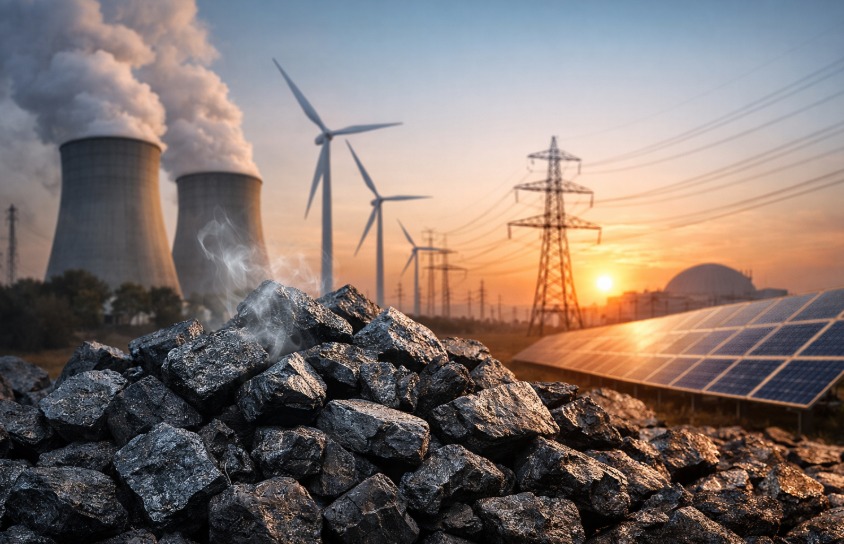
Global coal demand is nearing a turning point, with growth expected to stall and edge lower by the end of the decade as renewables, natural gas and nuclear power gain ground, according to a new report from the International Energy Agency (IEA).
The IEA’s latest annual market assessment, Coal 2025, released Wednesday, forecasts that worldwide coal demand will rise modestly in the near term before flattening and slipping slightly by 2030. The report provides outlooks for demand, supply and trade through the end of the decade, alongside analysis of investment trends, costs and pricing.
In 2025, global coal demand is projected to increase by 0.5%, reaching a record 8.85 billion tonnes. That headline growth, however, masks sharply divergent trends across major economies, reflecting weather events, fuel price dynamics and policy choices.
India, one of the world’s fastest-growing coal markets, saw consumption fall in 2025 following an early and intense monsoon season. It marked only the third annual decline in coal use in the country in the past 50 years. In contrast, the United States recorded a temporary reversal of its long-term decline in coal consumption. Higher natural gas prices, combined with policy measures that slowed the retirement of coal-fired power plants, pushed U.S. coal use higher after 15 years of steady decreases.
In Europe, coal demand continued to contract, but at a slower pace than in the previous two years, following double-digit declines. Meanwhile, China — which accounts for more than half of global coal consumption — saw demand remain broadly flat compared with 2024 levels.
Looking further ahead, the IEA expects global coal demand by 2030 to fall back to roughly the same level seen in 2023. The shift is being driven primarily by changes in the power sector, which currently represents about two-thirds of total coal use worldwide. Rapid growth in renewable energy capacity, steady expansion of nuclear power, and a substantial increase in liquefied natural gas supply are expected to erode coal’s role in electricity generation from 2026 onward. Coal demand from industrial uses, such as steelmaking, is projected to prove more resilient.
China remains central to the global outlook. The IEA expects Chinese coal demand to decline slightly by the end of the decade as the country continues to deploy renewable energy at scale. Beijing has stated its intention to see domestic coal consumption peak by 2030, a milestone that would have significant implications for global markets.
“Despite uncharacteristic trends in several key coal markets in 2025, our forecast for the coming years has not changed substantially from a year ago: we expect global coal demand to plateau before edging down by 2030,” said IEA Director of Energy Markets and Security Keisuke Sadamori. “That said, there are many uncertainties affecting the outlook for coal, most notably in China, where developments – from economic growth and policy choices to energy market dynamics and weather – will continue to have an outsize influence on the global picture. More broadly, trends in electricity demand growth and the integration of renewables worldwide could impact coal’s trajectory.”
While overall global demand is expected to soften, growth will not be evenly distributed. India is forecast to see the largest absolute increase in coal consumption through 2030, with demand rising by an average of 3% per year. That translates into an increase of more than 200 million tonnes, driven by expanding electricity demand and industrial growth. Southeast Asia is expected to record the fastest percentage growth, with coal demand rising by more than 4% annually over the same period.
The report also highlights upside risks to its projections. Faster-than-expected electricity demand growth in China, slower integration of renewable power, or increased investment in coal gasification could push global demand above current forecasts. More broadly, uncertainties remain around economic growth, policy approaches and the pace at which coal can be substituted in both advanced and developing economies.
On the trade front, China’s coal imports have played a key role in supporting global markets in recent years, offsetting declining imports from the European Union, Japan and South Korea. However, China reduced imports in 2025 amid oversupply and weak domestic demand, a trend the IEA expects to persist through 2030. As a result, global coal trade volumes are projected to decline. Metallurgical coal, used in steelmaking, is expected to fare better, supported by India’s reliance on imports to fuel its growing steel sector.
Against this backdrop of tepid demand, ample stockpiles and lower prices, the IEA anticipates coal production will fall in most major producing countries by 2030. China and Indonesia are expected to see output decline as domestic demand and export opportunities weaken. India stands out as an exception, with production set to rise as the government seeks to curb import dependence and bolster energy security.
Discover more from Wire Service Canada
Subscribe to get the latest posts sent to your email.
