

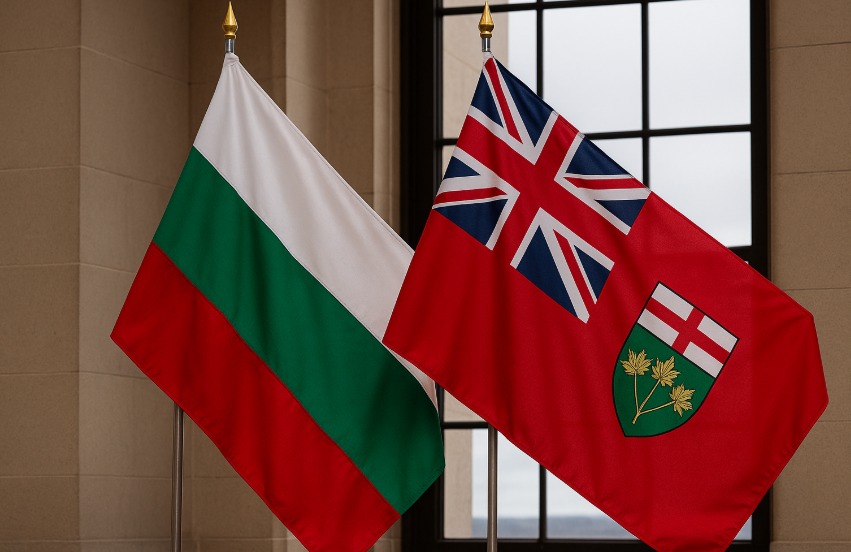
Ontario has secured a significant foothold in Europe’s fast-growing nuclear sector with a new agreement to provide technical expertise for Bulgaria’s ambitious expansion of its Kozloduy Nuclear Power Plant. The deal, announced Tuesday in Sofia by Ontario Energy and Mines Minister Stephen Lecce and Bulgarian Energy Minister Zhecho Stankov, calls for a Canadian consortium to support the planned construction of two Westinghouse AP1000 reactor units.
The agreement marks one of Ontario’s largest international nuclear partnerships to date and extends the province’s decades-long track record in large-scale reactor development and refurbishment into the light-water reactor market for the first time.
Lecce said the deal underscores Canada’s rising profile as a supplier of nuclear technology and project expertise at a time when many countries are seeking stable and low-carbon energy sources. “Ontario is solidifying Canada’s global leadership in clean, emissions-free nuclear power, and the world is watching,” Lecce said. “Ontario’s nuclear expertise will support Bulgaria’s large-scale nuclear expansion to deliver reliable, affordable power to their country, while creating jobs and protecting our economy here at home. As jurisdictions around the world seek stable, democratic sources of energy, global leaders are turning to Ontario’s 50-year track record of on-time and on-budget expertise.”
A newly formed consortium—Laurentis Energy Partners, BWXT Canada Ltd., and Canadian Nuclear Partners S.A.—has been selected to carry out a two-phase contract worth “hundreds of millions of dollars,” according to the release. Phase one begins immediately and will focus on planning work over a 15-month period. Pending regulatory and commercial approvals, phase two would start in 2027 and proceed with the multi-year construction of units 7 and 8 at Kozloduy, Bulgaria’s sole nuclear generating station.
Bulgaria’s energy ministry has framed the project as central to its strategy for long-term energy security, industrial development and alignment with European decarbonization goals. “Our country has secured leading international partners with proven experience across the full nuclear lifecycle – from design through commissioning,” Stankov said. “This project is an investment not only in our long-term energy security, but also in the strength of Bulgarian industry. Thirty percent of the specialists working on the project will be Bulgarian experts, providing our workforce with new knowledge, advanced technologies, and meaningful growth opportunities.”
The Kozloduy expansion is expected to generate hundreds of jobs across Canada and Europe, drawing on Ontario’s nuclear engineering, manufacturing and project-management workforce. It also offers Ontario-based firms a pathway to new export opportunities at a time when countries are accelerating nuclear development as part of broader clean-energy strategies.
Industry leaders highlighted the deal as evidence of growing global demand for Canada’s nuclear capabilities. “Laurentis’s foundation is built on decades of experience supporting CANDU technology, but our project-management, technical, and Owner’s Engineer expertise are highly transferable across reactor types and technologies,” said Leslie McWilliams, president and CEO of Laurentis Energy Partners. “This contract reflects the confidence placed in Canadian nuclear capability for complex new-build programs.”
John MacQuarrie, president of commercial operations at BWXT, noted the consortium’s relevance to Bulgaria’s energy ambitions. “BWXT has significant experience successfully supporting execution of large projects in the nuclear industry including the refurbishments for Bruce Power and Ontario Power Generation,” he said. “Our customers recognize that experience, and we are excited to leverage our technical capabilities in support of this important AP1000 development to help Bulgaria meet its energy security needs.”
The Ontario government has been pursuing international commercial opportunities in parallel with domestic expansion plans, including small modular reactor (SMR) collaborations in Estonia, Poland and Belgium, and support for the refurbishment of Romania’s CANDU Unit 1 reactor at Cernavoda. These initiatives form part of Energy for Generations, Ontario’s long-term energy roadmap aimed at keeping power affordable while bolstering industrial competitiveness.
Several nuclear-sector organizations said the Bulgaria deal demonstrates how Ontario’s supply chain is gaining traction abroad. “We’re pleased to see NII Founding Members contribute made-in-Canada expertise to yet another new nuclear project,” said Jessica Linthorne, president and CEO of the Nuclear Innovation Institute. Ivette Vera-Perez, president and CEO of the Organization of Canadian Nuclear Industries, added that the consortium “represents a significant opportunity for Ontario companies to bring that leadership to the international stage while supporting high-quality jobs here at home.”
National industry groups echoed that sentiment. “Canada’s nuclear expertise is recognized around the world, and this consortium reflects the confidence international partners place in our province’s proven capability,” said George Christidis, president and CEO of the Canadian Nuclear Association.
For Bulgaria, the Kozloduy expansion is one of the most consequential infrastructure projects in its energy transition. Petyo Ivanov, executive director of Kozloduy Nuclear Power Plant New Build, said the partners’ experience “guarantees that the project will be completed on time, within budget, and in full compliance with regulatory standards.”
With planning work set to begin immediately, both governments are framing the agreement as a milestone that strengthens economic ties while advancing shared clean-energy priorities.
