

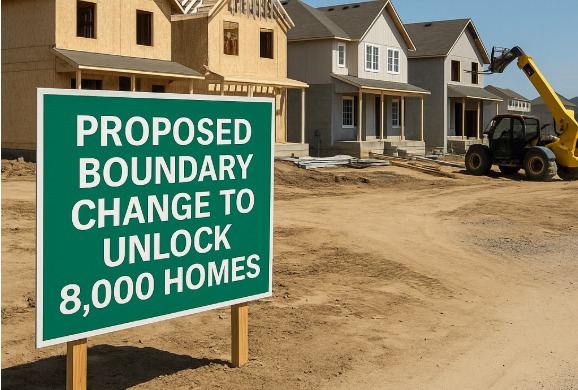
The Ontario government is moving to expand Barrie’s municipal boundaries through new legislation that it says will unlock thousands of homes, accelerate job creation and support long-term economic development across Simcoe County. The Barrie-Oro-Medonte-Springwater Boundary Adjustment Act, 2025, introduced Tuesday, would transfer approximately 1,673 hectares of land from the Townships of Oro-Medonte and Springwater to the City of Barrie.
If passed, the adjustment would provide Barrie with developable land needed to accommodate significant projected population and employment growth. The province estimates the shift could enable the construction of up to 8,000 new homes and support planning for a community expected to grow by 23,000 residents over time.
“Our government is taking action to support the construction of new homes where it makes sense and is needed most,” said Rob Flack, Minister of Municipal Affairs and Housing. “This boundary change will benefit the entire region by protecting jobs and accelerating economic growth in Simcoe County, while laying the groundwork for more people to live here.”
Barrie, the largest urban centre in Simcoe County, has experienced rapid population growth—nearly 13 per cent over the past two years. It serves as a regional hub for transportation, health care, education and employment. However, the city has no remaining developable land within its current boundary, a challenge that threatens future housing and employment capacity. According to provincial analysis, Barrie is on pace to run out of residential land in the 2030s and employment land in the 2040s without expansion.
The province argues that the boundary adjustment is necessary to align land supply with existing infrastructure and long-term growth pressures. Barrie has invested heavily in water and wastewater systems capable of supporting additional development, giving it the ability to “kick start future growth” more quickly than if new servicing infrastructure had to be built elsewhere.
By transferring land to the city, the government says it can “quickly and cost-effectively” leverage Barrie’s existing servicing capacity to support both housing and job creation, while enabling medium- and long-term planning for expanded infrastructure.
The Office of the Provincial Land and Development Facilitator (OPLDF) has been mediating discussions between Barrie, Oro-Medonte, Springwater and Simcoe County since May 2024. Despite 18 months of negotiations, the parties were unable to reach a resolution. Based on recommendations from the OPLDF, the province opted to move forward with legislation rather than continue negotiations that might further delay regional development.
The act also includes regulation-making authority for the Minister of Municipal Affairs and Housing to adjust ward boundaries ahead of the 2026 municipal election. If approved by the legislature, the boundary change would take effect on January 1, 2026, or upon Royal Assent, whichever comes later.
The affected lands represent only a small portion of the two townships—approximately 2.3 per cent of Springwater and 0.8 per cent of Oro-Medonte. The legislation would allow the minister to establish regulations on transitional matters such as phased-in property tax changes and financial compensation to ensure an orderly transition for residents and businesses impacted by the shift.
The proposed changes are intended to reinforce Simcoe County’s economic position, particularly along Highway 400 north of Highway 11, an area the province describes as well-suited to connect southern Ontario’s manufacturing sector with northern Ontario’s resource industries. The government also highlighted alignment with major regional transportation projects such as the Barrie GO Line expansion and the Bradford Bypass.
Barrie’s population is projected to nearly double from 169,000 in 2024 to 298,000 by 2051, with employment expected to rise to 150,000 jobs over the same period. The city’s long-term infrastructure investments—including upgrades to water and wastewater facilities and the development of new commercial and employment lands—are central to accommodating this growth.
Transit expansion is also a key factor. The Barrie GO Line carried 4.3 million riders in 2024, with ridership projected to grow to between 10 million and 14 million by 2041. Meanwhile, the Bradford Bypass, a new four-lane freeway linking Highways 400 and 404, is expected to ease congestion, facilitate population growth and create business opportunities throughout the region.
The province maintains that timely action is essential to ensuring Simcoe County can absorb future housing demand and support economic development. By moving forward with legislative intervention, officials say they intend to prevent further delays that could jeopardize long-term housing and employment needs.
Discover more from Wire Service Canada
Subscribe to get the latest posts sent to your email.
