

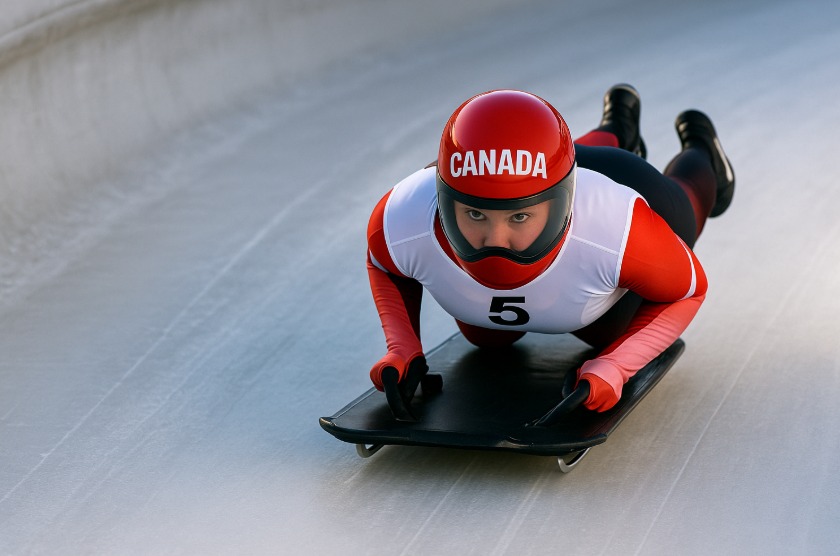
Canada’s skeleton program opened its World Cup campaign with a strong showing on the newly built Olympic track in Cortina, Italy, where Hallie Clarke and Jane Channell both delivered top-15 results in the first major international test of the season.
Clarke, 20, led the Canadian contingent with a sixth-place finish, demonstrating consistency on a course that will host the skeleton events at the upcoming 2026 Winter Games. Channell, a two-time Olympian, secured 15th place, closing out a performance that underscored both the experience and emerging depth within Canada’s women’s skeleton team.
“I’m really happy with how I’ve started this year. This is the healthiest I have been mentally and physically this quadrennial, and I can feel that translating into my sliding,” said Clarke.
The Brighton, Ont. athlete, who last season became the first competitor in the history of the sport to hold both the Senior and Junior World Championship titles simultaneously, registered a two-run combined time of 1:56.82. Her result reflects a strong early-season form and familiarity with the characteristics of the 1,445-metre, 16-corner course — the first new Olympic sliding venue constructed since Beijing 2022.
“I’m a big fan of this track. It has a very similar flow to Beijing, but some areas are also similar to Winterberg,” Clarke added. “It was my first time doing an Olympic Test Event on a new track, and I learned so much about how to feel the track and trust my instincts. I’m proud of the work I’ve done to get here and excited for what is to come.”
For Canada’s program, Clarke’s sixth-place result signals a continuation of her upward trajectory following a breakout 2023–24 season. As international federations increasingly emphasize test events ahead of major competitions, early familiarity with Cortina’s layout is expected to be a strategic advantage for athletes and coaches.
Channell, 37, also capitalized on lessons learned during the pre-season adaptation phase. The North Vancouver slider, who is working toward qualifying for her third Olympic Games, used a strong start position in her final heat to climb into 15th place with a total time of 1:57.62. Her performance came despite competing through a foot injury sustained earlier in the week.
“It’s always nice finishing the first race of the year, and special learning a brand-new track because it doesn’t happen often,” Channell said. “The track here is flowy and tricky. It’s easy to get down but hard to be fast. I haven’t quite found the balance of letting the sled run while doing enough. It’s a fun, challenging track.”
The Cortina track’s design — a blend of fast, sweeping sections and technically demanding transitions — drew significant attention from international teams assessing how it will shape racing strategies heading into 2026. For sliding nations, early data from this first World Cup event is expected to influence equipment choices, line selection, and off-season preparation.
Germany’s Jacqueline Pfeifer captured gold with a two-run time of 1:55.93, marking the first women’s skeleton victory on the new Italian course. Fellow German Hannah Neise finished second at 1:56.16, while Belgium’s Kim Meylemans secured bronze with a combined time of 1:56.25.
With the opening race complete, the World Cup circuit now moves to Igls, Austria — a track known for its shorter profile and emphasis on start speed. Both Clarke and Channell will look to build on their early-season momentum as the Canadian program continues its approach toward 2026.
The event also marked another visibility moment for Bobsleigh Canada Skeleton (BCS), the national governing body overseeing athlete development and high-performance programming in both sports. The organization, supported by corporate partners including Karbon, Athabasca Oil Corporation in collaboration with Canada Action’s I Love Canadian Energy campaign, Leeswood Construction, Bomber LD, PX3, Kuritec and Vessi, as well as the Government of Canada, Own the Podium and the Canadian Olympic Committee, continues its work to strengthen Canada’s competitive presence leading into the next Olympic cycle.
Bobsleigh Canada Skeleton describes its mission as developing “champions in the community, on and off the track,” a mandate reflected in the performances from Clarke and Channell as they begin another season on the international stage.