

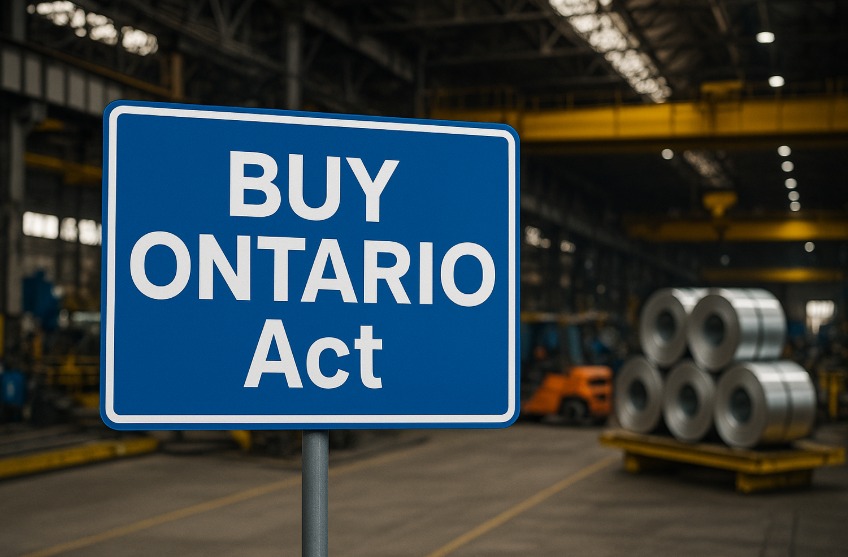
The Ontario government is moving ahead with sweeping procurement changes aimed at prioritizing goods and services produced in the province, a shift officials say will shield local businesses and workers from global trade uncertainty while anchoring long-term economic growth.
The government is set to introduce the Buy Ontario Act, 2025, legislation that would require public-sector organizations — including ministries, agencies, municipalities, and their contractors — to give preference first to Ontario-made products and services, and then to Canadian alternatives. The rules would apply across the province’s more than $30-billion annual procurement portfolio and support Ontario’s broader $220-billion infrastructure plan.
The proposed law is being framed as a direct response to escalating U.S. tariffs and geopolitical uncertainty. “Ontario workers and business owners’ livelihoods are under attack from President Trump and his tariffs, and they’re counting on us to step up,” said Stephen Crawford, Minister of Public and Business Service Delivery and Procurement. “Every year, the province spends more than $30 billion procuring goods and services that help serve the people of Ontario. We’re making sure that every possible procurement dollar that can be spent in Ontario is spent in Ontario, so we can protect our workers and build a more competitive, self-reliant and resilient economy.”
If passed, the Act would authorize the government to mandate Ontario-first procurement requirements and set detailed rules for how public entities and vendors must meet them. Compliance tools would include audits, penalties, holdbacks, performance management measures and potential barring from future procurement.
Todd McCarthy, Acting Minister of Infrastructure, said the legislation aligns with ongoing efforts to keep more of the province’s infrastructure investment circulating locally. “Ontario’s more than $220 billion plan to build is the largest infrastructure plan in Canadian history, and we’re spending every dollar of that plan that we can right here in Ontario,” he said. “As we build the transit, highways, hospitals, homes and schools our growing province needs, we’re also helping keep hundreds of thousands of workers on the job in sectors like construction, steelmaking, forestry, agriculture, manufacturing and more.”
Under the proposed policy framework, procurement outside Canada would remain permissible if domestic options are unavailable at a reasonable cost or timeline while still providing value for taxpayer dollars. However, the province says it is also working to expand domestic capacity and build vendor lists to ensure Ontario suppliers can compete for major contracts — including as subcontractors.
Economic Development Minister Vic Fedeli said strengthening procurement rules is essential as the global landscape becomes more volatile. “As U.S. tariffs continue to undermine the global economy, prioritizing the procurement of Ontario-made goods, services and products has never been more important,” he said. “The Buy Ontario Act would serve as an important pillar in our government’s plan to protect Ontario, anchoring the province’s long-term economic prosperity by ensuring that domestic companies have more opportunities to grow, expand and create good-paying jobs for our workers.”
Municipalities have already begun adopting similar approaches. Earlier this year, Toronto — supported by the province and federal government — pursued a procurement strategy for new Line 2 subway cars based on manufacturing at Alstom’s Thunder Bay facility. The province says the model improved competitiveness while helping secure local jobs.
Rob Flack, Minister of Municipal Affairs and Housing, said many communities are already embracing Ontario-first purchasing. “We’ve seen our province come together like never before to protect Ontario workers and businesses in the face of tariffs,” he said. “Many municipalities have already shown leadership in prioritizing Ontario workers and products when it comes to their choices, and I look forward to working together to make sure even more procurement and infrastructure dollars at all levels of government help protect Ontario.”
Industry partners responded positively to the proposed Act. Angela Clayton, President and CEO of Infrastructure Ontario, said, “We are proud of our partnership with the Ontario government in the delivery of Ontario’s $220-billion infrastructure plan and to strengthen the provincial economy through the prioritization of domestic goods and services in our projects.”
Metrolinx CEO Michael Lindsay emphasized the link between transit expansion and supply-chain resilience. “We are proud to get hundreds of thousands of workers to their jobs every day – and equally proud to directly create local jobs and a more resilient economy through the construction of our major transit projects. We are always looking for ways to support Ontario suppliers – whether they provide steel, systems, or services. This legislation is critical in enabling us to do precisely this.”
James Wallace, CEO of Supply Ontario, said the legislation aligns with procurement modernization efforts. “In the face of shifting trade dynamics, the advancements in the Buy Ontario/Buy Canada policy directly supports Supply Ontario’s efforts to modernize procurement, support local businesses, and protect Ontario jobs.”
Canadian Manufacturers & Exporters (CME) also endorsed the Act, saying it would strengthen local supply chains and support innovation. “CME welcomes the government’s introduction of the Buy Ontario Act… Ensuring Ontario tax dollars support Ontario workers and businesses will help manufacturers remain competitive, invest in innovation, and drive growth across the province,” the organization stated.
The government has not announced a timeline for passage of the legislation but says it plans to work closely with municipalities and industry groups to finalize implementation.