

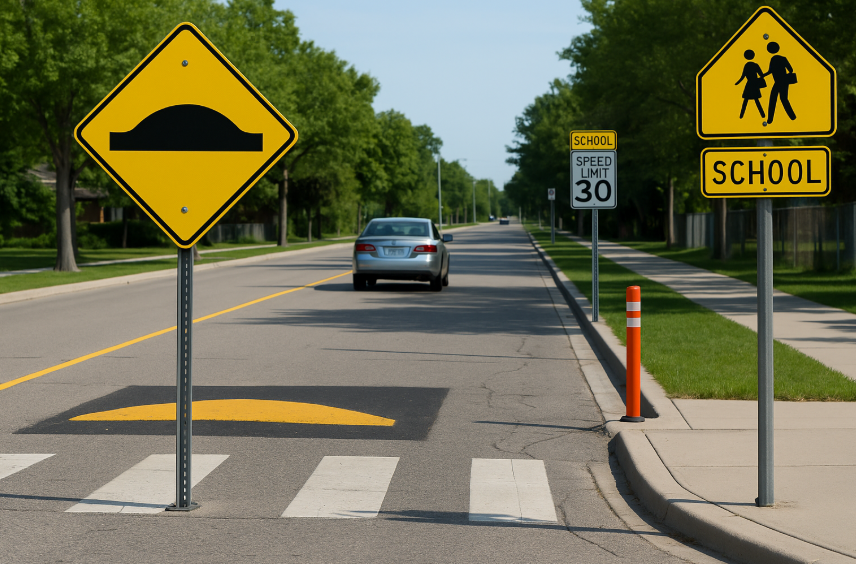
The Ontario government is launching a $210-million Road Safety Initiatives Fund (RSIF) aimed at improving safety in school zones and community safety zones through infrastructure upgrades and increased enforcement—rather than speed cameras, which the province has now banned. The move marks a significant shift in municipal road-safety funding and comes as the government responds to concerns about the cost impact of automated speed enforcement on drivers.
Announced Wednesday by the Ministry of Transportation, the RSIF will support the rollout of what the province describes as “proven road safety measures” such as speed bumps, raised crosswalks, roundabouts, high-visibility signage and enhanced police presence. Funding will be directed specifically to zones that previously deployed municipal speed cameras, many of which generated substantial fine revenue in recent years.
“Under the leadership of Premier Ford, our government is standing up for drivers by banning cash-grab speed cameras and supporting proven road safety measures that will make a real difference,” said Prabmeet Sarkaria, Minister of Transportation. “Ontario has some of the safest roads in North America and our new Road Safety Initiatives Fund will build on this record by ensuring municipalities have the resources they need to implement proven traffic-calming measures without making life more expensive for drivers.”
The province is allocating $42 million in immediate funding for municipalities to begin implementing traffic-calming measures, with the remainder available through an application process expected to open early next year. Eligible municipalities will be required to submit construction plans for traffic-calming infrastructure to secure their share of the funds.
The announcement follows the passage of the Building a More Competitive Economy Act, which received Royal Assent on Nov. 3 and officially prohibits the use of municipal speed cameras effective Nov. 14, 2025. The Ministry said the legislative change responds to public concern that municipalities were relying on automated speed enforcement as a revenue tool rather than a targeted safety measure.
Those concerns intensified as the use of speed cameras expanded rapidly. According to the government, more than 700 municipal speed cameras have been installed since 2019, resulting in millions of dollars in driver fines. One camera alone, located in the City of Toronto, issued more than 65,000 tickets and collected nearly $7 million in fines before 2025.
The government says the RSIF will replace what it views as an unfair cost burden on drivers with funding that allows municipalities to pursue traffic-calming solutions that do not rely on ticketing. The province has emphasized that slowing vehicles around schools and community spaces remains a priority—but that municipalities must use approaches that are cost-neutral for drivers.
All municipalities that previously used speed cameras will be eligible to apply for RSIF support. The $210 million allocation is a one-time investment and, according to the Ministry, is intended to help municipalities transition to new safety strategies without significant financial strain.
Ontario has consistently ranked among the safest road jurisdictions in North America, holding a position within the top five for more than two decades. Its fatality rate per 10,000 licensed drivers remains among the lowest on the continent. The Ministry says maintaining that record requires both infrastructure investment and continued public education.
In addition to the RSIF, the province pointed to other safety programs already in place, including the Road Safety Community Partnership Program, which funds not-for-profit organizations running awareness campaigns focused on priority road-safety issues. Municipalities may partner with these organizations to apply for funding. The province also highlighted the Reduced Impaired Driving Everywhere (RIDE) grant program, which supports police services in year-round campaigns and roadside checks aimed at preventing impaired driving.
The funding shift is expected to have a notable impact on municipalities that leaned heavily on automated speed enforcement as part of their road-safety mix. Some local governments have raised concerns about losing both a deterrent tool and the associated revenue stream. Others have welcomed the prospect of moving to infrastructure-based solutions that slow traffic more consistently.
The province maintains that the RSIF offers a balanced approach—one that enhances safety while ensuring affordability for drivers. With applications opening in early 2026, municipalities will now begin planning their traffic-calming proposals as they prepare to adjust to a new regulatory landscape.
The government has framed the move as part of a broader commitment to reducing costs for households while supporting evidence-based safety improvements. The coming year will reveal how municipalities adapt—and whether the new fund delivers the long-term reductions in speeding and collisions the province expects.