

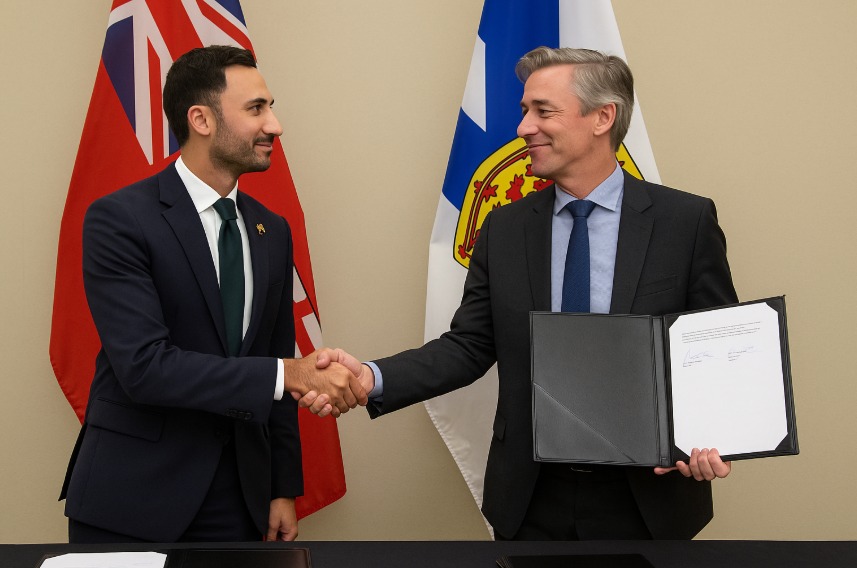
HALIFAX — Ontario and Nova Scotia have signed a landmark partnership to advance the development of small modular reactors (SMRs), marking a significant step in Canada’s pursuit of clean, reliable, and affordable energy. The agreement, signed in Halifax by Ontario’s Minister of Energy and Mines Stephen Lecce and Nova Scotia’s Premier and Minister of Energy Tim Houston, aims to leverage Ontario’s leadership in nuclear innovation to support Nova Scotia’s transition to a low-carbon future.
The collaboration underscores a growing national push toward nuclear energy as a key component of Canada’s clean energy strategy. By sharing technical expertise and coordinating policy, both provinces aim to accelerate SMR adoption, strengthen energy security, and create thousands of high-value jobs across the country.
A Shared Vision for Clean Growth
Under the agreement, Ontario and Nova Scotia will share knowledge and expertise on SMR development, including regulatory frameworks, supply chain readiness, financial modelling, waste management, and engagement with the public and Indigenous communities. The partnership also includes joint efforts to raise awareness of nuclear energy’s economic and environmental benefits, collaborate with other provinces and territories, and advocate for streamlined federal support to fast-track deployment.
“The world is watching Ontario as we lead the largest expansion of nuclear energy on the continent and build the G7’s first small modular reactor,” said Minister Lecce. “Through this important clean energy partnership with Nova Scotia, we are helping to advance small modular reactor technology to create good-paying jobs across the country. Small modular reactor deployment is an anchor of our nation-building plan that will create 18,000 construction jobs and add $500 million annually into Ontario’s economy. As we face instability in the global economy, Ontario is partnering with provinces East and West to deliver self-reliance, more jobs, and a stronger economy.”
The move builds on Ontario’s established nuclear expertise and reinforces its position as a global leader in the emerging SMR market. The province’s early investments in nuclear technology have already opened opportunities for more than 200 Canadian companies to participate in domestic and international projects.
Economic and Environmental Benefits
Each SMR has the potential to produce 300 megawatts (MW) of zero-emission electricity—enough to power 300,000 homes—offering a scalable and cost-effective complement to renewables like wind and solar. Ontario’s current SMR initiative at the Darlington nuclear site, led by Ontario Power Generation (OPG), is projected to deliver major economic benefits nationwide.
The construction of four SMRs in Ontario is expected to create up to 18,000 jobs and contribute more than $38 billion to Canada’s GDP, with long-term operation and maintenance sustaining about 3,700 highly skilled positions over the next six decades.
“Nova Scotia is open to exploring the full range of clean energy options that can help meet our province’s future energy needs, build grid resilience and protect ratepayers,” said Premier Houston. “We have an opportunity to learn from Ontario’s experience deploying nuclear technology and I see great value in this partnership to inform system planning and best practices for Nova Scotia.”
The collaboration could play a transformative role in Atlantic Canada’s clean energy transition, offering Nova Scotia a new avenue to decarbonize its electricity system, stabilize energy costs, and strengthen energy independence.
Building on a National Framework
Ontario’s partnership with Nova Scotia extends a growing network of interprovincial cooperation on SMRs. Since 2019, Ontario has worked with New Brunswick, Saskatchewan, and Alberta under a memorandum of understanding (MOU) to develop a joint strategy for SMR deployment. The group released its Strategic Plan for the Deployment of SMRs in March 2022, outlining how the technology can provide safe, reliable, and zero-emission power while positioning Canada as a global exporter of nuclear expertise.
In May 2025, Ontario approved OPG’s plan to begin construction on the first of four SMRs at Darlington—the first of its kind in the G7. Once operational, the unit will generate enough electricity to power 300,000 homes, securing a clean energy supply for decades to come.
Powering Canada’s Future
Ontario’s SMR initiative is a central pillar of the province’s Energy for Generations plan, designed to ensure reliable, affordable energy while driving economic growth. The government says its integrated approach provides the certainty needed for Indigenous communities, municipalities, and businesses to invest confidently in long-term projects.
As both provinces move forward, the partnership between Ontario and Nova Scotia represents a tangible example of how interprovincial cooperation can shape Canada’s clean energy future—balancing economic development with environmental responsibility.
“The Finch West LRT represents what can be achieved when government and partners work together to deliver modern, efficient transit,” said Lecce. “We’re building a system that will move people faster, connect communities, and support economic growth for decades to come.”
