

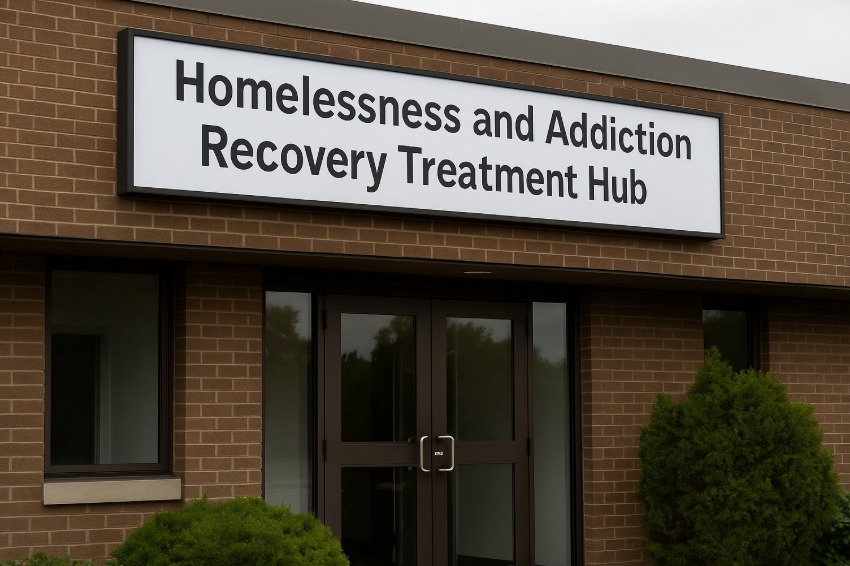
LONDON, ONT. — Ontario has taken another step toward strengthening its mental health and addiction care system with the opening of a new Homelessness and Addiction Recovery Treatment (HART) Hub in London. The facility, part of a nearly $550-million provincial initiative, will provide integrated services for people experiencing homelessness, addiction, and mental health challenges while enhancing community safety.
The London site joins a growing network of 28 HART Hubs being launched across Ontario, marking a major investment in the province’s mental health infrastructure. Operated by CMHA Thames Valley Addiction & Mental Health Services, the new hub is designed to deliver wraparound supports ranging from mental health and addiction care to housing and employment assistance. It officially opens its doors to the public on Monday, October 27, 2025.
“We are building a stronger, more connected system of mental health and addictions care that better reflects the needs of communities and focuses on lasting recovery,” said Vijay Thanigasalam, Associate Minister of Mental Health and Addictions. “The opening of this new HART Hub will ensure that people struggling with mental health and addictions challenges in London can get the care they need on their path to recovery, while keeping the community safe.”
A Comprehensive Model of Care
Each HART Hub functions as a centralized access point for multiple health and social services under one roof. The London Hub will provide a spectrum of programs, including mental health counselling, primary care, substance use treatment, supportive housing, and social and employment supports. The goal is to connect individuals to care that is continuous, coordinated, and community-based.
The new facility builds on the province’s strategy, Your Health: A Plan for Connected and Convenient Care, and aligns with Ontario’s broader Roadmap to Wellness initiative, a 10-year, $3.8-billion plan to improve access to mental health and addiction supports across the province.
Expansion Across Ontario
Since April 2025, nine existing Consumption and Treatment Services (CTS) sites have been transitioned into HART Hubs, providing expanded recovery services while maintaining community safety standards. The province plans to open additional hubs in communities across Ontario in the coming months, including two Indigenous-led Hubs in Kenora and the Sault Ste. Marie/Blind River/Sagamok region. These sites will offer culturally appropriate and community-driven care in partnership with Indigenous organizations.
HART Hubs will collectively add nearly 900 supportive housing units, more than 300 above the government’s initial target. These units will help participants transition from homelessness into stable, long-term housing while receiving ongoing treatment and recovery support.
Unlike traditional harm-reduction sites, HART Hubs will not offer safer supply, supervised drug consumption, or needle exchange programs. Instead, the focus is on recovery and rehabilitation through structured treatment and community support.
Local Impact and Community Collaboration
Local leaders have praised the launch of the London facility as a tangible step toward addressing the region’s escalating mental health and homelessness challenges.
“I’m very pleased to see this important commitment come to life here in London,” said Rob Flack, MPP for Elgin—Middlesex—London. “Our government is delivering on its promise to connect people to the care and supports they need and deserve. The new HART Hub will provide support for people on their path to recovery, while also ensuring our communities remain safe.”
Steve Pinsonneault, MPP for Lambton—Kent—Middlesex, echoed that sentiment. “The HART Hub model reflects the power of collaboration—bridging gaps in services, supporting recovery, and creating safer, healthier communities for everyone.”
For community organizations, the Hub represents a new approach to service integration and accessibility. Pam Tobin, Chief Executive Officer of CMHA Thames Valley Addiction and Mental Health Services, said the initiative reflects years of local partnership and planning.
“We are grateful to the Ministry of Health and Ontario Health for their support to bring the HART Hub model to life,” Tobin said. “This investment represents a step forward in how communities come together to meet the complex needs of people experiencing homelessness, addiction, and mental health challenges. I want to recognize the incredible dedication of our team, partners, and the many organizations across London and the region who have worked collaboratively to make this vision a reality. Together, we are creating pathways to care that will change lives.”
A Broader Provincial Commitment
Ontario’s investment in the HART network builds on multiple funding streams aimed at expanding mental health and addiction services. Under Budget 2025, the government committed $303 million over the next three years to support community-led and delivered mental health programs.
With nearly $550 million dedicated to the 28 HART Hubs, the province’s approach emphasizes coordinated treatment and long-term recovery rather than crisis response. Officials say this model is intended to reduce emergency room visits, improve housing stability, and address the complex intersection between mental health, addiction, and homelessness.
As the London HART Hub prepares to open, provincial and local leaders see it as a key step toward a more responsive and compassionate health-care system—one designed to meet people where they are, with the supports they need to rebuild their lives.
