

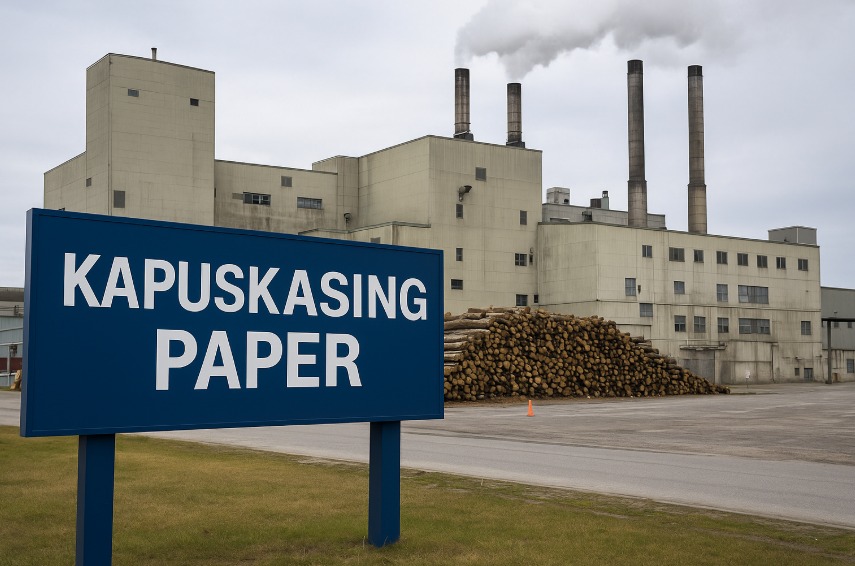
KAPUSKASING, Ont. — The Ontario government is investing $16.8 million to help keep the Kapuskasing Paper Mill operational, safeguarding nearly 300 direct jobs and thousands of others that depend on the northern forestry sector. The funding, announced Friday by the Ministry of Natural Resources, comes amid heightened U.S. tariffs on Canadian softwood lumber and growing uncertainty across the forestry industry.
Following weeks of discussions led by the province, the federal government has agreed to join Ontario in supporting the mill’s future with an additional $12 million in new funding. The combined $28.8 million package is designed to stabilize operations in the short term while longer-term solutions are developed to modernize and diversify production at the mill.
“Our government has been at the table from day one, stepping up again and again to protect good-paying jobs in Kapuskasing and across Ontario’s forestry sector,” said Kevin Holland, Associate Minister of Forestry and Forest Products. “We have been clear that Ontario cannot do this alone, and I want to thank the federal government for joining Ontario to help secure the future of Kap Paper, and the workers and northern communities that depend on it.”
Collaborative Effort to Secure the Mill’s Future
The province took a lead role in bringing together executives from Kap Paper, the Government of Ontario, and the Government of Canada to determine a path forward for the company. These talks centered on maintaining operations while identifying strategies to ensure long-term stability and competitiveness.
Ontario officials said the joint funding approach will support the mill’s immediate operational needs while the company continues developing a sustainable business model that includes product diversification and modernization of its facilities.
“As the forestry sector faces growing uncertainty due to U.S. softwood lumber duties and tariffs, Ontario is continuing to do what it takes to protect these vital jobs in the North,” said Mike Harris, Minister of Natural Resources. “After weeks of strong advocacy and many discussions, we appreciate that the federal government has joined us in standing up for workers and families that depend on forestry jobs.”
A Critical Employer in Northern Ontario
Located in northeastern Ontario, Kap Paper plays a key role in the province’s forestry supply chain. The mill’s continued operation helps sustain roughly 2,500 direct and indirect jobs across regional sawmills and related industries. In addition to being a cornerstone of Kapuskasing’s local economy, the company contributes significantly to the municipality’s tax base and regional economic growth.
The paper mill has faced financial headwinds in recent years, exacerbated by rising operating costs, trade pressures from the United States, and global shifts in demand for traditional pulp and paper products. Provincial officials said the new investment demonstrates Ontario’s commitment to northern industry resilience in the face of global economic uncertainty.
Part of a Broader Forestry Investment Strategy
The Kap Paper funding is the latest in a series of measures Ontario has rolled out to strengthen its forestry sector and shield northern communities from international market fluctuations. The government is also investing in new technologies, infrastructure, and training to ensure long-term competitiveness and sustainability in forest management and wood production.
Among the initiatives highlighted by the Ministry of Natural Resources:
-
$10 million to help sawmills remain competitive in changing global markets.
-
$72 million through the Forest Sector Investment and Innovation Program to boost productivity and open new market opportunities.
-
Nearly $50 million under the Forest Biomass Program to expand wood harvests and develop new uses for Ontario timber.
-
$20 million this year for the Provincial Forest Access Roads Funding Program, bringing total funding to more than $79 million.
-
Close to $3 million for wood-based construction education and research, including projects led by the Canadian Wood Council and the Canadian Wood Construction Research Network.
-
Over $25 million in electricity rate relief for forestry businesses through the Northern Energy Advantage Program in 2024–25.
Collectively, these investments align with the province’s Sustainable Growth: Ontario’s Forest Sector Strategy and Forest Biomass Action Plan, both aimed at promoting economic self-reliance, job creation, and innovation in northern communities.
A Cornerstone of Ontario’s Economy
Ontario’s forestry sector remains one of the province’s most important natural resource industries. In 2023, the sector generated $21.6 billion in revenue from the sale of manufactured goods and services, supporting 128,000 direct and indirect jobs across the province.
The government emphasized that Ontario’s forestry operations are grounded in sustainable management. “Wood produced from Ontario’s Crown forests is sustainably sourced and renewable,” the ministry stated. “Wood is a renewable resource, a clean energy source, and a sustainable – and biodegradable – alternative to single-use plastics.”
The additional investment in Kap Paper underscores Ontario’s broader strategy to ensure long-term resilience and competitiveness in its forestry industry — protecting workers, stabilizing northern economies, and positioning the province to thrive amid ongoing trade and environmental challenges.
