

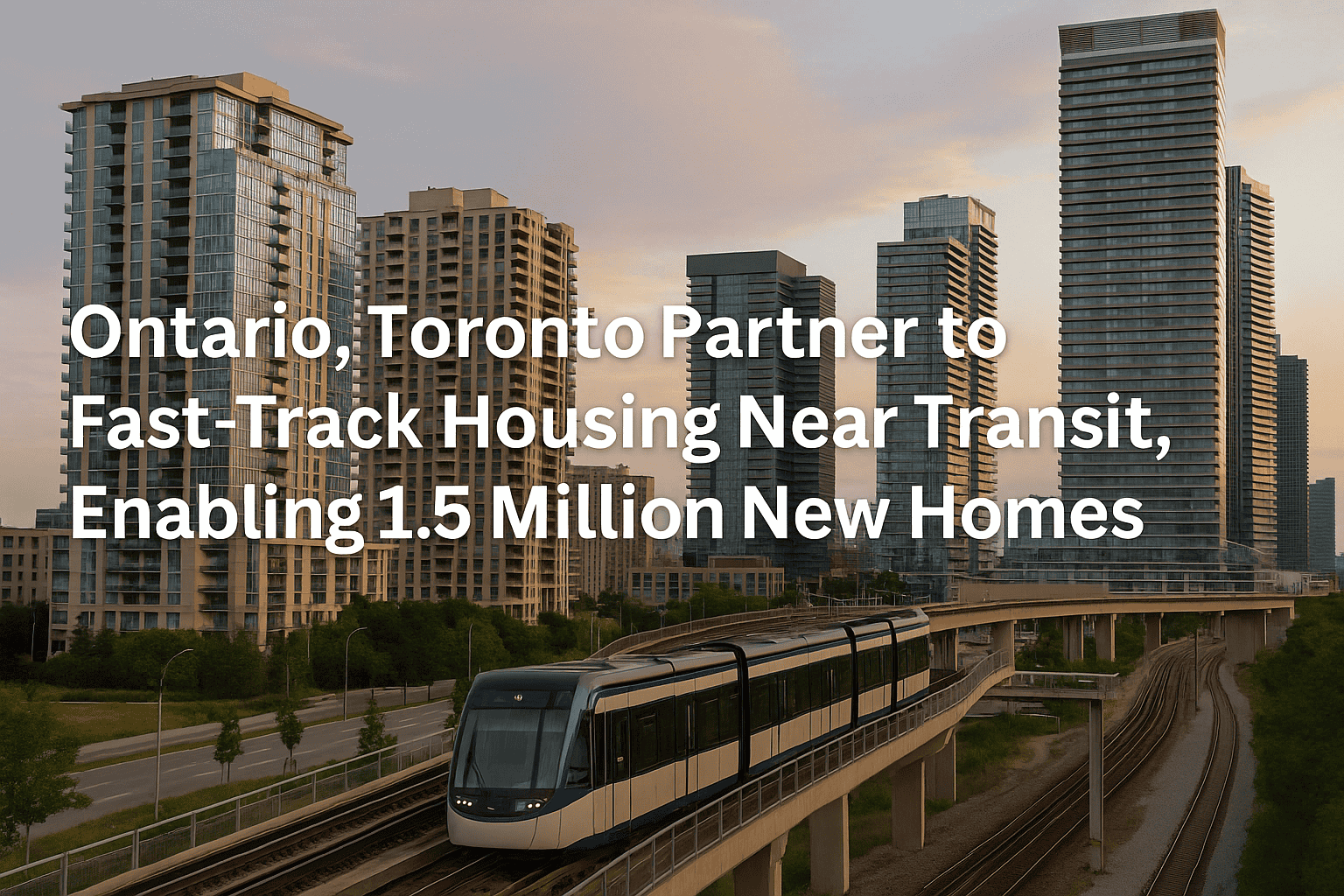
TORONTO — The Ontario government has approved sweeping changes to Toronto’s official plan, paving the way for taller buildings and greater density around 120 major transit stations. The amendments, developed in consultation with City of Toronto officials, are expected to support construction of more than 1.5 million new homes over the next 25 years while driving job creation and attracting investment.
The changes align with Ontario’s record investments in transit infrastructure and are designed to bring more residents within walking distance of reliable public transit, reducing gridlock and supporting the city’s long-term growth.
“I commend Mayor Chow for partnering with us on a bold, shared vision, one where more people can work, live and raise their families right here in Toronto,” said Rob Flack, Minister of Municipal Affairs and Housing. “The changes we are announcing today, along with our government’s latest legislation, are vital steps in our plan to protect Ontario’s future by getting shovels in the ground and building homes faster to meet the needs of our growing population.”
Increasing density to address housing and economic challenges
The amendments will allow developers to construct higher-density, taller buildings in proximity to transit hubs, making it easier for residents to live without relying on cars. The policy shift is intended to address Toronto’s shortage of affordable housing while also spurring economic activity during a period of U.S. tariffs and broader economic uncertainty.
Provincial officials say the increased density will not only help bring down housing costs but will also generate tens of thousands of construction and skilled trades jobs.
“Toronto needs more affordable housing,” said Olivia Chow, Mayor of Toronto. “We are tackling the housing crisis by cutting red tape to build more homes near transit to support our city’s growth. By building near transit stations, we are providing new residents with convenient and reliable transit options – ultimately getting drivers off the road, reducing gridlock and getting Toronto moving. Thank you to the provincial government for your partnership as we build for the future in Canada’s largest city.”
Linked to major transit and infrastructure investment
The policy changes are part of Ontario’s broader strategy to protect the provincial economy by leveraging a $200-billion investment in transit and infrastructure over the next decade. The province is currently rolling out the largest subway expansion in Canadian history, valued at $70 billion.
In June, the government awarded Toronto $67.2 million through the second round of the Building Faster Fund, a program that rewards municipalities that achieve at least 80 per cent of their provincially designated housing targets.
“Our government is investing $70 billion in the largest subway expansion in Canadian history to protect our economy in the face of U.S. tariffs and tackle gridlock,” said Prabmeet Sarkaria, Minister of Transportation. “By building more housing near transit stations in Toronto, we’re putting new residents within walking distance of fast, reliable public transit to keep people moving.”
Planning tools and further collaboration
Through the approval of the official plan amendments, Toronto’s inclusionary zoning framework will be activated in protected major transit station areas identified by the city. Inclusionary zoning allows municipalities to require that a percentage of units in new residential developments be set aside as affordable housing.
The province and city will continue to collaborate on plans for 14 additional transit station areas, including those tied to Ontario’s Transit-Oriented Communities Program, aimed at integrating housing, retail and office space directly with transit developments.
The changes also build on recent provincial efforts to streamline development processes and reduce building costs through the Protect Ontario by Building Faster and Smarter Act, 2025.
Quick facts
- Inclusionary zoning will apply in protected major transit station areas in Toronto, ensuring affordable housing requirements in certain developments.
- Ontario will work with Toronto on 14 other transit station area plans to further increase housing supply near transit.
- The province’s $70-billion public transit investment includes the Ontario Line, Scarborough Subway Extension, Eglinton Crosstown West Extension, and Yonge North Subway Extension.
- The Building Faster Fund incentivizes municipalities to meet or exceed their housing targets with financial support for infrastructure and community development.
By aligning land use policy with transit expansion, Ontario and Toronto officials say they are setting the stage for more affordable, accessible housing while positioning the city for sustained economic growth. The coordinated plan is expected to help Toronto meet the needs of a rapidly growing population and keep the economy resilient in the face of global trade pressures.
